Pi Agent Harness: The Runtime Layer Hidden Inside Modern Coding Agents
A monorepo that makes LLMs interchangeable, agent loops durable, and long-running coding sessions survivable.
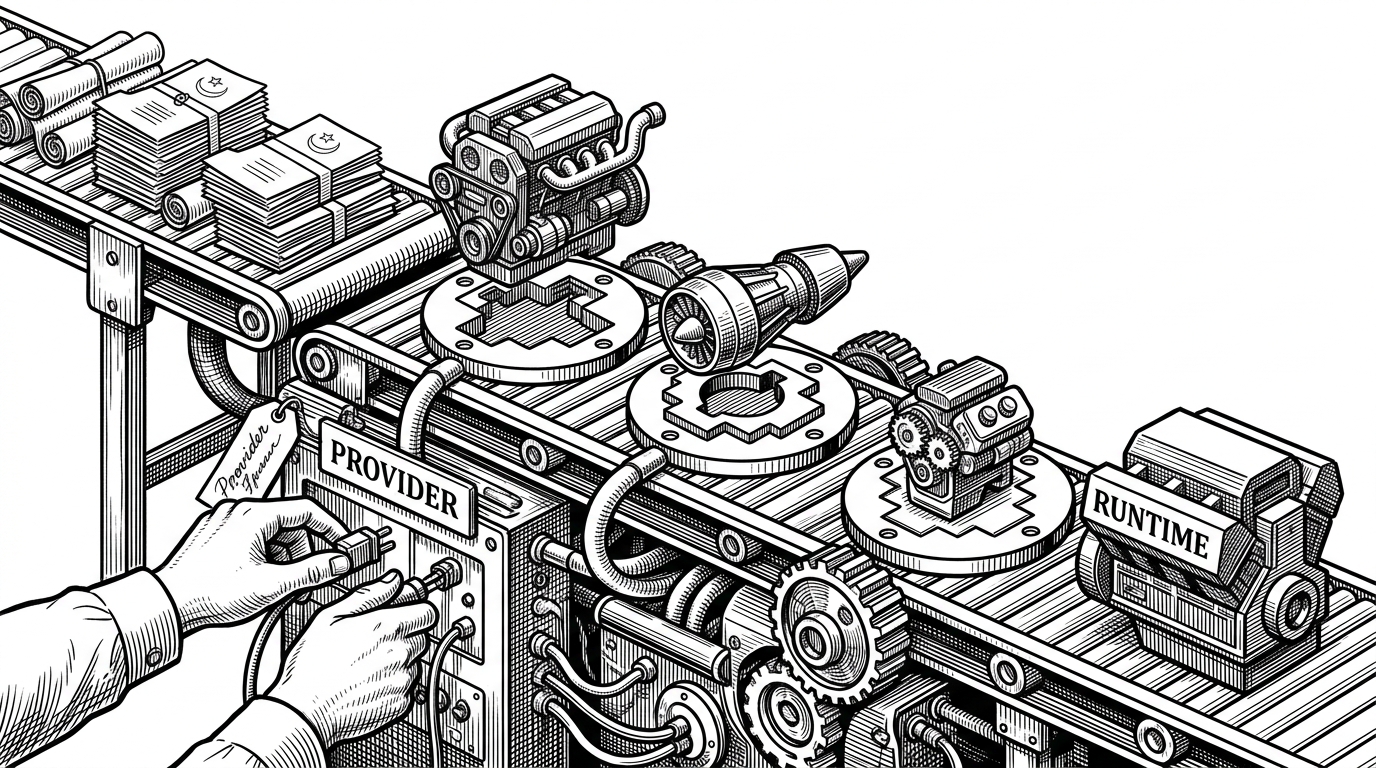
- Pi treats an agent like a process with state, events, and recovery, not like a single prompt wrapped around an SDK.
- Its unified provider layer makes model switching feel like configuration, because message translation is handled below the agent logic.
- Compaction is the project’s quiet superpower, because it keeps long coding sessions coherent when the context window gets tight.
- The UI layers are not an afterthought, because the terminal and browser surfaces are both part of the runtime story.
Pi is easiest to understand if you stop calling it an agent framework. It behaves more like a runtime for agent work, with the same instincts an operating system has for processes, memory pressure, and interfaces. That shift matters because real coding agents do not fail at the first prompt. They fail when state gets messy, providers disagree, or the session runs long enough to become expensive to remember.
Pi is about making distributed systems easy to write and reason about, by bringing the actor model to Rust with a strong emphasis on type safety.
Pi Is Not a Chatbot Library
The strongest idea in Pi is its harness mentality. It does not begin with text generation and then add tools as an afterthought. It starts with a durable loop: think, act, observe, recover, continue. That makes it a better fit for coding assistants, Slack bots, and any agent that has to survive interruptions without losing its place.
The repo’s structure shows that discipline. `packages/ai` handles provider translation, `packages/agent` owns the loop, `packages/coding-agent` specializes the behavior, and `packages/tui` plus `packages/web-ui` present the same running system through different surfaces. The separation is not cosmetic. It isolates the failure modes that usually get tangled together in smaller agent projects.
The Monorepo Separates Concerns by Failure Mode
Pi’s package layout reads like an answer to a systems question: what breaks first when agents get real work? The `ai` layer breaks if providers differ too much. The `agent` layer breaks if state and events are not modeled cleanly. The UI breaks if long sessions are unreadable. Pi splits those concerns into separate packages so each one can evolve without dragging the others along.
packages/
  ai/            Unified LLM API and provider registry
  agent/         State machine, loop, events, compaction
  coding-agent/  Domain-specific coding behaviors
  tui/           Terminal interface with differential rendering
web-ui/ Browser interface for the same runtime| Layer | What it owns | Why it matters |
|---|---|---|
| pi-ai | Provider registry, message normalization, model routing | Makes model switching feel like configuration instead of a rewrite |
| pi-agent | Loop, state, events, compaction | Keeps the agent alive across tool calls and long sessions |
| pi-coding-agent | Coding-specific behaviors and extensions | Turns a general runtime into a practical dev tool |
| pi-tui / pi-web-ui | Terminal and browser surfaces | Lets the same agent be observed and controlled in different contexts |
Why the Unified LLM Layer Matters
The `pi-ai` package is the quiet center of gravity. It uses a registry pattern so providers can be added, selected, and normalized through a single interface. That matters because most agent code gets brittle the moment model-specific payloads leak into the application logic.
Pi’s message transformation layer does more than translate names. It deals with tool-call IDs, vision support, and provider-specific quirks like thinking blocks and redacted reasoning. In practice, that means the rest of the system can act as if the model interface is stable, even when the underlying vendors are not.
This looks promising. Type-safe actors in Rust is a space with a lot of potential, and Pi seems to be tackling it with a clean design.
| Capability | Thin SDK wrapper | Conventional agent framework | Pi Agent Harness |
|---|---|---|---|
| Provider portability | Low | Medium | High |
| Message normalization | Usually manual | Partial | Centralized |
| Lifecycle events | Sparse | Sometimes | First-class |
| Compaction | Rare | Sometimes | Built in |
| UI surfaces | External | Often separate | Part of the stack |
| Extensibility | Limited | Moderate | High |
The Hard Part Is Not Calling the Model
Once the request leaves `pi-ai`, the real runtime work begins. Pi tracks an internal `AgentMessage` format, converts it to provider messages, and pushes the result through an event stream. That event stream is the difference between a black box and an observable system. It lets the runtime expose thinking progress, tool-call lifecycle events, and recovery points without flattening everything into log spam.
The agent loop is where the architecture earns its name. It is not a single request-response function. It is a persistent cycle that can emit, pause, transform, and resume. That is the shape you need if an agent is going to edit files, handle errors, and keep moving after an interruption.
// Simplified shape of the Pi agent loop
for (;;) {
  const llmMessages = convertToLlm(agentState.history)
  const response = await provider.generate(llmMessages)
  const events = interpretResponse(response)

  for (const event of events) {
    stream.emit(event)
    agentState = reduce(agentState, event)
  }

  if (needsCompaction(agentState)) {
    agentState = await compact(agentState)
  }

  if (agentState.done) break
}
Compaction Is How Long Sessions Stay Alive
Compaction is the most obviously necessary part of the repo. Context windows are finite, but real agent sessions are not. Pi responds by summarizing and trimming history while preserving the anchors that matter: task goals, file references, active decisions, and enough state to continue without sounding amnesiac.

That is why compaction is more than summarization. It is continuity management. A good runtime decides what to discard, what to compress, and what to keep alive. Pi treats that choice as a first-class engineering problem instead of a hidden implementation detail.
The UI Layer Is Part of the Runtime
Pi’s UI story reinforces the same thesis. The terminal and browser surfaces are not separate products bolted onto a backend. They are views over the same living system. That is a meaningful design choice because it keeps observability, interaction, and state in sync across contexts.
The mention of differential rendering in the TUI is a subtle tell. It suggests the project cares about responsiveness and incremental updates, not just dumping transcripts to the screen. For agent tooling, that matters. Users are not only reading output. They are watching a process unfold.
Where Pi Beats Conventional Agent Frameworks
Pi is strongest where simple wrappers are weakest. A thin SDK wrapper makes one model easy to call. A general framework may offer tools and orchestration, but still leave translation, lifecycle, and long-session coherence to the user. Pi bundles those invisible chores into the runtime itself.
| Question | Simple wrapper | Generic framework | Pi |
|---|---|---|---|
| Can I switch providers without rewriting logic? | Usually no | Sometimes | Yes |
| Does the agent survive long sessions cleanly? | Weakly | Partially | Yes |
| Are tool calls and events modeled explicitly? | Rarely | Sometimes | Yes |
| Do terminal and browser views share the same core? | No | Occasionally | Yes |
| Is compaction built into the loop? | No | Sometimes | Yes |
That is the deeper point of Pi. Its value is not that it can call more models. Its value is that it makes agent work durable, inspectable, and portable across providers and surfaces. In a field that still confuses prompts with systems, that is a real line of demarcation.