codex-with-chatgpt: The Repo That Splits Coding Into Thinking and Doing
ChatGPT plans. Codex executes. This bridge shows how to connect two AI systems without handing the web one the keys to your machine.
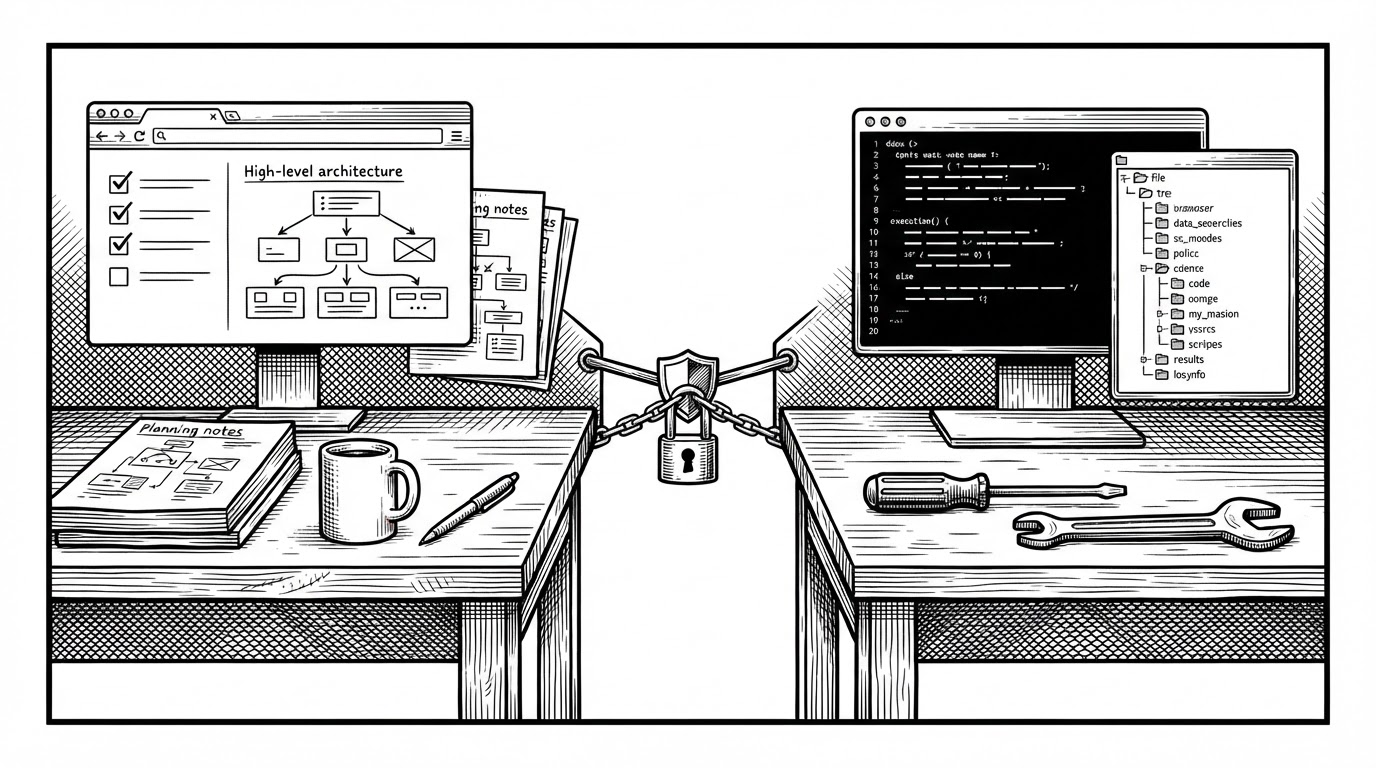
- codex-with-chatgpt is less a chatbot hack than a coordination layer that separates planning from execution.
- Its novelty is a trust boundary, not a UI trick, because the web-facing side stays read-only while the local side keeps control.
- The installation flow treats the README as instructions for another agent, which is a real shift in software distribution.
- The project makes a cost argument too, routing broad reasoning to existing ChatGPT subscription capacity instead of burning scarce coding-agent tokens.
Why split one coding agent into two?
The obvious read is wrong. This is not “ChatGPT for coding.” It is a deliberate split-brain system: ChatGPT handles planning, review, and broad reasoning, while Codex handles the local work that actually touches files and state. That split matters because it turns a coding agent into a coordination problem, not a single-model problem.
The economic logic is part of the design. If you already pay for ChatGPT Plus or Pro, why spend expensive API or Codex capacity on steps that can live in the web UI? `codex-with-chatgpt` turns that annoyance into an architecture.
ChatGPT Plus/Pro web quota sits idle while your coding agent burns scarce API/Codex tokens on planning and review. This project moves the thinking to the subscription you already pay for; Codex only executes.
The bridge is a protocol, not a shortcut
The repo’s C2C bridge is the real product. It moves messages through a state machine, not a loose chat loop, and that makes the whole thing legible: INIT, PAIR, PLAN, READ, EXECUTE, REVIEW, DONE. The sequence matters because each step has a different trust level.
The implementation choice that deserves attention is the narrow surface area. The public side exposes only what ChatGPT needs to inspect the workspace. The admin side stays loopback-only, guarded by a local token and kept away from tunnel exposure. That is the difference between an integration and a control plane.

Security comes from narrowing the blast radius
This is where the repo earns trust. The bridge uses OAuth2 with PKCE, a short-lived pairing code, and read-only MCP tools so the web side can inspect without mutating. That means ChatGPT can see enough context to plan well, but it does not get shell access, write access, or a casual path into your machine.
- The pairing step proves local presence before the remote side is trusted.
- The MCP layer is read-only, so inspection is allowed while mutation is blocked.
- The admin surface is loopback-only, which keeps tunnel exposure from becoming a privileged backdoor.
- The design assumes hostile networks first, which is the right default for a cloud-connected agent.
Use the ChatGPT web app as the planning and review brain for your Codex coding sessions, while Codex keeps full ownership of execution. Your repository is never uploaded: ChatGPT reads exactly the lines it needs through a secure, OAuth-protected, read-only MCP connection.
The smartest trick is the installation flow
The repo’s most agentic idea may be its least flashy one. The install instructions are written so another model can follow them. In practice, that means the README is no longer just documentation for humans. It is a script for a helper agent that can clone, build, configure, and launch the bridge on your behalf.
That changes distribution. Software does not just tell users what to do anymore. It tells an agent what to do, and the agent does the boring work. If that pattern spreads, the README becomes a machine-readable operating manual with human prose wrapped around it.
Stateless MCP keeps the bridge from getting sticky
The technical subtlety is easy to miss and easy to appreciate once you see it. The HTTP handler creates a fresh MCP server per request, which keeps the bridge stateless at the transport edge. That avoids the usual long-lived-session problems: memory leakage, stale context, and state bleeding between conversations.
That matters because the client is not a tidy internal service. It is a remote model with unpredictable pacing and an uneven interaction pattern. Fresh server instances per request are boring in the best way. They make a weird system behave like a dependable one.
Compared with the rest of the agent stack, this is unusually narrow
| Tool | Primary environment | Planning/execution model | Trust model | Best fit |
|---|---|---|---|---|
| codex-with-chatgpt | Web plus local bridge | ChatGPT plans, Codex executes | Read-only web side, local admin side | Users who want ChatGPT and Codex to cooperate |
| Claude Code | CLI | Single agent plans and executes in one loop | Local terminal trust | Terminal-first implementation work |
| Cursor | IDE | Inline editor assistance with agent features | Editor-centric workspace access | Developers who live inside an IDE |
| Aider | CLI | Chat-driven edits against git repos | Local repo access | Fast repo patching from the shell |
| Cline | VS Code extension | Agent inside the editor | Extension-scoped tool access | IDE-native MCP workflows |
| OpenCode | CLI | Multi-provider coding assistant | Provider-dependent | Users who want a flexible open-source harness |
The point of the comparison is not that one tool wins. It is that `codex-with-chatgpt` occupies a very narrow niche: web-planning plus local execution with an explicit trust boundary. That niche is real, and it explains why the repo feels more like a protocol adapter than a competitor to editor-first tools.
What this repo says about the next wave of coding tools
The larger lesson is that coding agents are drifting toward specialization. One model reasons broadly. Another edits locally. A bridge coordinates them. That is a healthier mental model than expecting one giant assistant to be equally good at planning, implementation, review, and trust management.
`codex-with-chatgpt` is interesting because it makes that split concrete. It shows how software can be distributed across multiple AI surfaces, with explicit boundaries instead of one all-powerful agent. That feels less magical, and more deployable.