vggt-omega: VGGT-Ω: The Geometry Model That Learned to Think in Registers
How Meta AI and Oxford rebuilt feed-forward 3D reconstruction around compact memory, multi-task heads, and a geometry-first Transformer that scales beyond classic SfM.
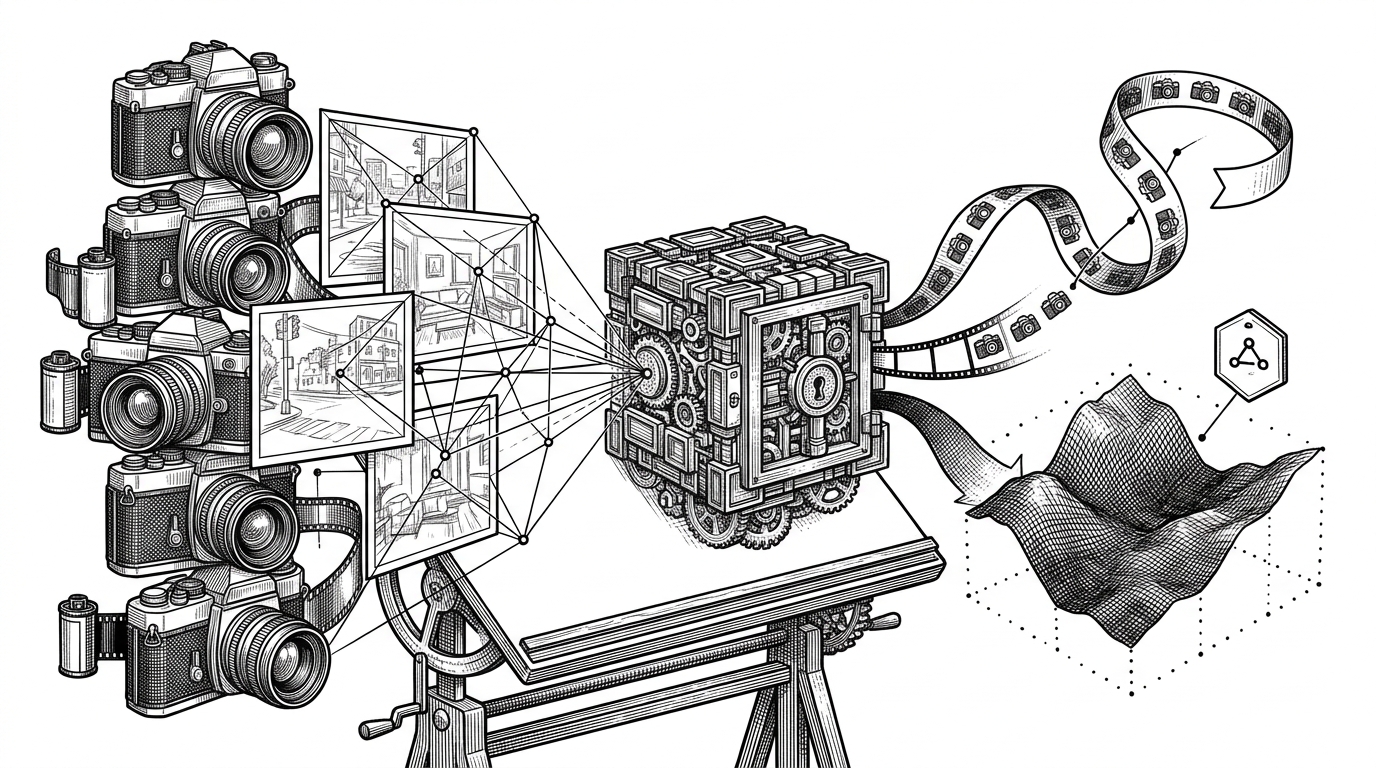
- VGGT-Ω treats 3D reconstruction as a memory-design problem, and the registers are the architectural move that makes scale possible.
- The model replaces full-frame geometric cross-talk with compact shared state, which lowers memory pressure and opens room for more supervised data.
- Its shared representation feeds three distinct heads for camera, dense depth, and language alignment, so geometry is no longer a single-purpose output.
- The big shift is not just faster inference. It is a feed-forward alternative to classic SfM and SLAM that changes failure modes and product scope.
The surprising thing about VGGT-Ω is not that it reconstructs 3D scenes in one pass. It is that it makes scene memory itself the bottleneck it solves. Instead of letting every frame fight every other frame with expensive global attention, the model compresses geometry into registers and routes inter-frame communication through that shared state.
That shift matters because it changes the economics of the model. The project’s paper frames the register design as a way to cut memory use sharply while scaling training data and keeping the system feed-forward. In plain terms, VGGT-Ω is trying to make 3D understanding look less like a hand-built pipeline and more like a reusable neural substrate.
The model that stopped doing global attention the hard way
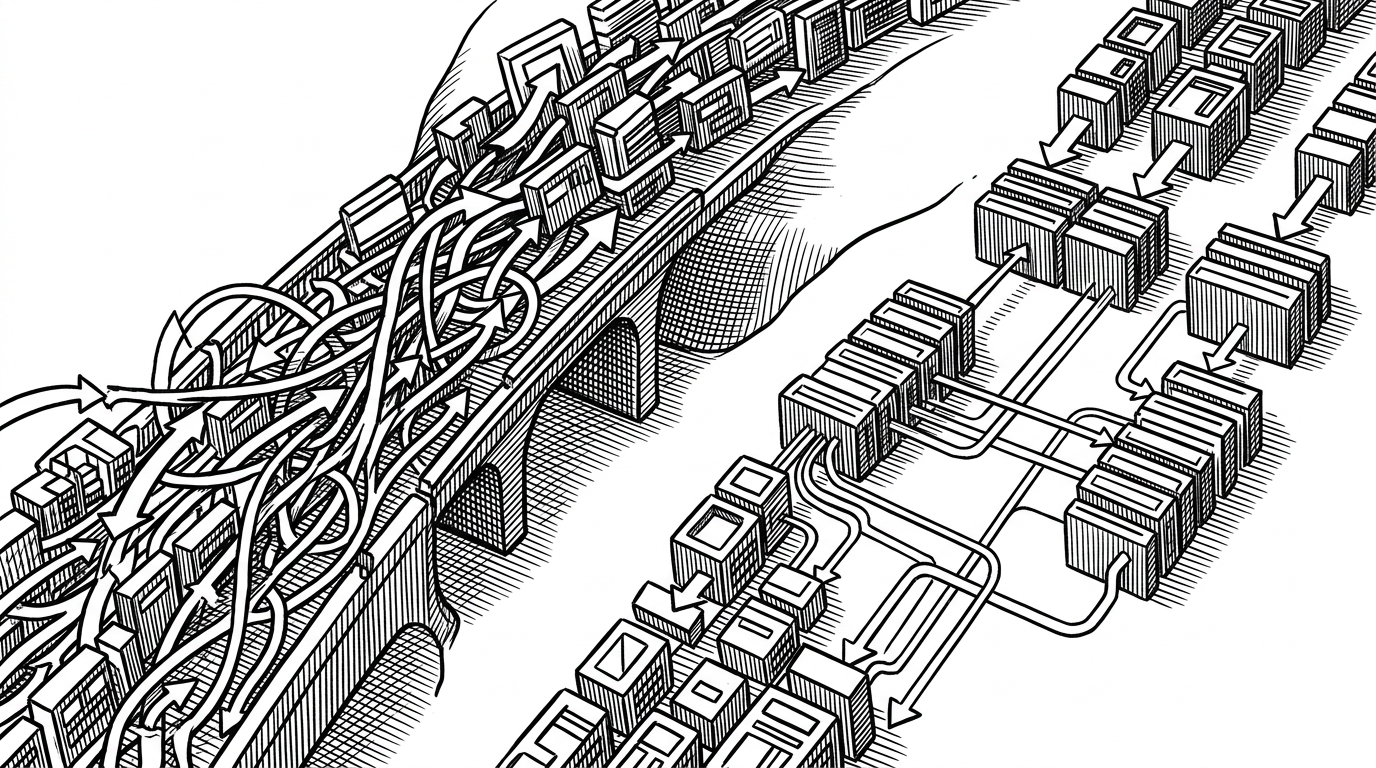
Classic multi-view geometry assumes the system should keep comparing observations until it converges. VGGT-Ω takes a different route. It still reasons across frames, but it does so through compact register tokens that act like shared scene memory, which keeps the model’s communication pattern narrow and tractable.
Why the old pipeline is the wrong mental model
VGGT-Ω is not trying to polish Structure-from-Motion. It replaces the pipeline mindset. Traditional SfM and SLAM are built around iterative estimation, explicit optimization, and a long chain of assumptions. VGGT-Ω instead learns a direct mapping from images to geometry, which changes latency, failure modes, and what the system can become downstream.
| Dimension | Classic SfM / SLAM | VGGT-Ω |
|---|---|---|
| Input assumptions | Careful feature matching and iterative refinement | End-to-end learned inference from images or video |
| Latency profile | Often multi-stage and slower | Single feed-forward pass |
| Memory behavior | Explicit geometry and optimization state | Compact register memory shared across frames |
| Failure mode | Can degrade when matching or optimization breaks | Can degrade when learned representations miss scene structure |
| Best-fit use case | Deterministic mapping and robotics pipelines | Fast 3D reconstruction, multi-task geometry, and downstream learning |
| Output type | Camera trajectory, sparse or dense structure | Camera, dense depth, confidence, and language-aligned features |
Inside the aggregator, where geometry is stored
The aggregator is the heart of the repository. It alternates intra-frame attention and inter-frame attention, but the important part is that it does not let every token talk to every other token forever. Patch tokens carry local visual detail, register tokens collect scene-level state, and a camera token gives the model a dedicated place to concentrate pose information.
# Conceptual shape of the aggregator's memory flow
frames = patch_embed(images)
frames = add_camera_token(frames)
frames = add_register_tokens(frames)

for layer in layers:
    frames = intra_frame_attention(frames)
    frames = inter_frame_attention_via_registers(frames)

shared_state = extract_register_and_camera_tokens(frames)
That design is what makes the model feel different from a standard vision transformer. The registers are not decorative. They are the shared workspace that lets the system move geometric evidence across time without paying the full cost of dense global exchange.
Runtime and GPU Memory We benchmark the end-to-end peak GPU memory usage of VGGT-Omega-1B-512 on a single NVIDIA A100 GPU with 624x416 input images.
Three heads, three jobs
Once the aggregator has built a shared geometric state, the model splits that state into specialized heads. The camera head reads the camera token and predicts pose and field of view. The dense head mixes multi-scale features to produce depth and confidence. The text alignment head adds something more unusual: a path from geometry into language space.
| Head | Reads from | Predicts | Why it matters |
|---|---|---|---|
| Camera head | Camera token | Pose and FoV | Turns shared scene memory into trajectory |
| Dense head | Multi-scale aggregator features | Depth and confidence | Provides spatial detail and uncertainty |
| Text alignment head | Learned language token over geometric state | Aligned embedding | Makes scene geometry queryable through language |
That last head is the quiet signal in the repository. It suggests the model is not just reconstructing a scene for its own sake. It is building a representation that other systems can query, reuse, and potentially act on.
The hidden implication: reconstruction becomes a proxy for understanding
This is why VGGT-Ω feels bigger than a reconstruction benchmark win. If geometry can be stored compactly, updated efficiently, and read out by different heads, then the model stops being a one-off mapping function. It becomes a reusable spatial memory layer for robotics, AR, VR, and vision-language-action systems.
The practical result is a stronger argument for feed-forward geometry models. Not because optimization is obsolete, but because a learned memory architecture can do more than estimate depth. It can organize the world into a format that downstream systems actually want to consume.