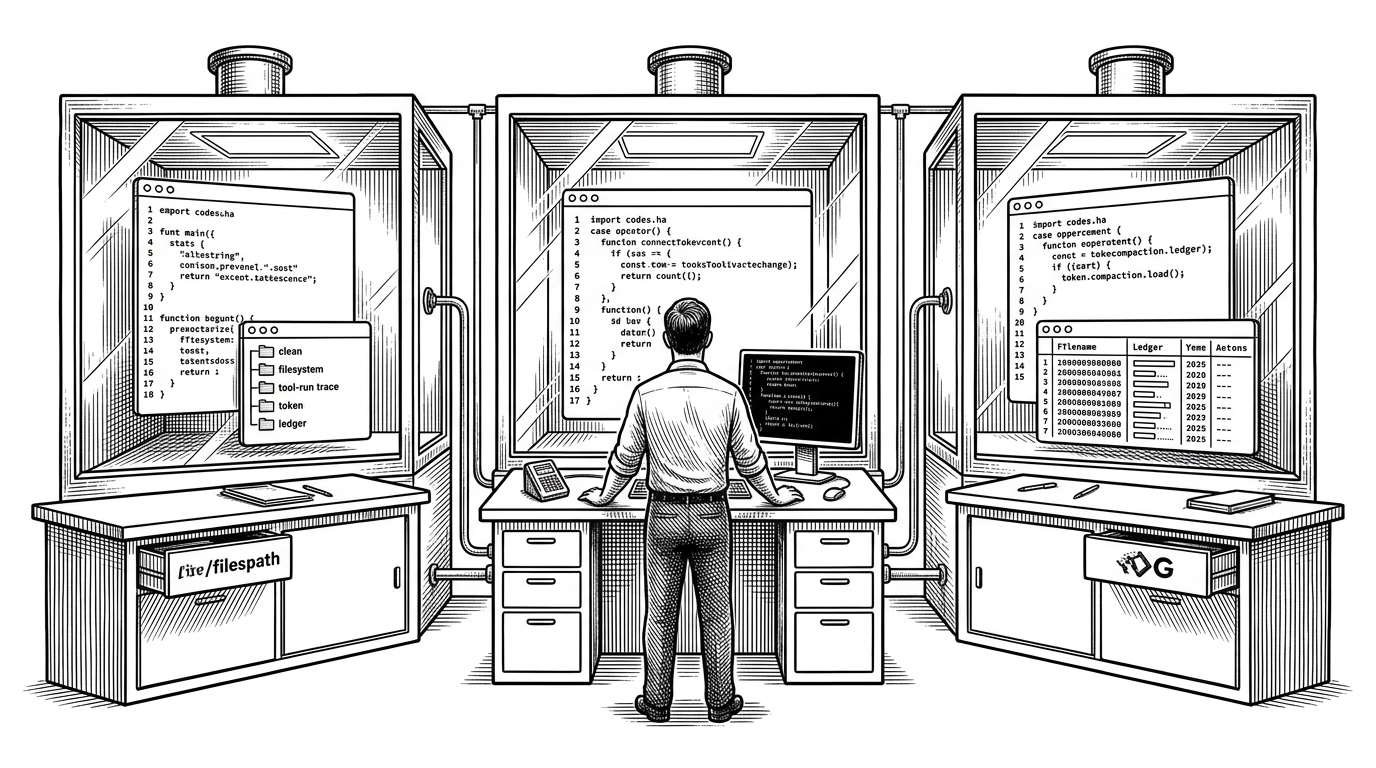
threaded-map-reduce: The Small Python Library That Rewrites the Rules of CPU-Bound Threads
A lean map-reduce implementation for free-threaded CPython, built around chunking, low-lock coordination, and a new assumption: threads can finally do real work on CPU-heavy tasks.

- This library is really a bet on free-threaded Python, where CPU-bound threads can finally compete with processes for the right jobs.
- Its edge comes from chunking work at the point of coordination, not from changing the underlying algorithm.
- The project is narrow on purpose: a small API, no production dependencies, and a performance story aimed at associative workloads.
- ThreadPoolExecutor, multiprocessing, and distributed frameworks still matter, but they live in different cost and complexity bands.
The GIL Is the Old Story
For years, Python concurrency advice was blunt. Threads were for I/O. Processes were for CPU. That rule made sense under the GIL, and it still describes a lot of production code today. But free-threaded CPython changes the ground under the whole conversation.
That is why threaded-map-reduce matters. It is not trying to be a general parallel runtime. It is a small, opinionated answer to a new question: if threads can truly run CPU-bound work in parallel, how do you keep coordination from eating the gain?
I do a lot of work in bioinformatics, especially in genetics, and the free-threaded Python seems very promising for my CPU bound tasks.
A Tiny API Built for One Job
The public surface is deliberately small: map, map_unordered, and map_reduce. That restraint is part of the design. The repo is not a framework with plugin hooks and orchestration layers. It is a sharp tool for a narrow shape of work.
from threaded_map_reduce import map_reduce

result = map_reduce(
    map_fn=is_prime,
    reduce_fn=lambda a, b: a + b,
    iterable=items,
    num_computing_threads=8,
    num_items_per_chunk=100,
)
The important detail is not the signature. It is the assumption behind it. The reducer must be associative enough that partial results can be combined safely. Once that is true, the library can divide the work, process chunks locally, and finish with a final aggregation.
The Trick Is Not Parallelism. It’s Chunking
The center of the implementation is a chunk dispenser. Instead of letting every thread fight over the iterator for every item, it hands out small batches. That means fewer lock acquisitions, fewer coordination events, and less overhead per unit of useful work.

How Map-Reduce Actually Flows Through the Library
The flow is simpler than the performance story might suggest. Worker threads pull a chunk, map over it locally, reduce that chunk locally, and emit a partial result. The main thread then drains the results queue and finishes the final reduction.
That split matters. The workers do the expensive part in parallel, but they do not keep chattering with shared state on every item. The queue only sees partials, and the sentinel handling keeps shutdown orderly.
In other words, the library spends synchronization where it has to. It does not spend it where it hurts most.
Why ThreadPoolExecutor Isn’t the Whole Answer
The closest baseline is concurrent.futures.ThreadPoolExecutor. It is general-purpose, battle-tested, and good at many things. That generality has a cost. Futures, task submission, internal bookkeeping, and broader abstraction overhead all matter when you are running millions of small CPU-heavy tasks.
| Option | Best fit | Main cost | Memory model | Why it loses or wins here |
|---|---|---|---|---|
| threaded-map-reduce | Associative CPU-heavy map-reduce on free-threaded CPython | Very low coordination overhead | Single process, shared memory | Wins when the work is repetitive and chunkable |
| ThreadPoolExecutor | General-purpose concurrency, especially I/O | Executor and Future overhead | Single process, shared memory | Convenient, but heavier than this repo for tiny CPU tasks |
| multiprocessing | Classic CPU parallelism under the GIL | Process startup and IPC | Separate processes | Strong fallback, but costlier for shared-data workloads |
| Dask | Larger task graphs and data pipelines | Scheduler and framework complexity | Often multi-process or distributed | Excellent scale, more machinery than this problem needs |
| Ray | Distributed Python workloads and actors | Platform overhead | Cluster-friendly | Powerful, but far beyond a simple local map-reduce |
| Joblib | Lightweight parallel loops | Backend overhead varies | Threads or processes | Handy, but not as tuned for this exact free-threaded niche |
The blunt verdict is simple. If you need orchestration, `ThreadPoolExecutor` is fine. If you need a narrow, low-overhead map-reduce path on free-threaded Python, this library trims fat in the right places.
When This Beats Processes, and When It Doesn’t
Processes still matter. They make sense when the workload is not thread-friendly, when a dependency forces the GIL back on, or when isolation is more important than shared-memory simplicity. They also remain the safer default on older Python builds.
This repo is for the other zone: CPU-heavy, associative, repeated work on modern free-threaded CPython, where shared memory is a feature and setup overhead is a tax you would rather avoid. That makes it especially interesting for workloads like prime counting, bioinformatics pipelines, and other tight loops that can be split cleanly into chunks.
Compared with Dask, Ray, or Joblib, the project is almost aggressively local. That is its point. It is not trying to become a distributed system to solve a single-machine performance problem.
The Real Lesson for Python’s Future
The most useful thing about threaded-map-reduce is not the package itself. It is the proof that Python’s performance conversation is shifting. Once threads can actually use multiple cores, the real constraint becomes coordination design, not just the presence or absence of the GIL.
That is a bigger deal than a niche library might suggest. It means a whole class of tools can get smaller, simpler, and faster by assuming threads are no longer second-class citizens for CPU work. This repo is an early example of that design style, and a good one.