Graphon: The Queue-Driven Engine That Makes Agent Graphs Act Like Live Systems
Inside the control loop that schedules nodes with ready queues, streams every event, and lets outside processes pause, resume, or abort a running workflow.

switch `api` to the published standalone `graphon` package instead of the vendored `api/graphon` source tree
- Graphon treats agent orchestration as a live runtime with queues, workers, and dispatch, not as a linear prompt chain.
- Its VariablePool keeps state outside the node, which makes branching and reuse feel like memory instead of wiring.
- The command channel makes pause, resume, and abort operational primitives instead of afterthoughts.
- Graphon's design reads like infrastructure extracted from Dify, not like a generic graph toy.
The part everyone misses about agent graphs
Most agent frameworks talk about graphs as if they were prettier chains. Graphon takes a harder line. It treats the workflow as a live runtime with scheduling, state, interrupts, and telemetry, which is closer to an operating system than a script runner.
That difference matters because agent work is rarely linear. Model calls hang, branches split, tools fail, humans step in. Graphon is built around those facts instead of hoping they stay edge cases.
The queue is the real abstraction
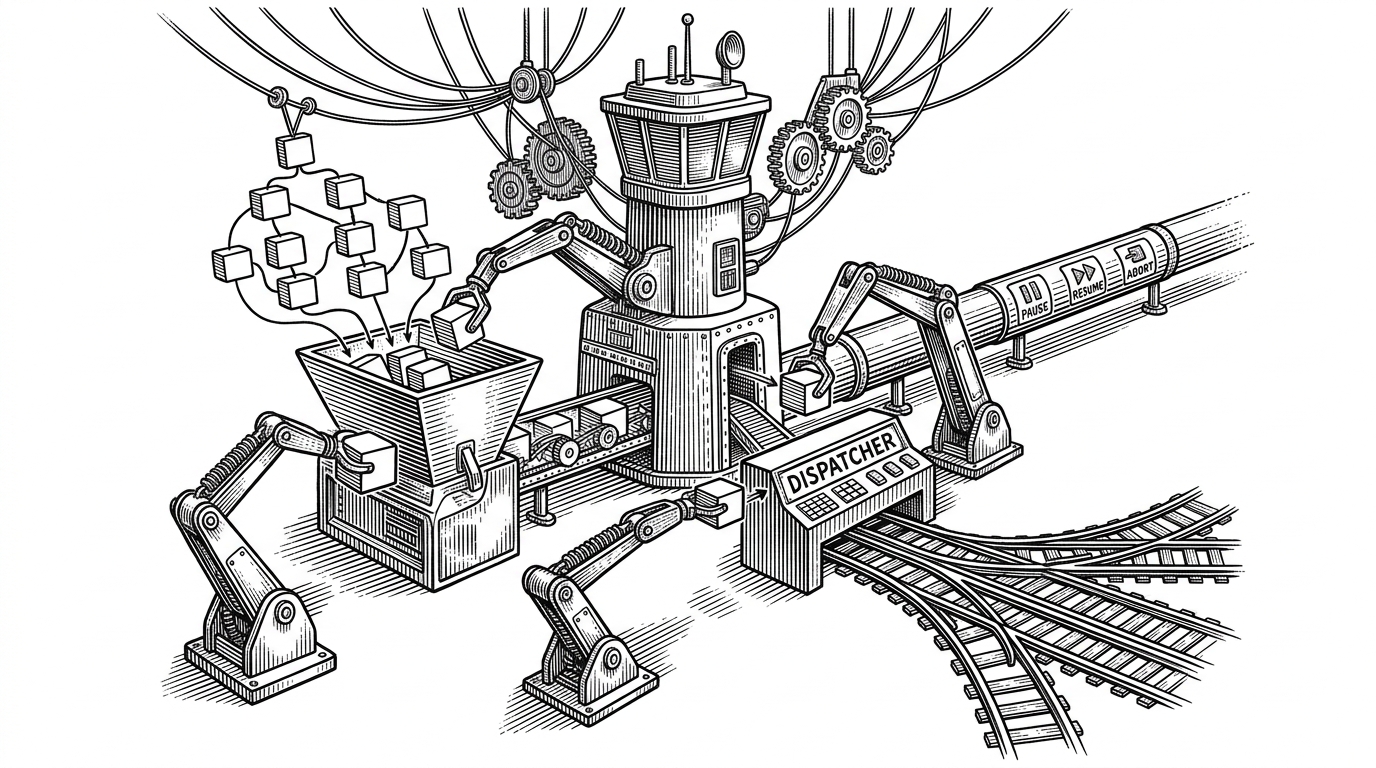
The core loop starts with a ReadyQueue. Workers pull the next runnable node, execute it, and push structured events into an event queue. The Dispatcher reads those events, asks the EdgeProcessor what unlocked next, and feeds new work back into the queue.
This is why the engine can fan out parallel branches without losing sight of the whole run. It also means a slow HTTP request or LLM call does not freeze the control plane. The queue keeps the system honest.
State lives outside the node
Graphon keeps graph structure and runtime state apart. The graph is the blueprint. The VariablePool is the moving memory that nodes read from and write to while the run is alive.
# conceptual view of the split
graph = Graph(...)
runtime = RuntimeState(variable_pool={})

runtime.variable_pool["crawl.title"] = crawl_result["title"]
summary_input = runtime.variable_pool["crawl.title"]
The point is not the syntax. The point is that state survives branching without turning every node into a dependency knot. A downstream node does not need to know how an upstream node produced its answer, only where the value landed.
The command channel turns a workflow into a system
The command channel is the step that turns orchestration into operations. Pause, resume, and abort are not UI tricks bolted on later. They are part of the runtime contract, so another process can control a live run while it is in flight.
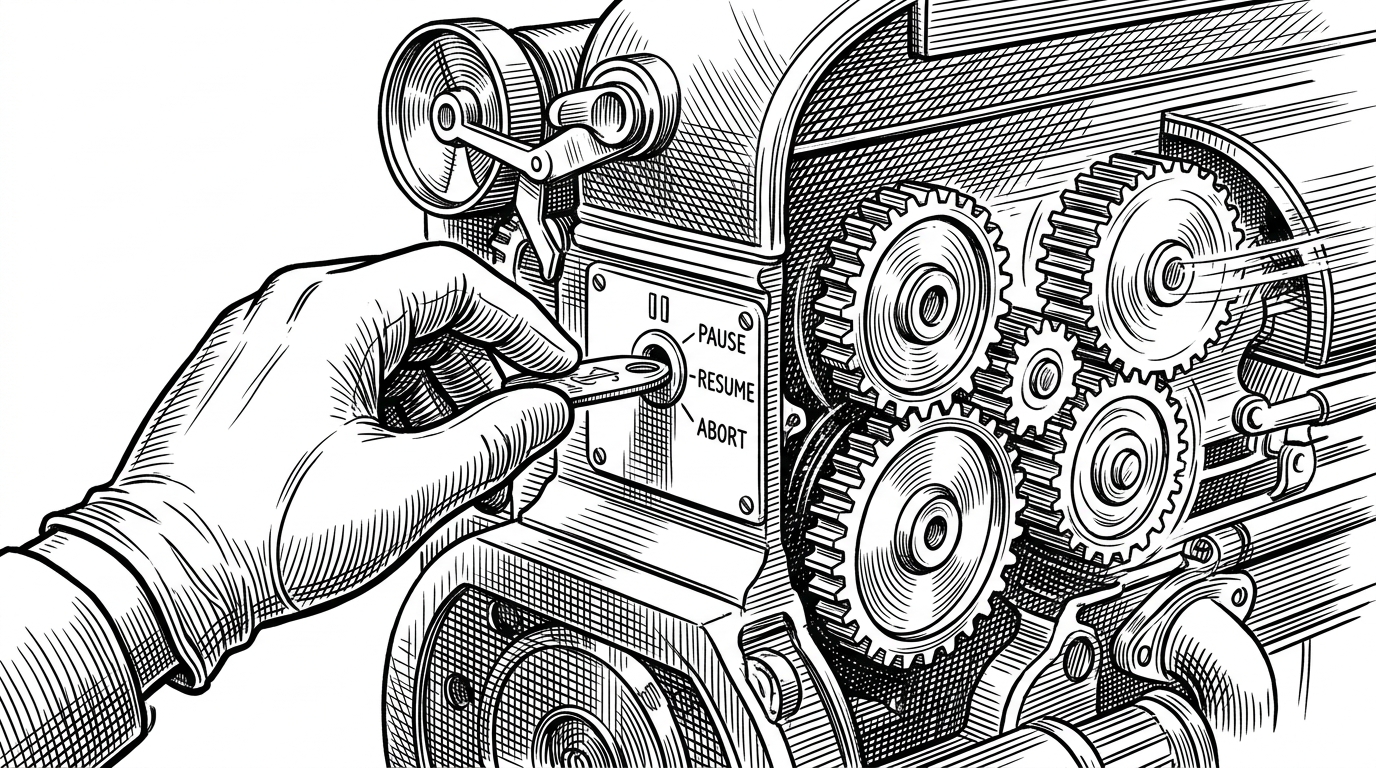
That matters once workflows become shared infrastructure. If a customer asks for a stop button, or a job has to yield to a higher-priority run, the engine already speaks that language. Graphon does not just report on state. It accepts commands.
Why LangGenius pulled this out of Dify
Graphon makes more sense when you see its lineage. It was shaped inside LangGenius and Dify as the execution layer for agent workflows, then extracted so the runtime could stand on its own.
That kind of extraction usually happens when a subsystem has outgrown the app that spawned it. The public package line makes the control plane reusable, but the original design brief still shows through: make the engine behave like production infrastructure, not glue code.
Graphon vs. the usual stack
Graphon is easiest to understand in contrast with the more common shapes in this category. Linear chains optimize for simplicity. Generic graph runners optimize for structure. Graphon optimizes for control.
| Axis | Linear chains | Typical graph runner | Graphon |
|---|---|---|---|
| Execution model | One node follows another | Nodes and edges form a graph | A queue feeds workers through a dispatcher |
| Runtime state | Passed through arguments or closures | Often shared by convention | Held in a separate VariablePool |
| Interruptions | Usually awkward | Possible, but not central | Pause, resume, and abort are first-class commands |
| Observability | Logs and callbacks | Graph events and traces | Granular events for each node and transition |
| Scaling posture | Best for straight-line flows | Good for workflow logic | Built for concurrent, operational control |
What builders should steal from Graphon
- Separate graph definition from runtime state.
- Make scheduling a queue problem, not a recursive one.
- Emit events as first-class output, not just logs.
- Treat interrupts as commands that any process can send.
The lesson is not that everyone should rebuild Graphon. The lesson is that serious agent systems need a control plane. If a workflow can branch, wait, fail, and resume, you need schedulers, events, and external commands, not just prettier function composition.