Robokin: The Rosetta Stone for Robot Arms
A backend-agnostic Python layer that turns URDFs, IK solvers, trajectory generation, and live visualization into one robotics workflow.
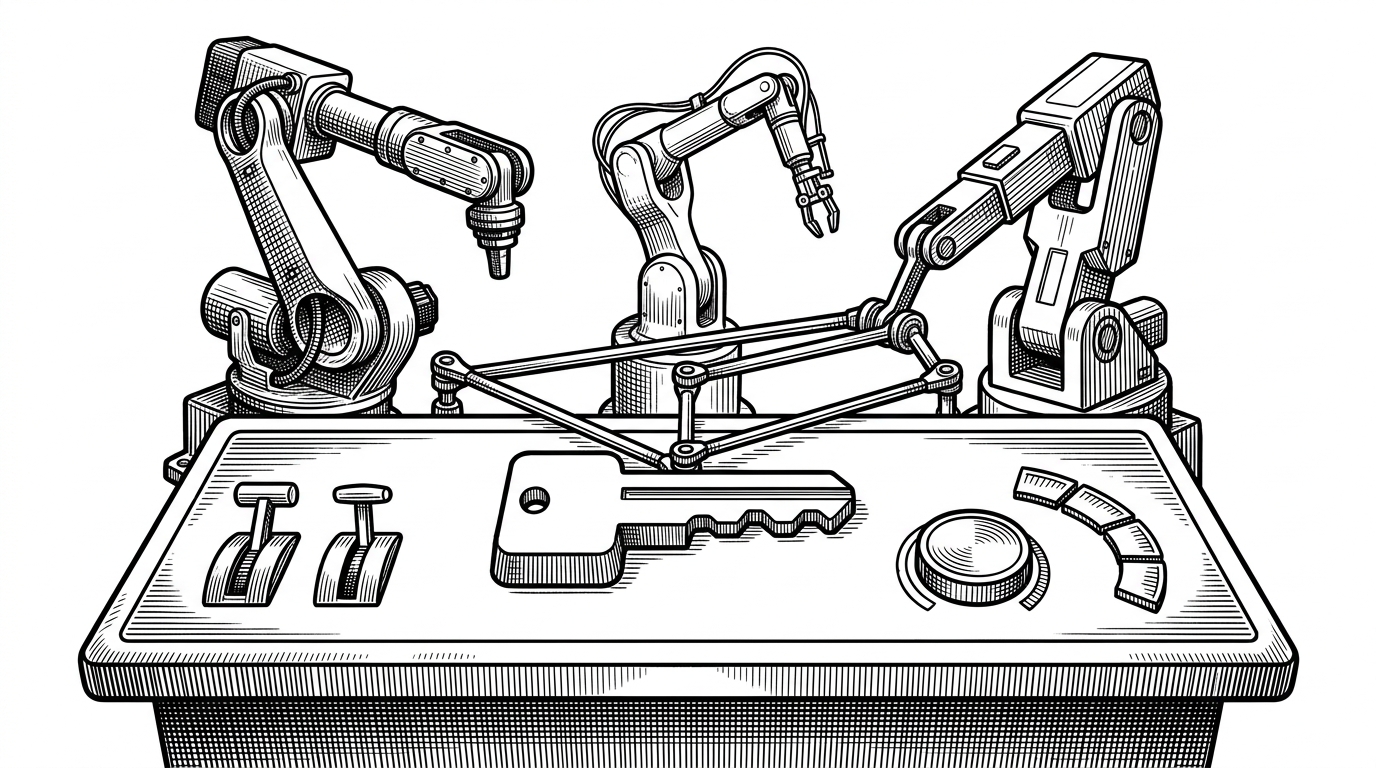
- Robokin’s main contribution is translation, not a new solver, because it makes multiple kinematics backends look like one Python API.
- The library treats motion as a workflow problem, pairing IK with trajectory shaping, visualization, and hardware-facing integration.
- Lazy imports keep the core package light while letting users opt into heavy backends only when they need them.
- The project points toward a lighter robotics stack where URDFs, solver choice, and observability stay decoupled but usable together.
Robotics stacks tend to fracture at the worst possible moment. One library knows the URDF, another solves inverse kinematics, a third handles motion timing, and a fourth shows you where everything went wrong. Robokin tries to erase those seams.
That is why the repo is more interesting as an adapter layer than as a math package. Its promise is simple: keep the robot description stable, swap solver backends when needed, and preserve one Python-shaped workflow across simulation, logging, and hardware.
Why robot arms are still too hard to wire together
A robot arm is not one problem. It is geometry, constraints, numerical optimization, timing, and feedback stitched together across different tools. In practice, that means developers spend too much time translating between formats instead of moving the arm.
Robokin attacks that translation cost. It starts from URDF-based robot descriptions, then layers a common interface on top of several solver backends so the rest of the code can stay boring.
Robokin provides a clean, backend-agnostic API for robot kinematics with pluggable IK solvers, 3D visualization, and real-arm integration.
Robokin’s core trick: one interface, many backends
The key design choice is the adapter pattern. Robokin wraps different solver families behind classes such as PlacoKinematics, PyRokiKinematics, and RoboPlanKinematics, but the surface area stays familiar: servo_step(), solve_goal(), and generate_segment().
| Layer | Robokin | Single solver library | ROS-heavy stack |
|---|---|---|---|
| Robot model | Loads URDF-based descriptions once | Usually assumes its own model path | Often spread across packages and launch files |
| Solver choice | Backend-agnostic and swappable | One backend, one mental model | Possible, but buried in system integration |
| Motion style | Adds trajectory shaping on top | Often limited to solving poses | Available, but heavier to assemble |
| Visualization | Built to plug into modern tools | Usually separate | Integrated, but tightly coupled |
| Developer ergonomics | One consistent Python API | Fast, but narrower | Powerful, but more overhead |
This matters because the abstraction is not fake. Robokin does not pretend Placo, PyRoki, and RoboPlan are identical. It only normalizes the parts the caller should not have to relearn every time.
The part most people miss: lazy-loading the heavy stuff
Robokin’s __init__.py uses lazy loading through __getattr__. That means importing the package does not immediately pull in every backend dependency, which is exactly what you want in a robotics library with optional solvers and specialized extras.
# Conceptual shape of the import pattern
from robokin import PlacoKinematics

# The backend module is only imported when the symbol is requested.
# That keeps core imports light and avoids forcing every dependency on every user.
The trade-off is subtle but important. The core stays usable for more people, and backend-specific failures happen only when a user actually chooses that path. In a dependency-heavy field, that is real ergonomics.
How the motion layer changes the feel of the robot
Robokin is not content to solve a target pose and stop there. Its motion planner adds two distinct ways to move: Cartesian motion, where the end effector follows a straight spatial line, and joint-quintic motion, where the solver finds a target and the joints interpolate smoothly toward it.
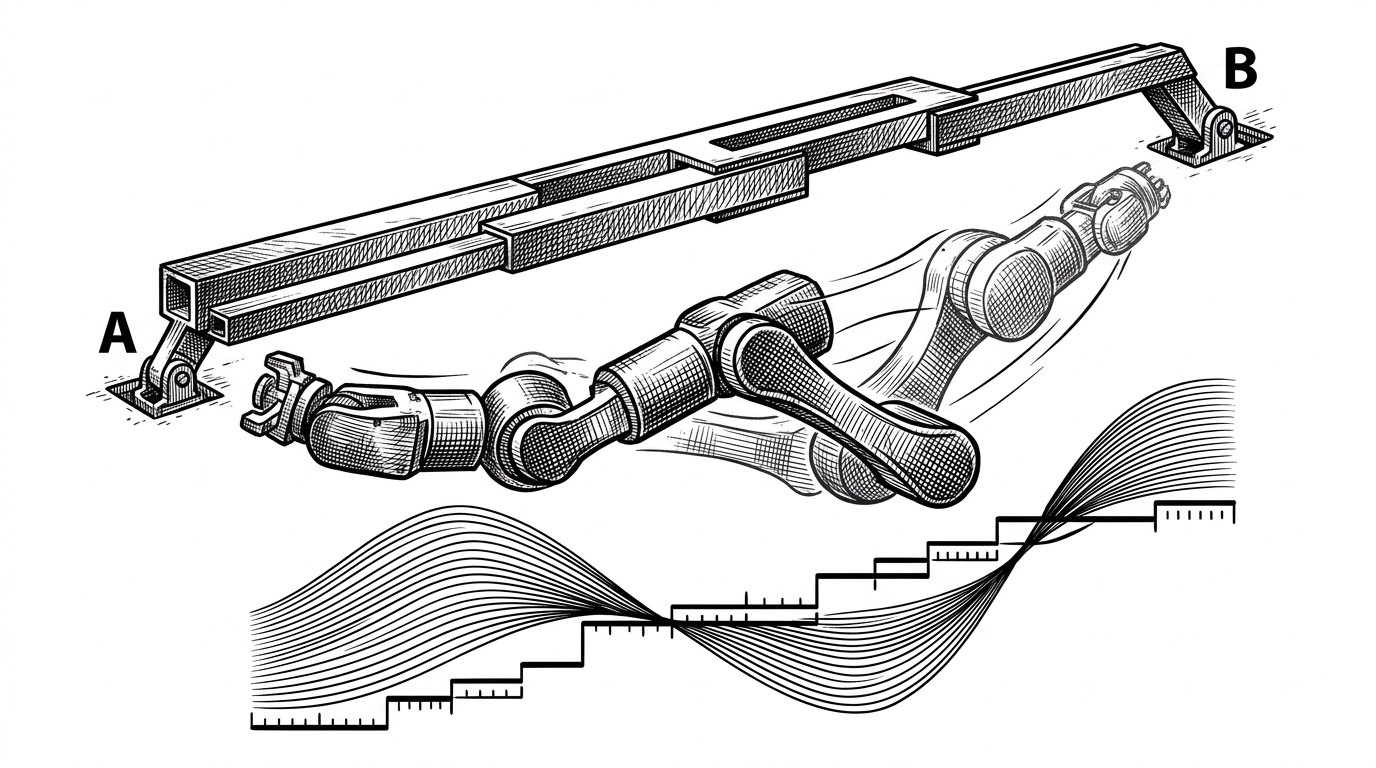
That distinction is easy to miss until you have watched a robot overshoot, twitch, or pause awkwardly. Good robotics software is not only correct. It is legible in motion.
Why the math layer matters more than it looks
Under the hood, the library’s transformations.py file does the quiet work that makes motion feel controlled: SE(3) interpolation, quintic easing, and step estimation from speed rather than arbitrary frame counts.
# Conceptual responsibilities in transformations.py
# - smooth rotation interpolation
# - smooth translation blending
# - quintic easing for zero-velocity, zero-acceleration endpoints
# - step count derived from physical speed targets

# The point is continuity, not just destination matching.
That is the difference between a demo and a usable robot workflow. Sudden starts and stops are not just ugly. They can stress hardware, confuse operators, and make debugging much harder.
The modern robotics stack Robokin points toward
Robokin sits in a newer Python-first robotics ecosystem: Viser for interactive 3D, Rerun for temporal logging, LeRobot for AI robotics workflows, and ROS 2 for hardware integration when you need it. The project feels like a bridge from heavyweight, monolithic setups to smaller, composable pieces.
| Tool | What it contributes | How Robokin uses it |
|---|---|---|
| Viser | Browser-based 3D interaction | Live robot state and inspection |
| Rerun | Temporal multimodal logging | Playback and debugging of motion |
| LeRobot | AI robotics workflows | Real-arm and dataset-adjacent integration |
| ROS 2 | System-level robotics plumbing | Hardware-facing deployment when needed |
That is also why the repo feels timely. Robotics development is moving toward tools that are easier to compose, easier to inspect, and less dependent on one giant framework doing everything.
Where Robokin fits in the robotics landscape
Compared with a single solver library, Robokin is broader. Compared with a full ROS-centric stack, it is lighter and more focused. Its job is not to beat every backend. Its job is to make backend choice feel like an implementation detail.
| Approach | Strength | Limitation |
|---|---|---|
| KDL | Battle-tested and familiar | Not designed as a unifying interface |
| Pinocchio | Fast and highly optimized | Still a solver library, not an adapter layer |
| PyRoki | Modern and JAX-friendly | Focused on its own backend model |
| Robokin | One Python API over multiple backends | Depends on the quality of the chosen backend |
That is the right trade. If the backend is the place where math lives, Robokin is the place where the rest of the software stack can stop caring which math engine won today.
What to watch next
Robokin’s likely future is more backend support, tighter hardware integration, and deeper use in AI-driven robotics workflows. The core idea should stay the same: one code path, many kinematics personalities.
That is a strong place to stand in a fragmented field. The software that wins in robotics is often the software that reduces translation, not the software that adds another dialect.