Xilem: The Rust UI Framework That Splits Intent From Execution
A reactive view layer on top of a retained widget engine, Xilem is Linebender’s answer to the hardest part of native UI in Rust: how to be declarative without fighting ownership, layout, rendering, or accessibility.
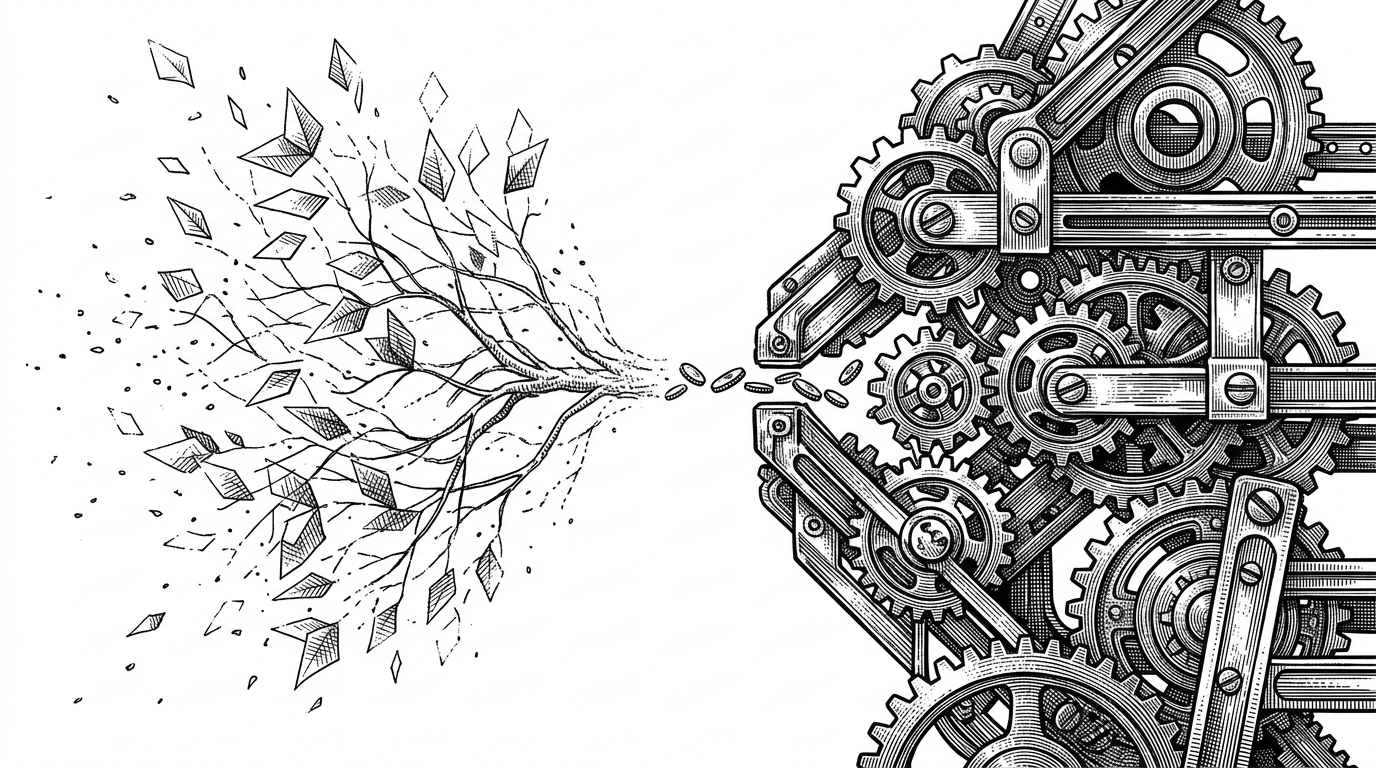
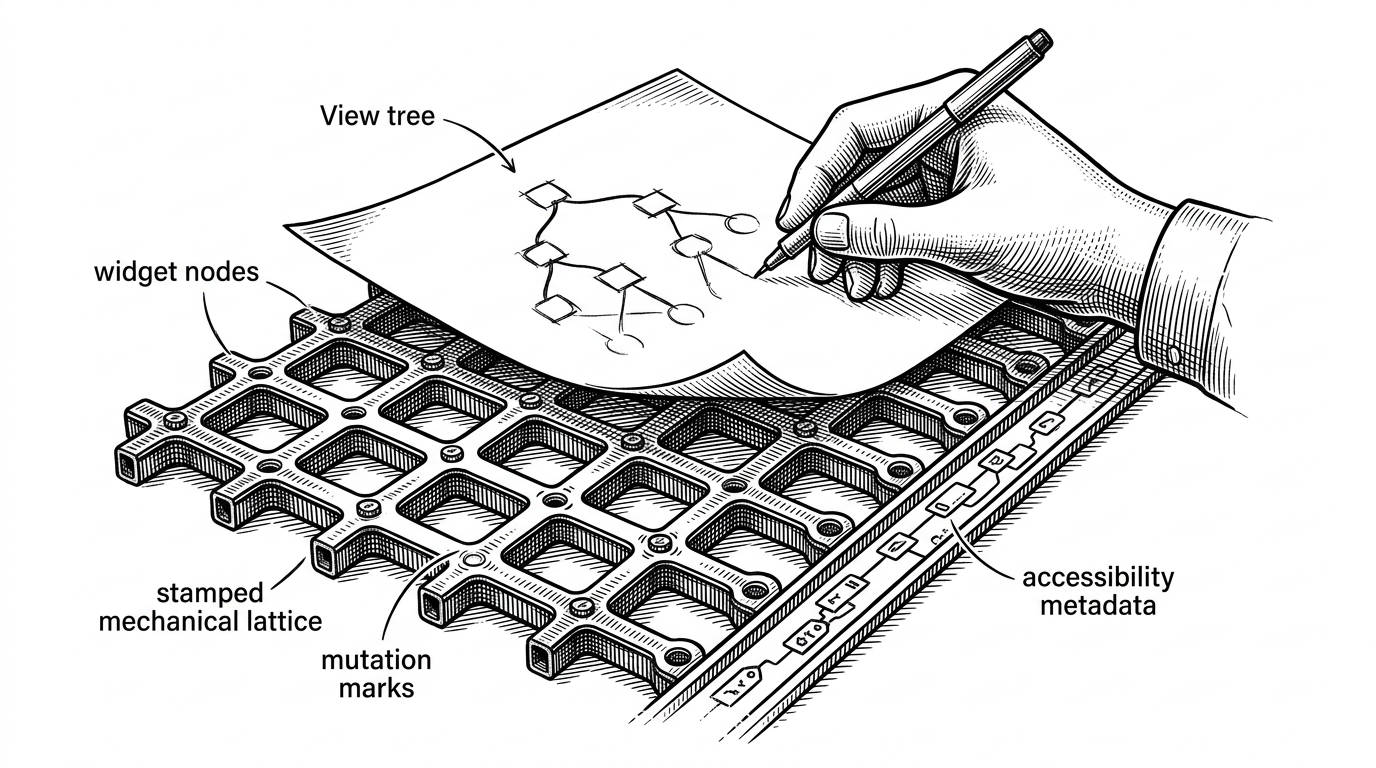
- Xilem’s main innovation is not declarative UI by itself, but the split between a transient View tree and a persistent Masonry widget tree.
- That split lets Rust keep ownership and lifecycle rules intact while still giving developers a SwiftUI-like way to describe interfaces.
- Masonry is not a thin helper layer. It is the runtime substrate for events, layout, painting, and accessibility.
- Xilem’s ambition is vertical integration: renderer, text, accessibility, and widgets are all part of the same bet.
The interesting part of linebender/xilem is not that it is another Rust UI framework. It is that it refuses to collapse intent and execution into one thing. You write a short-lived view description. Masonry keeps the durable widget state, handles events, measures space, paints pixels, and feeds accessibility.
The real idea: a UI tree that disappears
In Xilem, the View tree is not the UI. It is a temporary description of what the UI should be. That sounds subtle, but it is the whole design.
Rust makes long-lived mutable UI trees awkward. Ownership wants clear boundaries. UI frameworks want state that outlives a single render pass. Xilem’s answer is to let the high-level tree vanish after reconciliation, while the lower-level widget tree persists and does the actual work.
Why Masonry exists at all
Masonry is the engine room. It is a retained-mode widget toolkit with a strict lifecycle: pointer events, text events, measurement, layout, painting, and accessibility hooks all live there. Xilem sits on top of it, but Masonry is what makes the whole stack real.
That choice matters. A thin wrapper over generic primitives would leave Xilem dependent on someone else’s compromises. Instead, Linebender is building the substrate itself. The payoff is control over the pieces that usually decide whether a UI toolkit feels native or brittle.
// Conceptual shape, simplified
fn app_view(state: &AppState) -> impl View<AppState> {
    VStack::new()
        .with_child(Label::new(state.title.clone()))
        .with_child(
            Button::new("Increment")
                .on_click(|state| state.count += 1)
        )
}

// Xilem produces a new View tree from state,
// then reconciles only the necessary Masonry mutations.
That lifecycle is why Masonry matters more than it first appears. Measurement and layout are not afterthoughts. Accessibility is not bolted on later. They are part of the runtime contract.
How a state change becomes a UI update
The reconciliation flow is the key technical move. A state change produces a new View tree. Xilem compares it with the previous tree. Then it mutates Masonry only where the structure or properties actually changed.
That means the framework is neither fully immediate mode nor a naive rebuild-everything virtual DOM. The View tree is typed and lightweight. The widget tree is persistent and capable. The diff between them is what keeps the system small enough to reason about and powerful enough to run native UI.
| Step | What happens | What stays stable |
|---|---|---|
| State change | Application state mutates | The app model |
| New View tree | Xilem re-runs view code | The previous widget tree |
| Diff | Xilem identifies structural and property changes | Unchanged widget nodes |
| Masonry mutation | Only selected widgets update | Widget IDs, layout context, accessibility linkage |
That is the trick. The framework lets you write declarative UI without forcing Rust to pretend that the whole tree is a disposable blob. Only the description is disposable.
The ecosystem is part of the thesis
Xilem is not a crate in isolation. It is the visible top of a stack that includes Vello for rendering, Parley and Fontique for text, AccessKit for accessibility, and winit for windowing. Each piece exists because the project wants to own the full path from state change to painted, accessible pixels.
That is a big bet. It also explains why Xilem feels more like a platform thesis than a framework release. The architecture only makes sense if the pieces below it are good enough to justify the complexity above it.
How Xilem compares to the field
Xilem is easiest to understand by contrast. It is not trying to be the simplest Rust UI toolkit, and it is not trying to be the most web-native. It is trying to occupy a narrower and stranger space: statically typed view descriptions, retained runtime execution, and deep integration with a custom renderer and accessibility stack.
| Project | Model | Typical strength | Where Xilem differs |
|---|---|---|---|
| Xilem | Typed view tree over retained widgets | Native feel with strong ownership discipline | Vertical integration from views to renderer |
| Iced | Elm-inspired architecture | Straightforward reactive desktop apps | Less vertically integrated below the UI layer |
| Dioxus | React-like virtual DOM | Cross-platform reach and web familiarity | More VDOM-oriented and WebView-friendly |
| Slint | DSL-driven toolkit | Polished tooling and stable product focus | Less like embedded reactive Rust code |
| Egui | Immediate mode | Fast to use for tools and prototypes | Different trade-off on persistence and accessibility |
The point of the comparison is not to pick a winner. It is to show the bet. Xilem leans toward persistent runtime state, typed reactive views, and a custom native stack. That is a very specific answer to the Rust UI problem.
What still makes Xilem experimental
The project is candid about its own rough edges. Styling is still a major challenge. Documentation is thinner than the architecture deserves. The web backend exists, but it does not yet carry the same confidence as the native path.
That honesty matters. Xilem reads less like a finished toolkit than a research program with unusually strong engineering discipline. The codebase is a serious attempt to define what native Rust UI should become, but it is still working through the hard parts that decide whether a framework becomes infrastructure or remains an experiment.