MMAction2: The Config Engine Behind Video AI
A deep dive into the OpenMMLab toolbox that turns video understanding into reusable configs, hooks, and task modules.
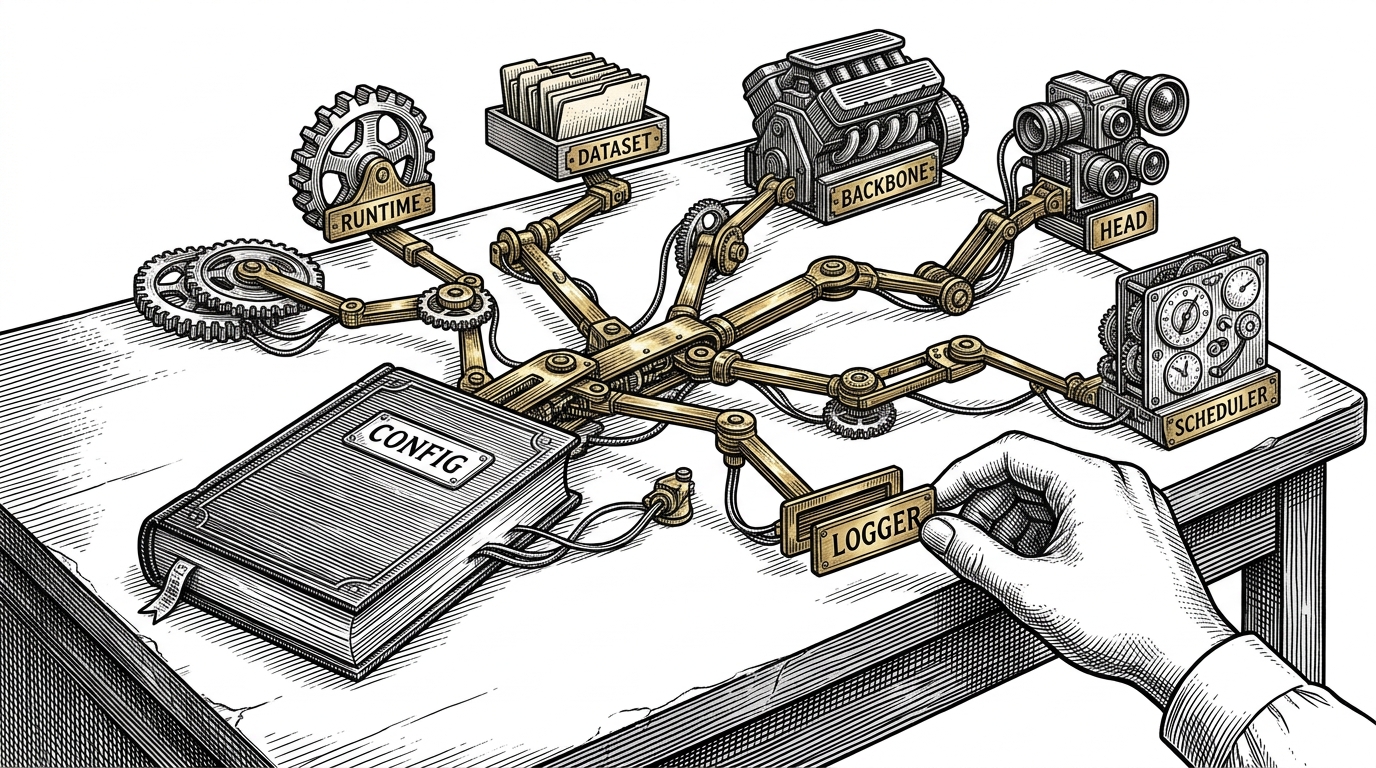
- MMAction2 is less a model zoo than a control layer for video research, because configs define the system and hooks define the behavior.
- Its recursive config graph lets teams swap runtimes, loggers, schedulers, and datasets without rewriting the training loop.
- The project’s real moat is reproducibility, since preprocessing, indexing, and task plumbing are explicit instead of hidden behind a black box.
- Its breadth matters because one shared grammar can serve recognition, localization, detection, retrieval, and multimodal work.
The most interesting thing about MMAction2 is not its model list. It is the way the repo turns video understanding into a system of reusable parts. Training, logging, checkpointing, visualization, and dataset handling are all pushed into a shared grammar that feels closer to an operating system than a script.
The hidden superpower is the config graph
MMAction2 is built around hierarchical configs in `configs/_base_`. A base file can define runtime defaults, a model backbone, or a dataset recipe, and a child config inherits all of it while overriding only the pieces that change. That makes experiments legible. You can see what is stable, what is specific, and what was modified for a given run.
As a part of the OpenMMLab 2.0 projects, MMAction2 1.x unifies and refactors the interfaces and internal logics of train, testing, datasets, models, evaluation, and visualization.
That separation matters because video research changes constantly. One day you are comparing backbones, the next you are changing frame sampling or evaluation hooks. MMAction2 lets those changes live in the config layer, not in a custom training loop.
Why event-driven training changes the game
The runtime side is just as important. In `default_runtime.py`, hooks such as `RuntimeInfoHook`, `IterTimerHook`, and `DistSamplerSeedHook` define how the system behaves across the lifecycle of training. Logging, timing, seeding, checkpointing, and visualization are not special cases. They are events.

That is why MMAction2 feels durable. A new visualization backend or logger does not require a new orchestration script. You register another hook, adjust the config, and the runner picks it up.
A single backbone, many video problems
The model abstraction is modular in the same way. A typical MMAction2 model separates `data_preprocessor`, `backbone`, and task head. Recognition might use an `I3DHead`. Temporal localization might use a `BmnHead`. The grammar stays the same even when the task changes.
| Aspect | MMAction2 | Narrow video repos |
|---|---|---|
| Primary scope | Multiple video tasks in one framework | Usually one model family or one benchmark lane |
| Config model | Recursive inheritance with shared bases | Often flatter, more script-centric |
| Runtime behavior | Hook-driven and pluggable | Frequently hardcoded in training scripts |
| Best fit | Teams that need a reusable research and experimentation layer | Teams reproducing one paper or one architecture |
| Main limitation | More moving parts to learn upfront | Less reusable once the task broadens |
The point is not that every task uses the exact same architecture. The point is that the same assembly language can express different video jobs. Once that clicks, the repo stops looking like a collection of examples and starts looking like a platform.
The real moat is reproducibility
Video ML breaks easily. Frame extraction rate, resize policy, annotation indexing, and sampling strategy can all move metrics. MMAction2 makes preprocessing visible through scripts and dataset tooling instead of hiding it inside a notebook or a private pipeline. That transparency is not glamorous. It is what makes results repeatable.
# Example of the kind of explicit preprocessing MMAction2 keeps in-repo
bash tools/data/kinetics/preprocess_k400.sh

# Typical flow in the OpenMMLab style:
# 1. prepare raw video files
# 2. generate annotations or indexes
# 3. extract frames or decode on the fly
# 4. launch training from a config that names the exact dataset recipe
For a domain where small preprocessing mistakes produce big benchmark drift, that is a major advantage. The repository does not just help you train. It helps you recreate a result with your future self in mind.
MMAction2 is wider than one task, and that is the point
The breadth is not accidental feature bloat. It is a platform strategy. MMAction2 spans action recognition, temporal action localization, spatio-temporal action detection, skeleton-based action detection, video retrieval, and multimodal work. The shared conventions make each new task cheaper to add than it would be in a standalone repo.
| Task family | What it answers | Why the shared framework helps |
|---|---|---|
| Action recognition | What is happening? | Common backbones and heads can be reused |
| Temporal localization | When does it happen? | Same runtime, different labels and losses |
| Spatio-temporal detection | Who is doing what and where? | Task-specific heads still fit the same model grammar |
| Skeleton-based work | How does motion encode action? | Dataset and pipeline conventions stay consistent |
| Retrieval and multimodal | Which clip matches this query? | The config and runner model still hold |
That breadth also explains why MMAction2 matters inside OpenMMLab. If you already know the conventions from MMDetection or MMPose, the mental overhead drops fast. The ecosystem starts to feel like one language instead of a set of separate dialects.
How it compares to the usual suspects
Compared with PySlowFast, GluonCV, 3D-ResNets-PyTorch, and PaddleVideo, MMAction2 trades narrowness for reuse. PySlowFast is a strong reference point for specific video models. 3D-ResNets-PyTorch is excellent when your question is exactly about 3D ResNets. MMAction2 is the better choice when the question is broader: how do we build, compare, and iterate across many video tasks without changing the operating model each time?
| Repo | Scope | Modularity | Ecosystem fit | Best fit |
|---|---|---|---|---|
| MMAction2 | Wide, multi-task video understanding | High, config and hook driven | Strong inside OpenMMLab | Teams that need a framework |
| PySlowFast | Focused on FAIR video models | Moderate | Mostly standalone | Reproducing or extending SlowFast-style work |
| GluonCV | Broad CV toolkit with video support | Moderate | Cross-domain vision library | Teams needing a general CV stack |
| 3D-ResNets-PyTorch | Narrow model family | Low to moderate | Standalone research repo | Model-specific experimentation |
| PaddleVideo | Video toolkit in the Paddle ecosystem | High within its stack | Strong inside Paddle | Teams standardized on PaddlePaddle |
The comparison is not about benchmark vanity. It is about whether you want a repo that ends at a paper, or one that keeps paying off as the workflow expands.
The OpenMMLab effect
MMAction2 is also a product of its ecosystem. The project’s docs say the 1.x line is part of OpenMMLab 2.0 and that it unifies and refactors train, testing, datasets, models, evaluation, and visualization. That shared foundation is the hidden accelerant. It lets teams move across detection, pose, and video without relearning the whole stack.
That is the real origin story. MMAction2 did not begin as a one-off toolkit for one benchmark. It became a shared layer for a family of computer vision problems, with the same configuration style and the same runtime assumptions traveling across projects.
What this repo is really for
MMAction2 is not just a collection of state-of-the-art papers. It is a stable language for video understanding work. The repo makes experimentation composable, reproduction explicit, and task expansion less expensive. That is why it still matters even when the specific models change.