VTP: Giving Diffusion Models a Semantic Brain
How MiniMax-AI moved beyond pixel-perfect reconstruction to unlock the scaling laws of visual tokenization.
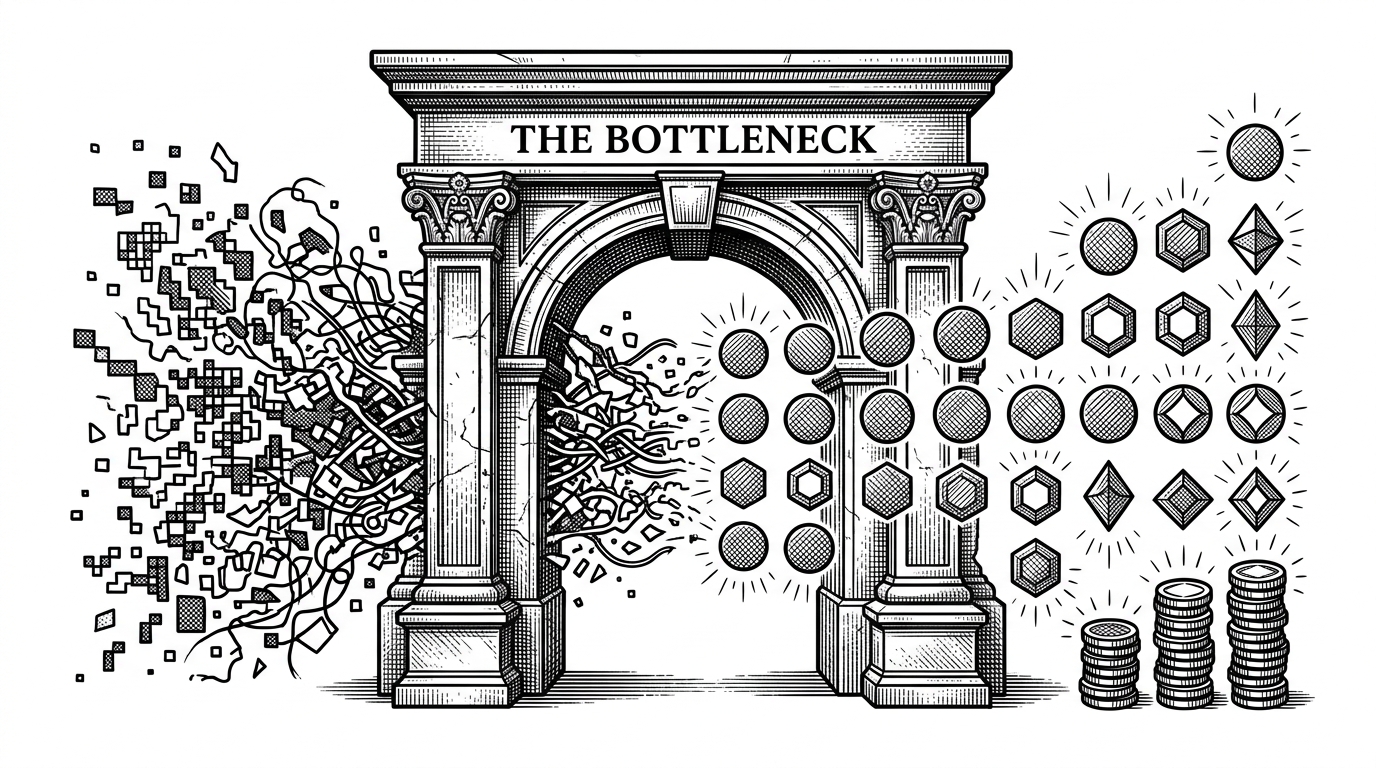
- VTP replaces pixel-perfect reconstruction with a semantic bottleneck to overcome the scaling limits of traditional auto-encoders.
- The architecture unifies vision, text, and reconstruction tasks into a single model to align visual tokens with language and structure.
- Extreme latent compression forces the model to distill high-level meaning rather than just recording RGB values.
- Diffusion models using VTP tokens achieve faster convergence and superior generation quality by leveraging pre-existing semantic understanding.
The Ceiling of Pure Reconstruction
Traditional auto-encoders have a fundamental limitation. They optimize for pixel-perfect reconstruction using Mean Squared Error. This approach treats a dog and a cat as just different arrangements of RGB values, ignoring the actual meaning of the image entirely.
When researchers try to scale these traditional models, they hit a generative plateau. The models learn to paint by numbers incredibly well but fail to grasp high-level concepts. To build visual models that scale like Large Language Models, the tokenizer itself needs a semantic brain.
Traditional auto-encoders CANNOT be scaled up for diffusion generative models.
The Triple-Threat Architecture
VTP solves the scaling problem by forcing its visual tokenizer to perform three tasks at once. The architecture acts as a Vision Tower, a Text Tower, and a Pixel Decoder simultaneously. This unified backbone is defined in the repository as the VTPModel.
Instead of relying solely on reconstruction loss, VTP introduces a Loss Trinity. It uses contrastive learning to align images with language, self-supervised learning for structural understanding, and standard reconstruction for pixel fidelity.
Understanding is the key driver for improving the learnability scaling.
The Narrow Gate
The magic of VTP happens inside a file called vision_transformer_bottleneck.py. A standard Vision Transformer processes images in high-dimensional spaces. VTP forces these rich features through a drastic compression step.
This bottleneck compresses a 768-dimensional latent space down to just 64 dimensions. By squeezing the data through this narrow gate while demanding it satisfy language, structure, and pixel-level tasks, the model is forced to distill pure semantic meaning.
Faster Convergence Through Understanding
The payoff for semantic tokenization is dramatic. When Diffusion Transformers use VTP tokens instead of standard VAE latents, they learn much faster. The model does not have to waste compute figuring out what a wheel is because the token already contains that semantic concept.
Same FLOPs in DiT Training, VTP scaling helps better generation.
| Model | Architecture | Primary Optimization |
|---|---|---|
| VTP | Unified Transformer | Semantic Understanding & Generation |
| Magvit-v2 | Lookup-free Quantization | Video Compression & Fidelity |
| VQGAN | Adversarial Quantization | Pixel Reconstruction |
From Research to Reality
VTP is not just an academic exercise. It forms the foundation for the MiniMax-M2 series of multimodal models. By treating visual tokenization as a pre-training problem, MiniMax bridges the gap between text reasoning and high-fidelity image generation.
As multimodal AI shifts toward unified objective functions, the era of the frozen, pixel-obsessed encoder is ending. The future belongs to models that understand what they see before they try to draw it.