Bloodify-Healthcare-Dashboard: Bloodify: The Java Dashboard That Turns a Fingerprint Into a Donor Decision
A Spring Boot healthcare app that links biometric input, compatibility rules, emergency override logic, and QR-verifiable PDF reports into one end-to-end blood bank workflow.
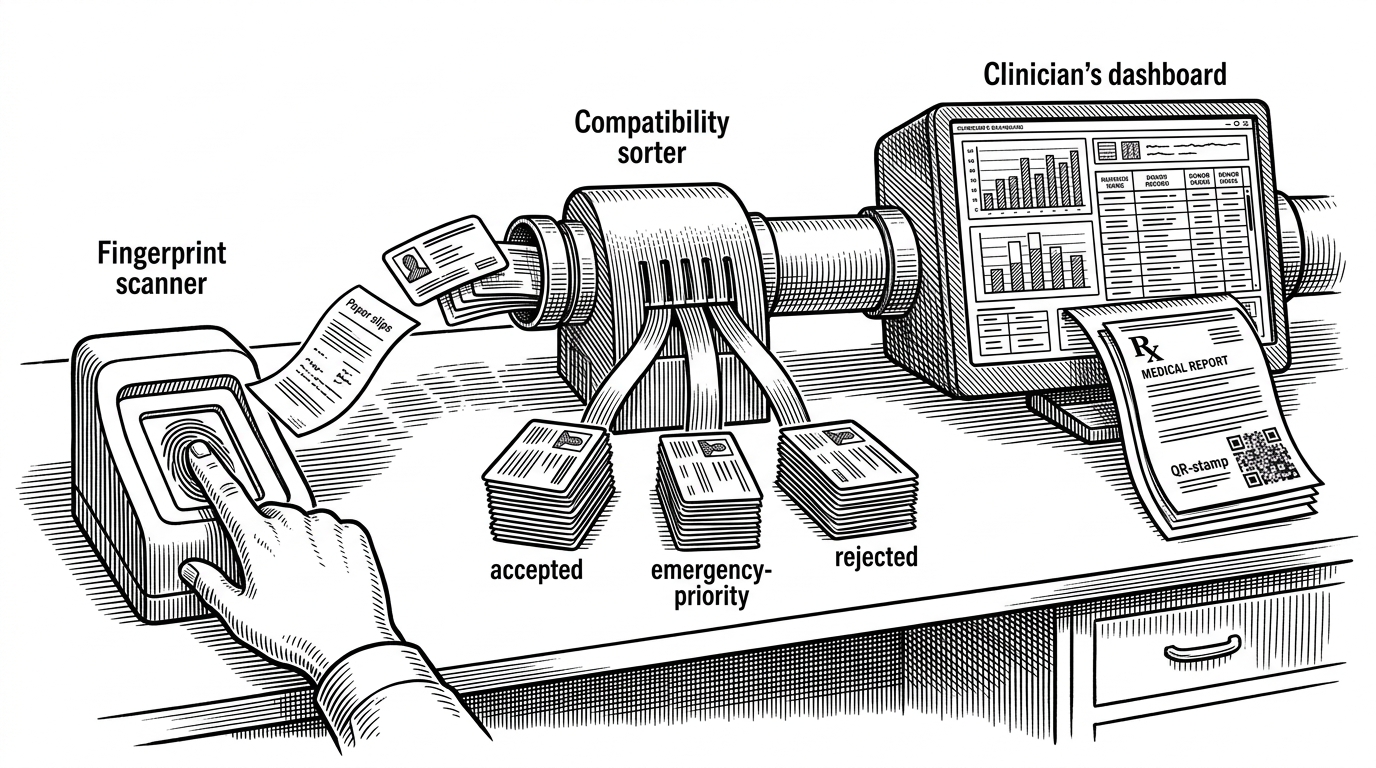
- Bloodify is best understood as a triage pipeline, not a reporting dashboard, because it connects biometric intake directly to donor selection and verified output.
- Its most interesting move is the emergency override, where the matching engine changes from standard compatibility filtering to urgency-first donor ranking.
- The app is built to be hardware-aware without becoming hardware-dependent, thanks to a browser workflow that can fall back when the fingerprint sensor is unavailable.
- The PDF layer is part of the trust model, since the report is designed to be verifiable rather than just printable.
Bloodify is interesting because it treats blood-bank software as a sequence of decisions, not a pile of forms. A fingerprint comes in. Compatibility rules run. Emergency logic can widen the search. A donor list and a QR-verifiable PDF come out the other end.
That makes the project feel closer to a clinical workflow engine than a generic hospital UI. The stack is Spring Boot, but the real subject is policy: how to encode urgency, locality, and donor eligibility into software that a front desk or triage team can actually use.
When a Fingerprint Becomes a Clinical Decision
The core idea is simple to describe and unusual to build. Bloodify starts with biometric capture, turns that input into a blood-group prediction, filters compatible donors, and then packages the result into a formal report. The dashboard is the visible layer, but the logic underneath is where the project earns its name.
In the repo, that flow is split across familiar Spring boundaries: controllers handle requests, services carry the matching and PDF logic, and repositories persist donor data in H2 through JPA. That architecture is conventional. The sequence it supports is not.
The Hardware-First Bet
Bloodify tries to bridge a physical device and a browser UI without asking the user to leave the web app. The research points to SecuGen WebAPI integration, with a localhost capture flow for fingerprint scanning and a file-upload fallback when the sensor is unavailable. That matters because it keeps the workflow usable in mixed environments instead of locking it to one lab setup.
That fallback is more important than it looks. It means the app is not pretending every deployment has the same hardware. It can still move forward when the biometric path is offline, which is exactly the kind of resilience a real intake desk needs.
Map<String, Object> prediction = modelUtilsService.predictBloodGroup(fingerprintImage);
String bloodGroup = (String) prediction.get("bloodGroup");
Double confidenceScore = (Double) prediction.get("confidenceScore");
List<Map<String, Object>> probabilities = (List<Map<String, Object>>) prediction.get("probabilities");
That shape is telling. The UI does not just want a label. It expects a structured response with a confidence score and probabilities, which is how you design for a future model before the model is real. The repo is effectively AI-ready without depending on an actual trained model.
Why the Emergency Override Matters
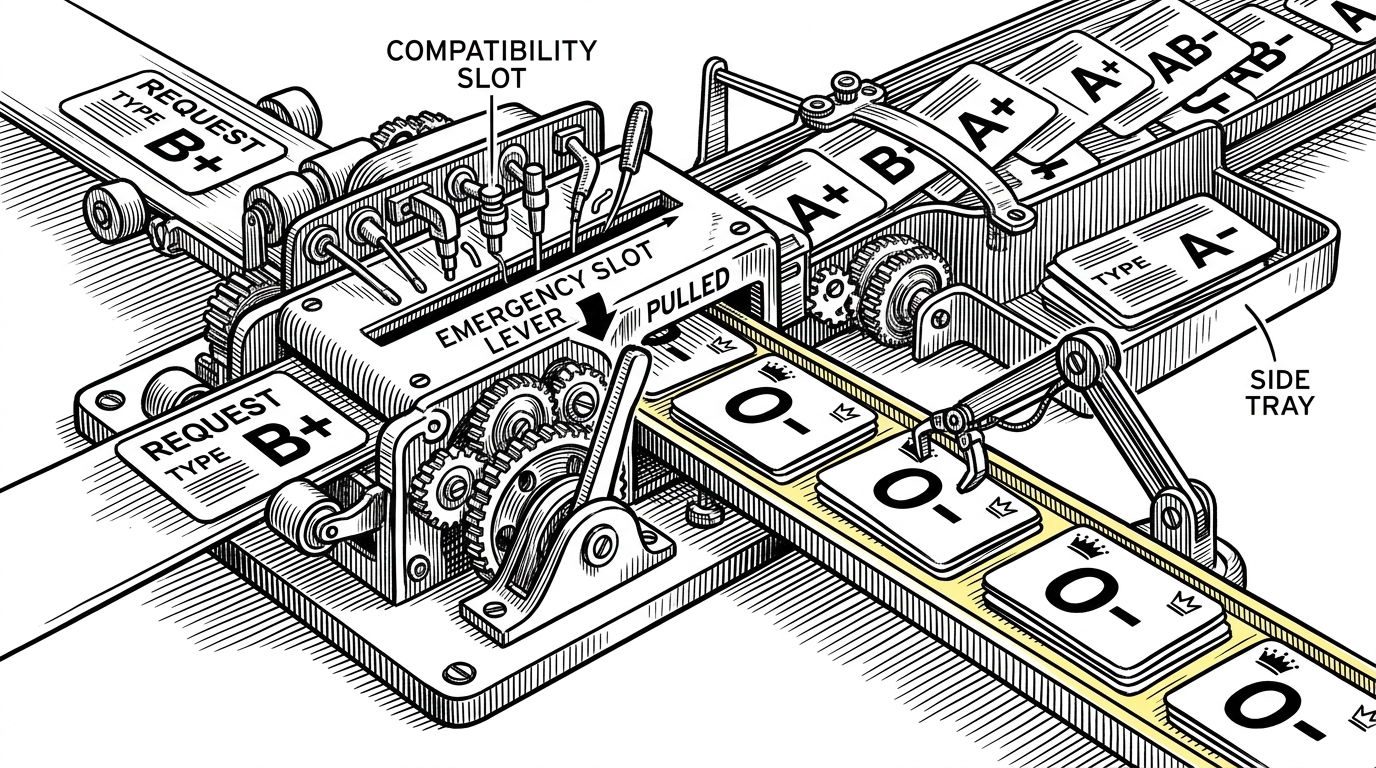
This is the most important section in the project. Under normal conditions, donor matching can stay strict. In emergency mode, the logic changes. O- donors get pulled into the candidate pool, and locality becomes a priority signal instead of a soft preference. That is not just a filter tweak. It is encoded triage policy.
| Mode | Candidate pool | Priority rule | What the user sees |
|---|---|---|---|
| Normal search | Strict compatibility matches | Blood-group compatibility first | A narrow, rule-driven donor list |
| Emergency mode | Compatibility matches plus O- donors | Urgency and locality first | A wider list with O- promoted to the top |
| Generic dashboard | Usually just charts and tables | No operational policy | Information without a decision path |
That difference is why the project is more than a CRUD interface. It encodes a judgment about what to do when time matters more than purity of match. In a real setting, that kind of rule deserves scrutiny, but it also deserves respect. The software is explicitly trying to operationalize an exception path.
Mock AI, Real Workflow
Bloodify’s prediction layer is mocked, but the surrounding system is built as if a real classifier will eventually slot in. That is a smart separation. The frontend can already handle structured outputs, and the backend can already route those outputs into donor selection and charts. The placeholder is not a dead end. It is a contract.
This is where the project feels mature for a prototype. It is not overcommitted to the model. It is committed to the workflow around the model. That matters because most production pain in healthcare software is not the prediction itself. It is what happens after the prediction.
The PDF Is Not an Afterthought
Bloodify closes the loop with a generated medical report. The report is not just a download button. The research points to iText7 PDF generation with embedded QR verification, which makes the document readable, printable, and checkable. In a clinical context, that is the difference between a convenience export and a trust layer.
Once donor data becomes a formal PDF, the app is doing more than displaying state. It is producing an artifact that can move between systems and still be verified later. That is a small but meaningful shift in ambition.
Where Bloodify Fits Among Health Platforms
Bloodify is not trying to compete with full EMR systems. It sits in a narrower lane: donor intake, compatibility logic, emergency triage, and verifiable reporting. That makes it more focused than general healthcare platforms and more operational than a typical blood-bank demo.
| Project type | Scope | Strength | Trade-off |
|---|---|---|---|
| Bloodify | Blood donor workflow and triage | Fast, focused decision pipeline | Not a full medical record system |
| OpenEMR / OpenMRS | Broad clinical records and practice management | Deep coverage and large ecosystems | Heavyweight for a narrow blood-bank use case |
| DHIS2 | Population health data and analytics | Strong reporting and national-scale visibility | Not specialized for bedside donor matching |
| Simple blood-bank CRUD app | Basic storage and admin screens | Easy to build | Stops before matching policy and verified output |
That niche is the point. The project is compelling because it chooses one job and drives it all the way through. It does not chase breadth. It tries to make the decision chain legible, fast, and auditable.
What This Project Teaches
Bloodify is a good lesson in how to design software for the messy edge between hardware, policy, and records. First, build a fallback when the sensor is missing. Second, separate prediction from workflow. Third, make emergency rules explicit. Fourth, generate documents that can be checked later, not just viewed once.
Those lessons travel well beyond healthcare. Any system that has to move from signal to decision to proof can borrow this shape. Capture cleanly. Decide carefully. Explain the exception. Leave behind something verifiable.