Adaptive-RAG: The Repo That Decides When Not to Retrieve
A LangGraph-powered AI system that routes each question to local search, general model knowledge, or web search, then checks its own answers before they reach the user.
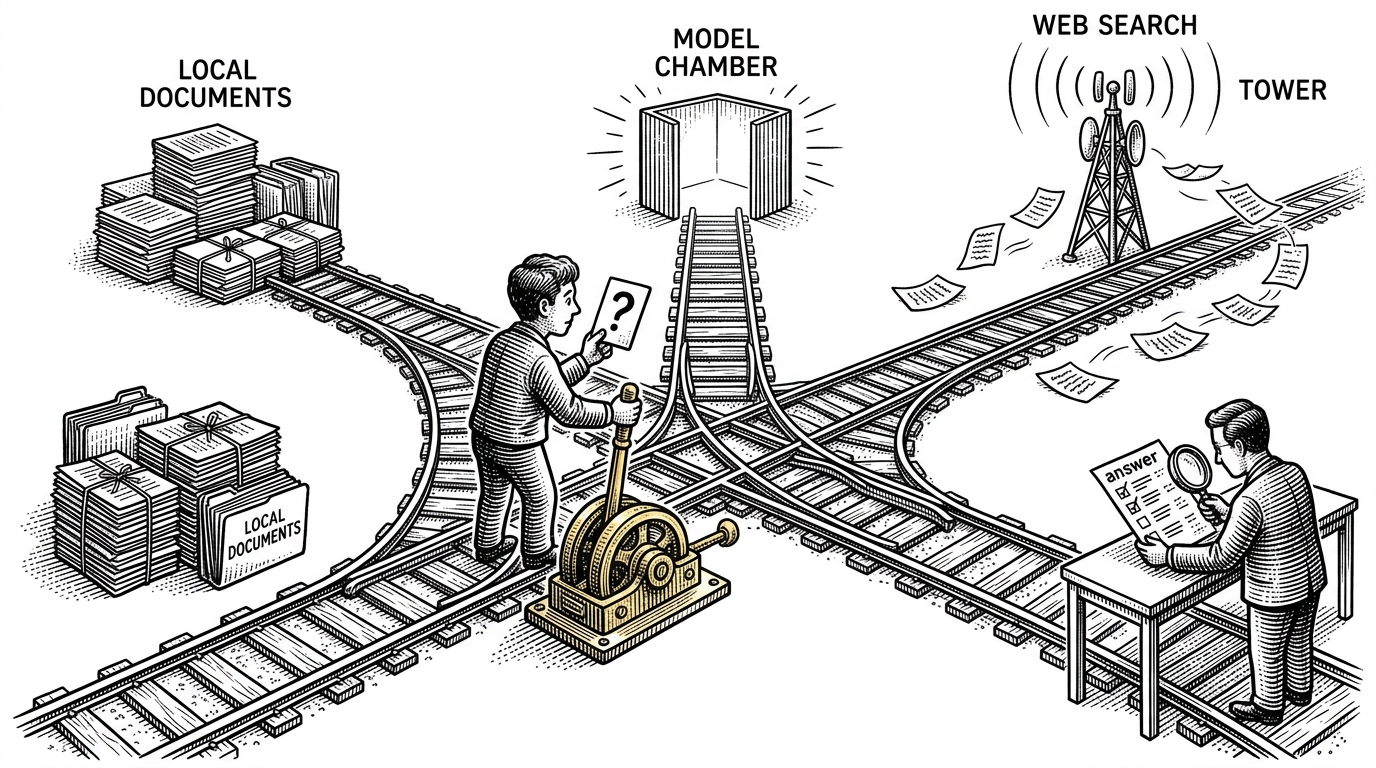
- Adaptive-RAG is really a routing policy for uncertainty, not a classic RAG pipeline with extra polish.
- The repo saves work by skipping retrieval for questions the model can answer directly and by sending only the right queries to local docs or the web.
- Its real strength is the closed loop: classify, answer, verify, then rewrite and retry when the answer is weak.
- The architecture feels production-minded because memory, prompts, retrieval, and the API layer are separated instead of welded together.
Most RAG systems assume retrieval is always the right first move. This repo makes a sharper bet: first classify the question, then decide whether to retrieve from local docs, ask the model directly, or call the web. That changes the project from a chatbot wrapper into a control system for answer paths.
A novel adaptive QA framework that can dynamically select the most suitable strategy for (retrieval-augmented) LLMs from the simplest to the most sophisticated ones based on the query complexity.
Why this RAG system starts by asking whether it should retrieve at all
The first surprise in umang-bhavsar/adaptive-rag is simple: retrieval is optional. A query classifier sends each request down one of three lanes, and only one of them hits local documents. The others go straight to general model knowledge or out to web search.
That design matters because it removes the default tax most RAG apps pay on every question. Easy questions do not need a vector lookup. Fresh questions do not need a stale local corpus. Mixed workloads need a policy, not a single retrieval habit.
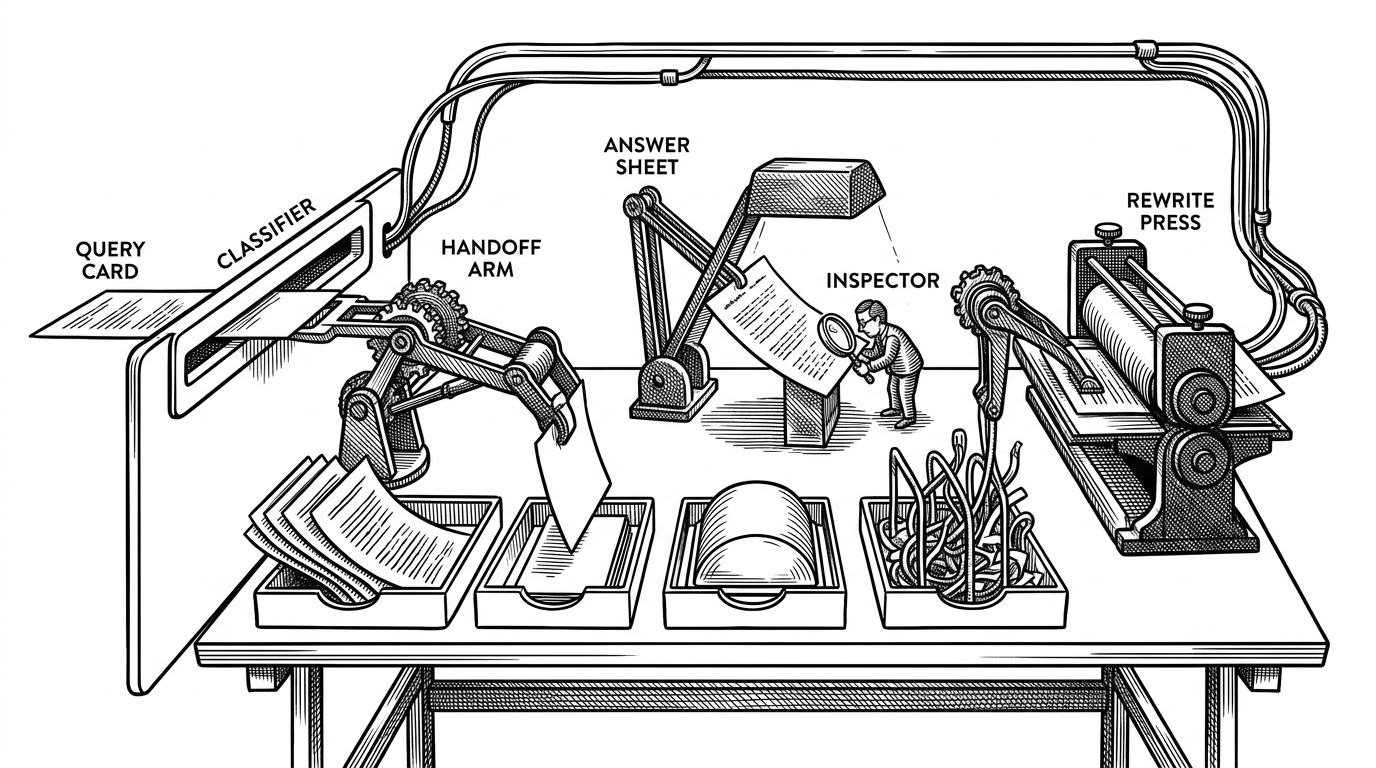
The control loop: classify, retrieve, grade, rewrite
# src/rag/graph_builder.py, simplified
route = query_classifier(user_query)

if route == "index":
    context = retriever(user_query)
elif route == "general":
    context = general_llm(user_query)
else:
    context = web_search(user_query)

answer = generate(context, user_query)
faithful = verify_answer(answer, context)

if not faithful and rewrite_attempts < MAX_REWRITE_ATTEMPTS:
    user_query = rewrite(user_query)
    return run_graph(user_query)

return answer
That loop is the repo's real center of gravity. It does not just retrieve. It grades the output, and if the answer is not supported, it rewrites the query and tries again. That makes the system feel less like a prompt chain and more like a small fault-tolerant machine.
The code path is shaped by src/rag/graph_builder.py, which behaves like a state machine rather than a linear script. The key move is the handoff from classification to routing. After that, the verifier acts like a referee, not a decorative post-processing step.
Why the repo feels production-minded
The architecture is not just clever. It is practical. FastAPI handles the backend, Streamlit handles the interface, MongoDB keeps chat history, and the vector store stays isolated inside retrieval setup code. That separation matters when a demo starts behaving like a real product.
Persistent memory is the quiet tell. MongoDBChatMessageHistory means the system can remember a session across restarts instead of pretending context lives only in RAM. The prompt layer is also decoupled, so behavior can change without rewriting the orchestration logic.
# src/config/prompts.yaml
classify_prompt: |
  Decide whether the question should go to local docs, general knowledge, or web search.

verify_prompt: |
  Check whether the answer is supported by the retrieved context.
  Return a judgment, not a rewrite.

rewrite_prompt: |
  Rewrite the query to improve retrieval quality without changing intent.
The prompt layer is separate on purpose
That YAML file is not a convenience. It is an operating principle. In agent systems, prompts tend to drift faster than code, so pulling them out of Python keeps the system editable without making the graph brittle.
Adaptive-RAG is a really nice approach that brings together some interesting ideas... of flow engineering or adaptive RAG which is the idea of doing tests in your rag pipeline or in your rag inference flow to do things like check relevance documents.
What makes this different from naive RAG, Self-RAG, and GraphRAG
| System | Retrieval policy | Self-checking | Latency profile | Best use case | Main cost |
|---|---|---|---|---|---|
| Naive RAG | Always retrieve | Usually none | Predictable, but wasteful on easy questions | Simple document QA | Unnecessary retrieval on every query |
| Self-RAG | Retrieves and reflects during generation | Yes | Higher, because of more reflection cycles | Complex reasoning and critique-heavy tasks | More compute and more moving parts |
| CRAG | Retrieves, then grades retrieved content | Yes, before generation | Moderate to high | Noisy retrieval environments | Extra grading step before answering |
| GraphRAG | Preprocesses into graph structure, then retrieves relationally | Indirectly | Front-loaded preprocessing cost | Entity-rich, relational corpora | Heavy indexing and setup cost |
| Adaptive-RAG | Chooses whether to retrieve at all, then verifies the answer | Yes, through a closed loop | Lower on easy questions, higher only when needed | Mixed-complexity workloads | Routing logic plus retry orchestration |
The key difference is not sophistication for its own sake. It is restraint. Adaptive-RAG is trying to spend the least amount of compute that still gets a trustworthy answer. That is a different goal from maximizing retrieval everywhere.
The trade-off: smarter routing, more moving parts
The downside is obvious once you see the upside. A routing system is harder to debug than a fixed pipeline. Each branch introduces its own failure mode, and the verifier can hide problems if you do not inspect the intermediate state carefully.
But that complexity is the point. Production AI systems are not clean lines from prompt to answer. They are choices, fallbacks, checks, and repairs. This repo is honest about that reality.
The bigger lesson
The broader lesson is not just that LangGraph is useful. It is that retrieval should be treated as a decision, not a reflex. Good systems should know when to spend tokens, when to stay local, and when to say the answer is not yet good enough.
That is why adaptive-rag stands out. It is not a retrieval system with extras. It is a routing system for uncertainty.