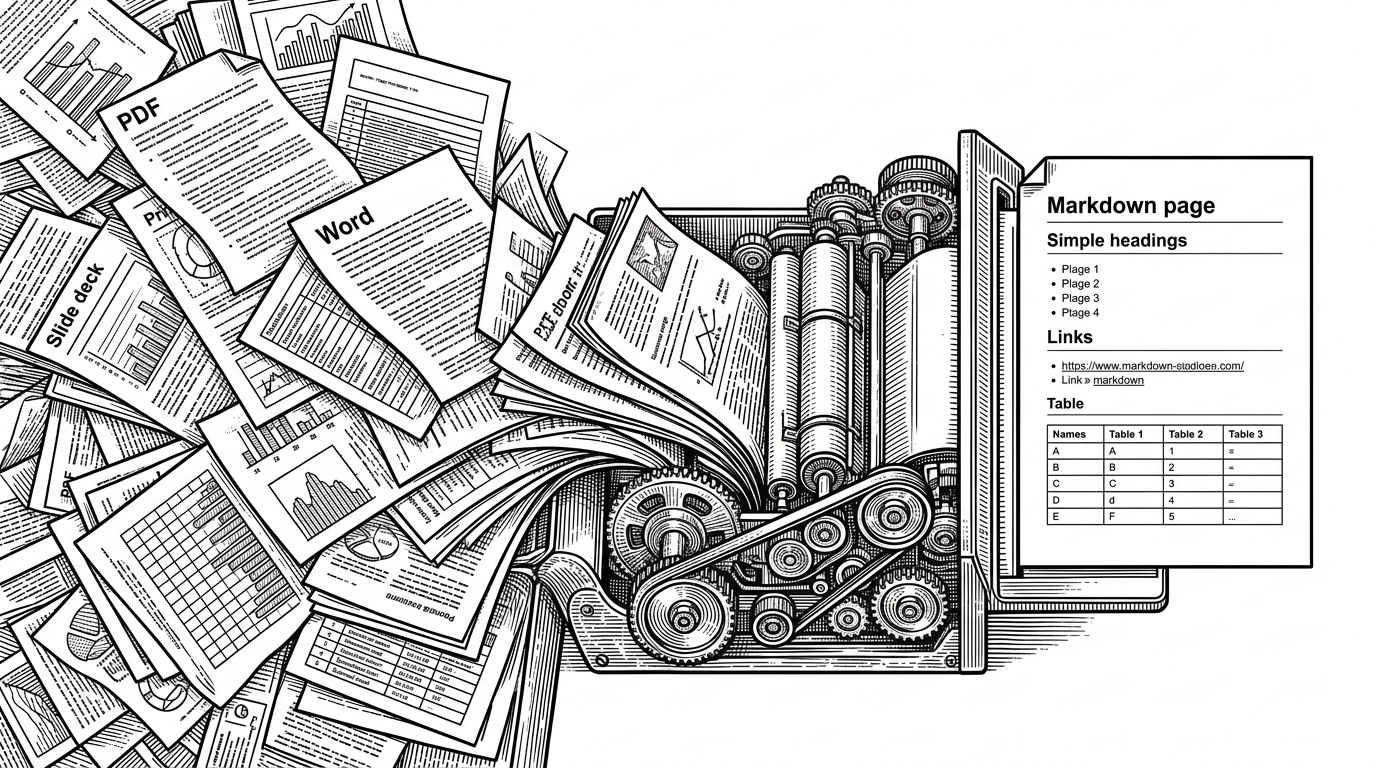
LLMOps_series: MultiDocChat: The Session-Scoped RAG Template That Treats Ingestion, Retrieval, and Evaluation as One System
A close look at how `yashprogrammer/LLMOps_series` turns multi-document chat into a portable, testable FastAPI stack with per-session FAISS indexes, LCEL retrieval, and LangSmith evaluations.
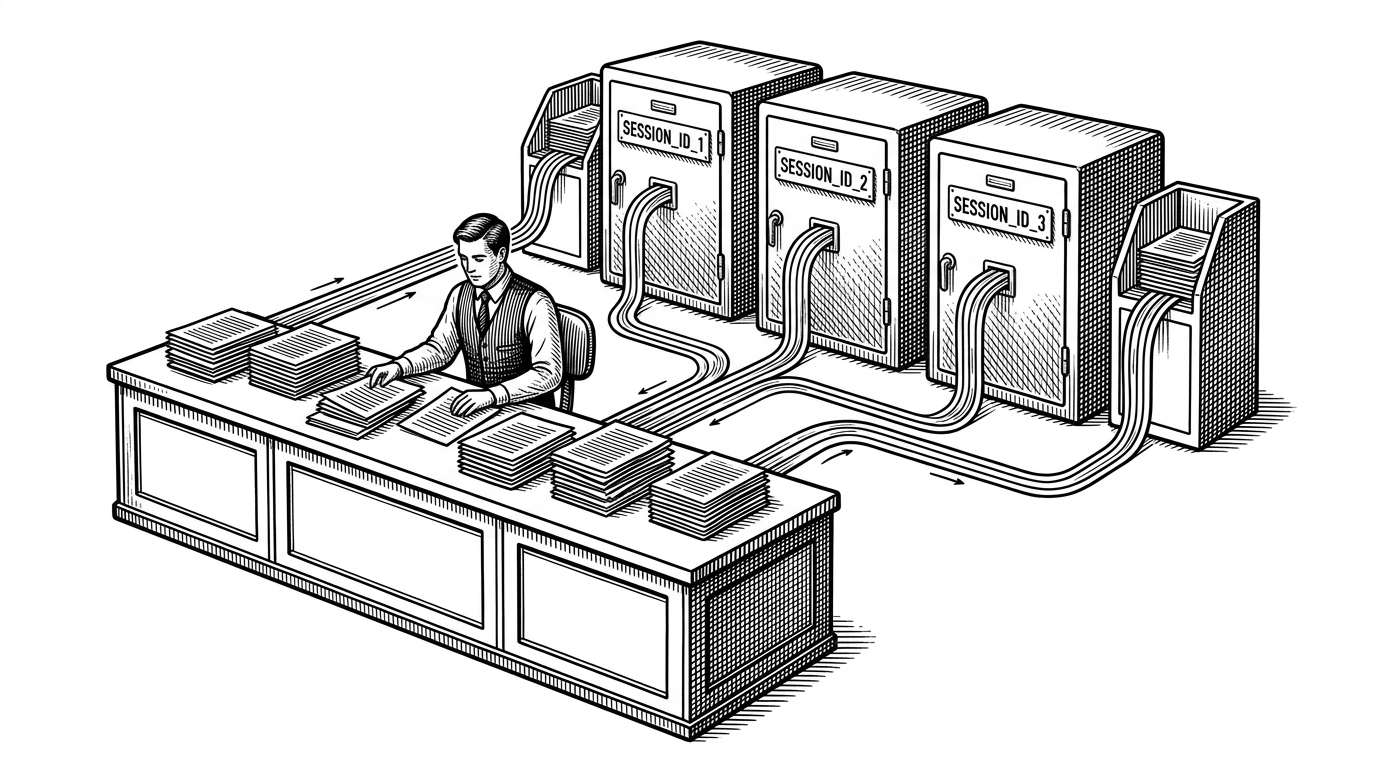
- MultiDocChat’s real contribution is session isolation, not another generic PDF chatbot.
- The repository treats ingestion, retrieval, and evaluation as one reusable pipeline instead of three separate demos.
- Question rewriting is the hidden step that makes conversational retrieval work cleanly across follow-up turns.
- The adapter pattern makes the core RAG logic portable across API, local testing, and evaluation runs.
Why Most RAG Demos Break the Moment Two People Use Them
Most RAG tutorials solve the easy problem: one user, one upload, one chat thread. The minute you add another person, or another document set, the app starts leaking context in ways that are hard to debug and easy to ignore.
That is why this repo matters. `yashprogrammer/LLMOps_series` is really a lesson in how to keep a RAG system sane when the input is not a single PDF, but a stream of sessions, each with its own files, index, and chat history. The UI is just the front door.
| Pattern | What it assumes | Where it fails |
|---|---|---|
| Single-demo chatbot | One corpus, one conversation | Cross-talk appears as soon as users or docs multiply |
| Similarity-only RAG | Nearest chunks are enough | Repetitive chunks crowd out coverage |
| MultiDocChat | Each session owns its own state | Requires careful routing, storage, and evaluation discipline |
The Session Boundary Is the Product
The architecture is built around `session_id`. Uploaded documents land in `data/<session_id>/`, and the corresponding FAISS index lives in `faiss_index/<session_id>/`. That is the difference between a notebook demo and something that can pretend to be a multi-tenant service.
The browser keeps the session key in localStorage, so the client keeps speaking the same identity back to the server. That small decision lets ingestion, retrieval, and chat history stay aligned without forcing every request through a heavyweight auth system.
# Conceptual shape of the isolation layer
session_id = get_or_create_session_id()
raw_dir = f"data/{session_id}"
index_dir = f"faiss_index/{session_id}"

# same session, same data path, same retriever state
ingestor = ChatIngestor(use_session_dirs=True)
vectorstore = FaissManager(index_dir=index_dir)
retriever = vectorstore.load_retriever(search_type="mmr")
That is the quiet win. The code makes the session boundary explicit instead of treating it as accidental state floating around the app.
Retrieval Is Not Just Search, It Is Question Rewrite, Then Search
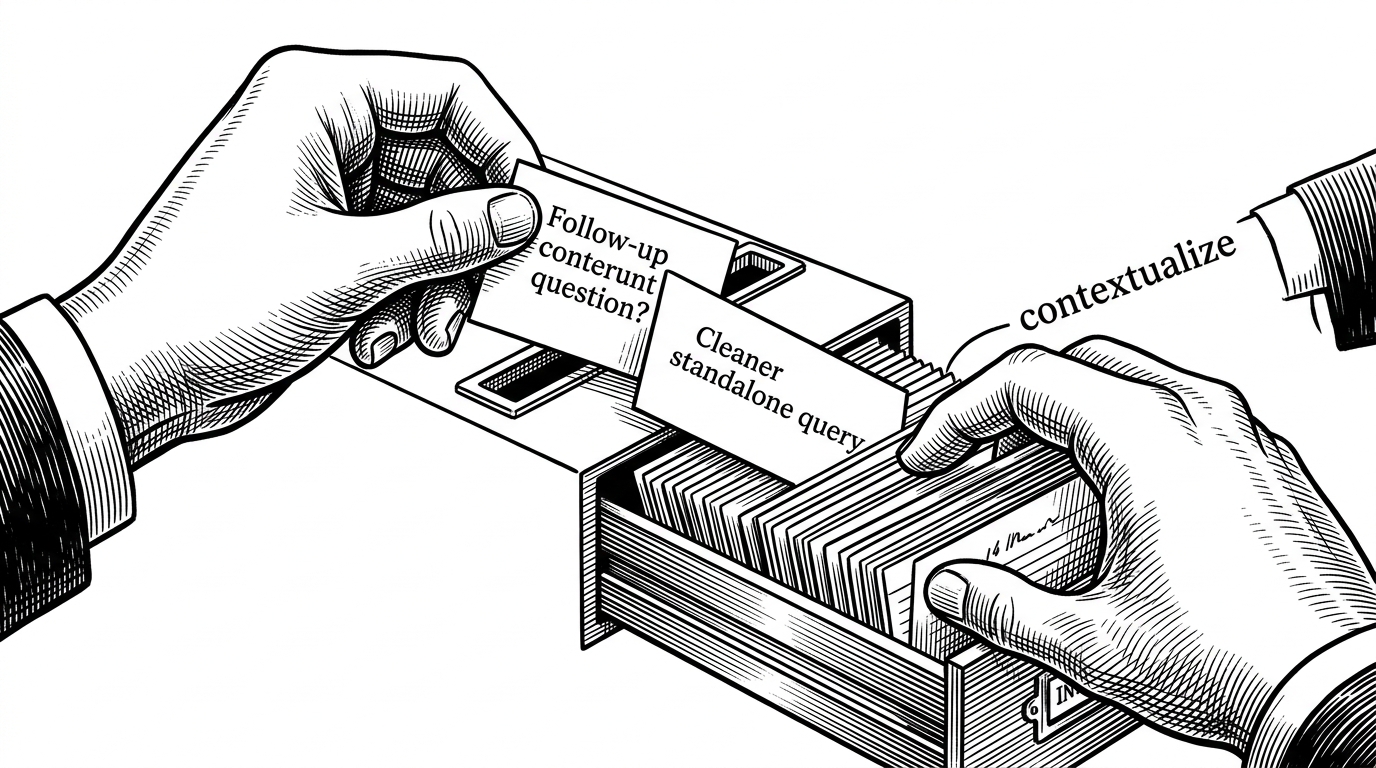
The most interesting part of the retrieval flow is not the vector store. It is the LCEL chain that contextualizes the latest user message against chat history, then sends the rewritten question to FAISS, then hands the retrieved context back to the model.
That makes the system tolerant of pronouns, omissions, and follow-up questions. Instead of assuming the latest user turn contains enough information, it converts conversational context into a cleaner retrieval query first.
# Simplified retrieval sequence
standalone_question = contextualize(chat_history, user_input)
chunks = retriever.get_relevant_documents(standalone_question)
answer = generate_answer(chunks=chunks, chat_history=chat_history, question=standalone_question)
This is a small design choice with big consequences. It reduces the chance that the retriever anchors on the wrong fragment just because the user said "that one" or "the earlier part".
| Stage | Naive RAG | MultiDocChat |
|---|---|---|
| Query handling | Latest message only | Rewrites follow-ups into standalone questions |
| Retrieval input | Raw chat text | Contextualized question plus history |
| Answer quality | Depends on lucky phrasing | More stable across conversational turns |
Why the Repo Prefers MMR
The default retriever choice is Maximal Marginal Relevance. That matters because it optimizes for coverage, not just closeness. The point is to avoid three near-duplicate chunks that all say the same thing in slightly different words.
That tradeoff is honest. MMR usually asks a little more of the system, but it gives the model a more varied evidence set. For RAG, that often beats raw nearest-neighbor purity.
| Retriever mode | Strength | Weakness |
|---|---|---|
| Similarity search | Fast and simple | Can return redundant chunks |
| MMR | More diverse context | Adds retrieval overhead |
| MultiDocChat default | Balanced evidence for answers | Needs tuning for corpus size |
The Adapter Pattern That Makes the Core Portable
The neatest engineering move in the repo is the adapter boundary. `FastAPIFileAdapter` wraps web uploads in a portable interface, while `LocalFileAdapter` lets the evaluation loop reuse the same ingestion path without pretending to be a browser.
That means the heart of the system does not belong to FastAPI. It belongs to the ingestion contract. Swap the interface, and the core stays intact.
# The point is portability, not the framework
adapter = FastAPIFileAdapter(upload_file)
# or
adapter = LocalFileAdapter(path_to_fixture)

result = ChatIngestor().ingest(adapter, session_id=session_id)
This is the kind of separation that makes a project easier to test, easier to extend, and easier to explain to the next engineer who inherits it.
The Ops Loop Is the Real Upgrade
The evaluation path is what pushes this repo beyond a clever demo. `run_evaluations.py` and LangSmith turn the same ingestion and retrieval pipeline into something measurable, not just shippable.
That matters because the best way to test a RAG app is often to run the same code path the user will hit. Separate mock logic is comforting, but it rarely tells you where the product actually breaks.
| Approach | How it behaves | What you learn |
|---|---|---|
| Toy chatbot | One-off prompts and manual checks | Whether the demo looks good |
| Eval-aware RAG | Reuses ingestion and retrieval paths | Whether the system survives real workflows |
| MultiDocChat | Session-scoped, measurable, repeatable | Whether the architecture can be trusted |
The repo does not just ask, "Can the model answer?" It asks, "Can this pipeline be run, replayed, and evaluated the same way every time?" That is a more serious question.
What This Stack Gets Right, and What It Still Leaves You to Solve
This repo is strongest where many RAG projects are weakest: state isolation, portable ingestion, and evaluation reuse. It is also honest about what it does not solve for you. Durable auth, long-lived chat persistence, and production-grade tenancy still need real system design around the scaffold.
That is not a flaw. It is the point. MultiDocChat is valuable because it exposes the joints instead of hiding them behind a managed abstraction.
| Option | Best at | Still on you |
|---|---|---|
| MultiDocChat | Clear architecture for session-scoped RAG | Auth, persistence, scaling policy |
| Managed platform | Fast setup and hosted primitives | Vendor constraints and opaque internals |
| One-PDF tutorial | Teaching first principles | Real isolation and evaluation discipline |
If you want a template for learning how production RAG systems actually stay organized, this is the kind of repo worth studying.