Aider: The Terminal Tool That Turns Git Into an AI Pair Programmer
A deep dive into how Aider constrains LLM edits, maps entire repos with Tree-sitter, and treats commits as a built-in undo system.


I built Aider because I wanted a way to use LLMs to help me write code that was integrated into my existing workflow. I spend a lot of time in the terminal, and I wanted a tool that would allow me to interact with an LLM without having to switch contexts.
- Aider’s real product is control, not novelty, because it wraps model output in Git-backed reversibility and constrained edit formats.
- Tree-sitter repo maps give the model structural context without flooding the prompt with whole files.
- The codebase assumes LLMs will make small mistakes, then builds repair logic that makes those mistakes survivable.
- Aider doubles as a benchmark harness, which makes model quality visible in edits rather than demo polish.
Aider’s pitch is simple: stay in the terminal, keep Git in the loop, and let an LLM make changes without taking over the whole workflow. That sounds modest until you realize the design is doing something most AI coding tools still struggle with. It turns a chatty model into a disciplined editor.
Git Is the Undo Button
Aider’s trust model starts with a practical insight: if the model is allowed to edit files, the safest place to land those edits is a Git repository. Every successful change can become a commit, which means the user gets a visible checkpoint instead of a mystery rewrite.
That changes the emotional tone of the tool. You are not asking an LLM to be perfect. You are asking it to make a bounded change in a system where rollback is cheap and obvious. That makes experimentation feel less like gambling and more like version control doing its job.
Why the Terminal Still Wins
Aider is terminal-first for a reason. The shell already sits next to Git, tests, linters, and deployment commands. A tool that lives there can fit into an existing developer loop instead of forcing a migration into a heavy editor or a separate web app.
| Dimension | Aider | IDE copilots | Generic chat tools |
|---|---|---|---|
| Primary surface | Terminal | Editor panel | Browser or app |
| Context source | Repo map plus selected files | Open buffers and workspace | Copied snippets or pasted files |
| Edit style | Constrained file edits and commits | Inline suggestions or plugin actions | Freeform generation |
| Safety model | Git checkpoints and rollback | Manual review, undo varies | User-managed copy and paste |
| Workflow fit | Unix-style composability | IDE-centered | One-off assistance |
That matters most when the task is iterative. Aider rewards the developer who wants to inspect, refine, test, commit, and move on without changing environments.
Aider Does Not Just Prompt the Model
Under the hood, Aider is closer to a policy engine than a chatbot. The `Coder` base class in `aider/coders/base_coder.py` manages the loop, the chat state, token accounting, and the rules for how edits should be requested and applied. Different coder strategies then specialize that loop for different models and different kinds of changes.
That strategy layer is the hidden architecture. In `aider/coders/`, Aider can choose search and replace blocks, whole-file edits, or a two-step architect flow where one model plans and another applies. The point is not elegance for its own sake. It is to match the edit format to the model’s strengths.
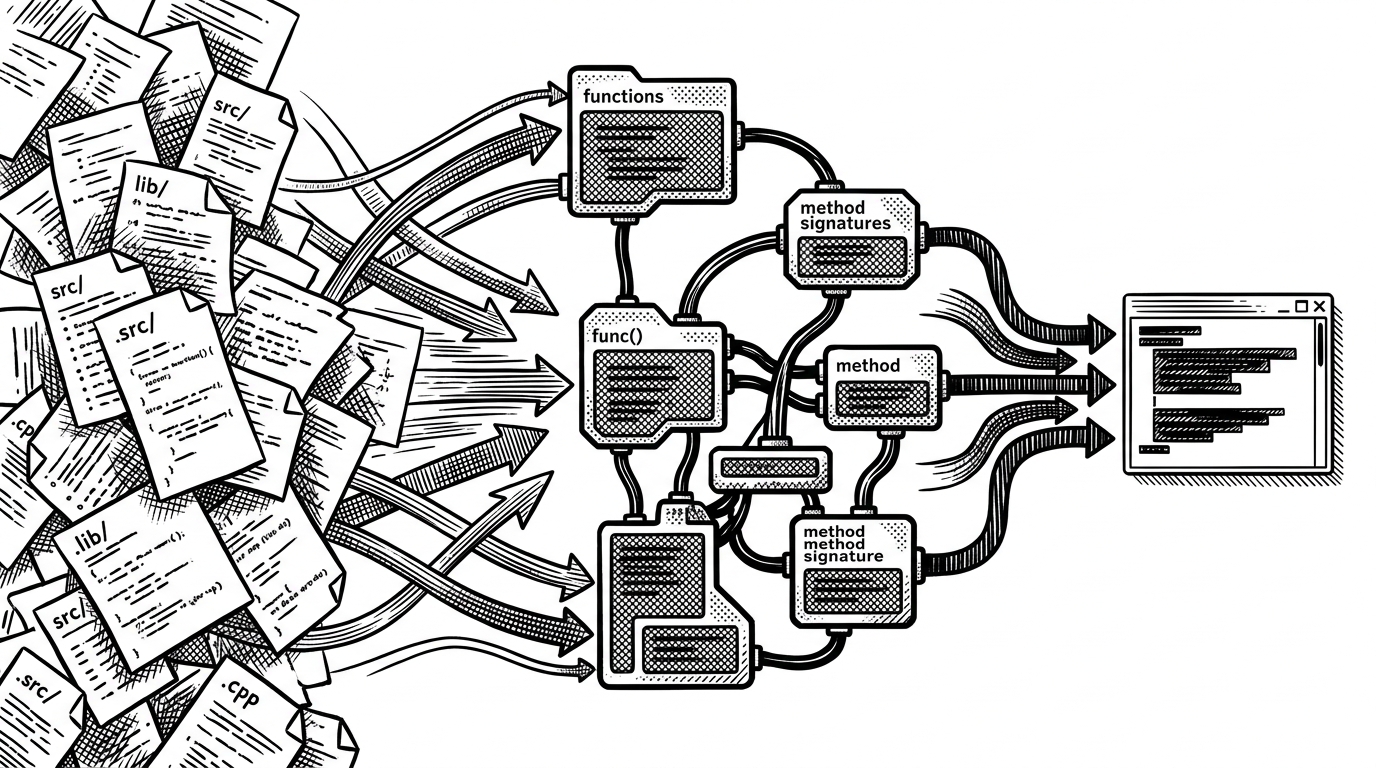
How Tree-Sitter Becomes a Repo Map
This is where Aider gets interesting. Instead of trying to stuff a whole codebase into the model’s context window, it uses Tree-sitter queries to extract signatures and structural metadata. Functions, classes, and methods become a compact map the model can reason about quickly.
That map is not a crude summary. It preserves the shape of the repository. The model can see where code lives, how pieces relate, and which files matter, while still leaving most of the raw source out of the prompt. That is a better answer to context limits than brute-force file dumping.
The repository map is the real context engine
Aider’s `repomap.py` turns structure into usable context, and the `aider/queries/` directory holds the Tree-sitter query files that make that extraction language-aware. The result is a compressed view of the codebase that feels IDE-like without becoming IDE-dependent.
The Clever Part Is Repairing Imperfect Edits
The edit loop in `aider/coders/editblock_coder.py` assumes an uncomfortable truth: LLMs will miss exact matches, drift on whitespace, or produce almost-correct replacement blocks. Aider does not pretend that will not happen. It builds repair logic around it.
That is why fuzzy matching matters. When the search block is close but not exact, Aider tries to recover with line similarity rather than failing immediately. This is less glamorous than prompting tricks, but it is the sort of engineering that makes the whole system dependable.
# Conceptual shape of Aider's edit flow
search_block = get_llm_search_block()
replace_block = get_llm_replace_block()

match = exact_match(search_block, file_text)
if not match:
    match = fuzzy_match(search_block, file_text)

if match:
    file_text = apply_replacement(file_text, match, replace_block)
    commit_change(file_text)
else:
    request_correction_from_model()
The cleverness here is restraint. Aider does not ask the model to be precise and stop there. It gives the model a second chance through validation and repair, then only writes the change when the edit is safe enough to trust.
Why Aider’s Benchmarking Matters
Aider is also a measuring instrument. Its website includes an LLM code editing leaderboard, and the project keeps model settings that tune which edit format works best for which model. That makes it both a tool and a test harness for comparing how models behave on real edits.
| Question | Aider’s answer | Why it matters |
|---|---|---|
| Which model edits cleanly? | Model settings and benchmarks | The tool encodes observed behavior, not marketing claims |
| Which edit format fits best? | Search/replace, whole-file, or architect mode | Different models need different guardrails |
| How do you know it worked? | Applied diff plus commit | Success is visible in Git, not just in chat |
That benchmarking culture changes the project’s posture. Aider is not only helping you code. It is accumulating evidence about which models are actually reliable at code change, which is a much harder standard than generating a plausible answer.
What the Singularity Metric Really Signals
The project’s self-reported Singularity score is a memorable detail because it says something about the team, not just the tool. Aider is built with deep dogfooding in mind. The software is being used to improve itself, which is a strong signal of product conviction and a fast feedback loop.
That also comes with trade-offs. A strongly singular codebase can move quickly, but it can also concentrate knowledge in one maintainer and raise the bus factor. Still, in Aider’s case, the metric reinforces the central thesis of the project: the system is meant to make AI-assisted coding not just possible, but operationally trustworthy.
Aider is the first AI coding tool that I've found to be genuinely useful. It's not a replacement for a human programmer, but it's a fantastic force multiplier. It's especially good at things like boilerplate generation and refactoring.