SKILL-GAP-ANALYSIS-AGENT: PrepMentor AI: The Placement Coach That Feels Like AI, but Runs on Rules
A local-first assessment app turns quiz answers into readiness scores, roadmap suggestions, and admin analytics without a real backend.
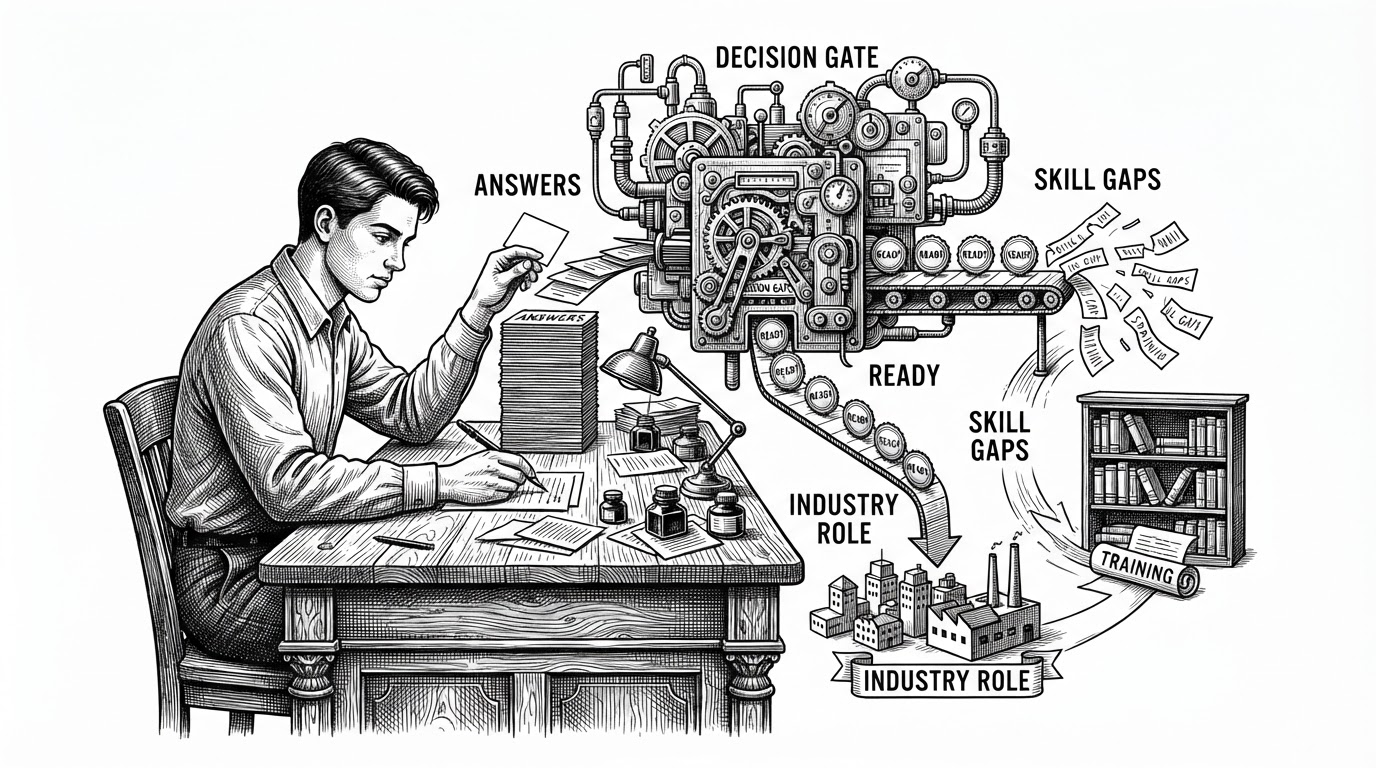
- PrepMentor AI feels like an intelligent placement coach because it converts structured answers into a readiness tier, a roadmap, and company targets.
- Its core trick is not generative AI but a deterministic rules engine that is easier to reason about, cheaper to run, and better suited to offline use.
- The local-first stack turns a student tool into a deployable product that can survive constrained environments without giving up polish.
- The admin analytics layer broadens the app from a single-user assessment into a cohort-level planning tool for educators and placement officers.
The app that behaves like a coach, not a quiz
The strongest thing about this repo is the experience. A student answers a set of questions, gets scored across categories, and lands on a readiness tier that comes with next steps, not just a number. That makes the app feel like a placement coach, even though the underlying machinery is much simpler than the branding suggests.
The repository describes itself as a skill-gap analysis agent, but the actual product shape is more useful than the label. It is less a chatbot and more a decision system: assess, classify, recommend, export.
Analyze your resume against job descriptions to identify missing skills. Receive curated course recommendations to bridge your skill gaps.
The secret is a rules engine, not a model
Under the hood, the app leans on plain JavaScript files that do one job each. questions.js defines the assessment bank, app.js calculates outcomes, and analytics.js turns the same data into cohort views. That division matters because the product’s intelligence is mostly encoded in rules, thresholds, and mappings.

That architecture gives the app three advantages. It is predictable, it is fast enough to feel immediate, and it can run with no live model call in the critical path. For a student-facing tool, that is a real product decision, not a compromise.
Why the local-first stack matters
The repo is built like a static SPA: HTML, vanilla JS, localStorage, and a lightweight PowerShell server for local development. That choice keeps the project portable, especially for users who may not want to install a bigger toolchain or depend on a cloud backend.
It also changes the trust model. A local-first flow makes assessment state feel owned by the browser, not borrowed from a remote service. For an educational product, that can be the difference between a demo and something a placement office might actually use.
| Dimension | PrepMentor AI | Typical cloud skill-gap app |
|---|---|---|
| Recommendation method | Deterministic rules and thresholds | LLM-generated analysis |
| Offline capability | Works with browser storage and a local server | Usually depends on network calls |
| Operational cost | Low | Higher, especially at scale |
| Behavior | Predictable and repeatable | Variable and prompt-sensitive |
| Primary audience | Students and placement staff | Often individual job seekers |
| Output style | Roadmap plus readiness badge | Narrative feedback or chat replies |
The PowerShell server is a subtle tell. It suggests the repo is optimized for environments where a student can launch a local host without asking for special infrastructure. That is not flashy, but it is thoughtful.
Analytics turns a student tool into an admin tool
The smartest extension in the repo is the analytics layer. Once the assessment data exists, the same records can be repackaged for placement officers as cohort-level insight: branch distribution, readiness spread, and success patterns. One workflow serves both the learner and the institution.
That dual-use design matters because it widens the product’s value without adding a second system. The student sees a roadmap. The administrator sees a dashboard. The data model stays small.
What this project gets right, and what it is still faking
The repo gets the product fundamentals right. The data is separated from the logic, the logic is separated from the presentation, and the output is polished enough to feel opinionated. That discipline is why the experience works.
What it is faking is the AI label. The current source reads more like a structured expert system than a generative agent. That is not a flaw. It is the reason the app can stay simple, deterministic, and cheap to run.
| Claim | What the code actually does | Why it matters |
|---|---|---|
| AI coach | Rule-based scoring and roadmap mapping | Gives consistent advice without inference overhead |
| Personalization | Category-specific thresholds and weak-skill detection | Creates tailored output from simple inputs |
| Intelligence | Predefined decision paths | Makes behavior easy to test and explain |
| Automation | Assessment plus PDF export plus analytics | Turns one pass through the UI into a reusable artifact |
Where it sits in the market
Compared with LLM-heavy skill-gap analyzers, PrepMentor AI is narrower but calmer. It gives up free-form language generation in exchange for control, speed, and offline resilience. Compared with enterprise HR suites, it is lighter, student-facing, and far easier to understand at a glance.
| Product type | Strength | Weakness |
|---|---|---|
| PrepMentor AI | Simple, local-first, explainable | Less flexible than model-driven tools |
| LLM skill-gap analyzers | Richer language and broader inference | More variability and infrastructure cost |
| Enterprise HR platforms | Deep workflow integration | Heavyweight and closed |
That niche is real. If your job is to help students understand whether they are placement-ready, you do not necessarily need a general-purpose model. You need a trustworthy answer, a readable next step, and a system that does not collapse when the network does.
Why this repo is worth watching
PrepMentor AI is a good template for a certain class of educational software. It proves that a product can feel personalized without being generative, and useful without being cloud-heavy. That is a strong lesson for anyone building trust-sensitive tools.
The deeper takeaway is strategic: not every assistant needs to hallucinate, chat, or call an API. Sometimes the better product is the one that turns a small set of inputs into a sharp, repeatable decision.