The Invisible Bridge: Inside the NVIDIA DLSS SDK
How a massive C-API orchestrates the shift from traditional rasterization to hardware-accelerated neural rendering.
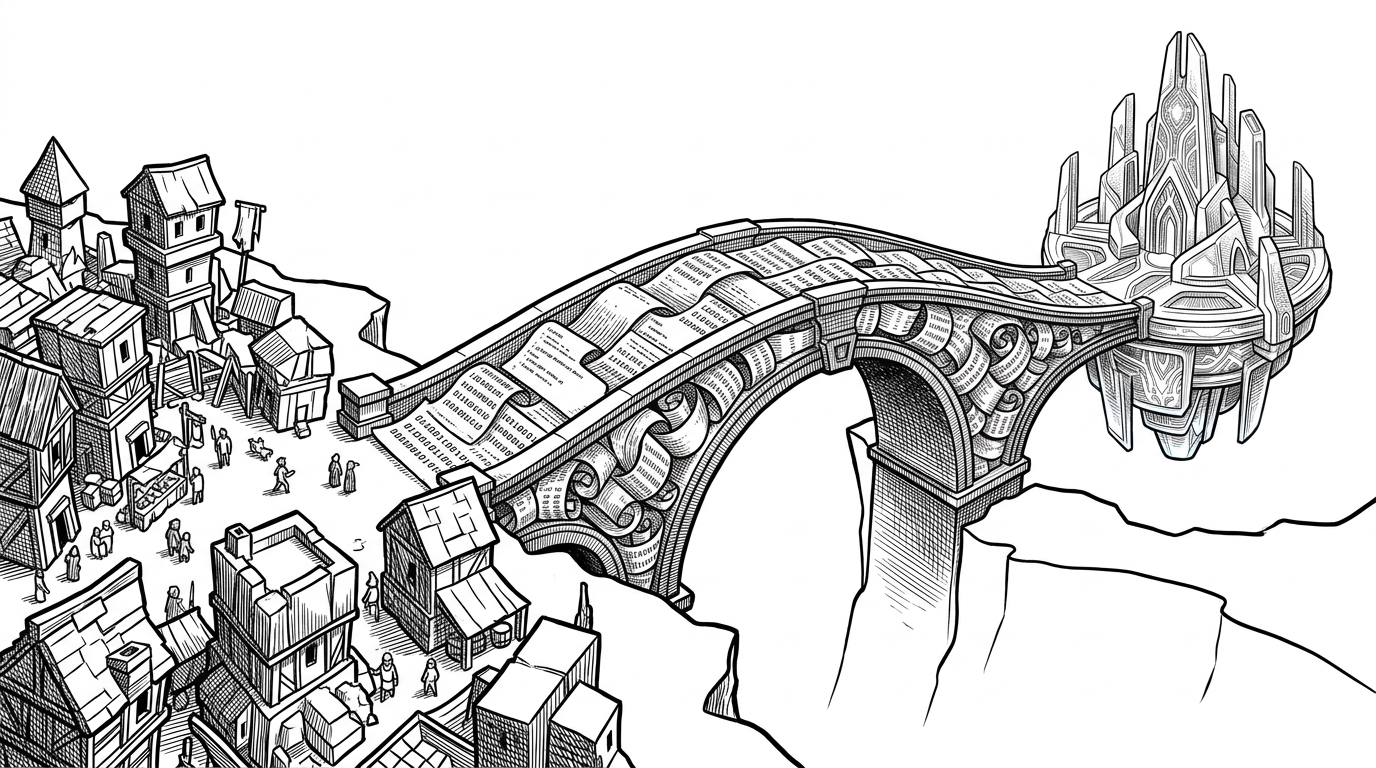
- The DLSS SDK uses a decoupled C-API to bridge static game binaries with rapidly evolving, private neural models.
- Modern neural rendering requires the game engine to provide complex physical data including motion vectors and camera clip-space matrices.
- Developers must implement precise sub-pixel camera jitter to provide the AI with the temporal samples necessary for image reconstruction.
- NVIDIA prioritizes proprietary hardware acceleration over cross-vendor compatibility to maintain control over the execution environment.
The API as an Air Gap
Look inside the DLSS repository and you will not find a neural network. You will find an intricate, 360-kilobyte wall of C code. The repository is a public-facing wrapper for a strictly private brain. It solves a massive distribution problem. Game engines compile into static binaries that ship on discs and digital storefronts, but AI models evolve weekly. Tying the two together directly guarantees a fragile system.
NVIDIA solves this with the Next Generation Image Experience (NGX) framework. At its core is NVSDK_NGX_Parameter, a string-keyed black box container. Instead of passing rigid data structures, the game engine asks the driver to set or get values by name. This decoupled architecture ensures a game compiled years ago can interface seamlessly with a DLSS model released tomorrow.
Beyond Pixels: The Data Hunger of DLSS 3.5
Early upscaling algorithms asked for a single frame and made it larger. Modern neural rendering asks for context. A deep dive into nvsdk_ngx_defs_dlssg.h and nvsdk_ngx_defs_dlssd.h reveals the escalating data demands of features like Frame Generation and Ray Reconstruction.
The API contract now requires game developers to feed the beast with depth buffers, motion vectors, and exposure values. Frame Generation even demands camera clip-space matrices. The AI is not just looking at the picture. It is reconstructing the physical math of the virtual camera.

The Jitter Symphony
The most human element of the SDK is its obsession with sub-pixel movement. The repository includes utilities like DLSS_Debug_Jitter_Configs.txt to manage a concept called jitter. To reconstruct a high-resolution image from low-resolution inputs, the neural network needs slightly different samples of the scene over time.
Game developers must intentionally offset their camera projection matrix by fractions of a pixel every frame. If the jitter pattern is mathematically misaligned with what the AI expects, the resulting image shimmers and hallucinates. The SDK provides the exact mathematical phases required to keep the AI grounded in reality.
The Neural Arms Race
The approach taken by NVIDIA stands in stark contrast to the open-source alternatives. AMD's FidelityFX Super Resolution (FSR) and Intel's XeSS prioritize cross-vendor compatibility. They are designed to run on almost any modern hardware. NVIDIA restricts DLSS to its proprietary Tensor Cores.
| Feature | NVIDIA DLSS | AMD FSR (Open) |
|---|---|---|
| Core Approach | Hardware-accelerated deep learning | Algorithmic / AI-hybrid (FSR 4) |
| Hardware Requirement | NVIDIA RTX (Tensor Cores) | Vendor-agnostic (Any modern GPU) |
| Code Visibility | API Headers only (Black Box) | Fully open-source shaders |
| Primary Advantage | Image stability and path-tracing viability | Universal access and console support |
This hardware-software synergy allows DLSS to offload complex transformer models without crippling the main GPU rendering pipeline. It is a calculated trade-off. NVIDIA sacrifices universal reach for absolute control over the execution environment.
The Future of Generative Frames
As the technology evolves into DLSS 5, the boundary between rendering and generating blurs. The newest iterations move beyond upscaling pixels to generating entire textures and geometry based on 2D inputs. This shift has sparked fierce debate regarding artistic intent versus AI interpretation.
Yes, DLSS 5 takes a 2D frame plus motion vectors as input.
NVIDIA maintains that these advancements provide developers with unprecedented tools. The core philosophy remains unchanged. The SDK will continue to serve as the stable, versioned bridge between the creative intent of the game engine and the immense generative power of the driver.
The reason for that is because, as I have explained very carefully, DLSS 5 fuses controllability of the geometry and textures and everything about the game with generative AI