LinkGrid Agent: The Thin Python SDK That Hides a Pooled Transport, a Tiny Cache, and a Locked-Down Persona
A close look at an async BitNet client that squeezes performance out of a global HTTP pool, keeps dependencies minimal, and bakes product identity into the default prompt.
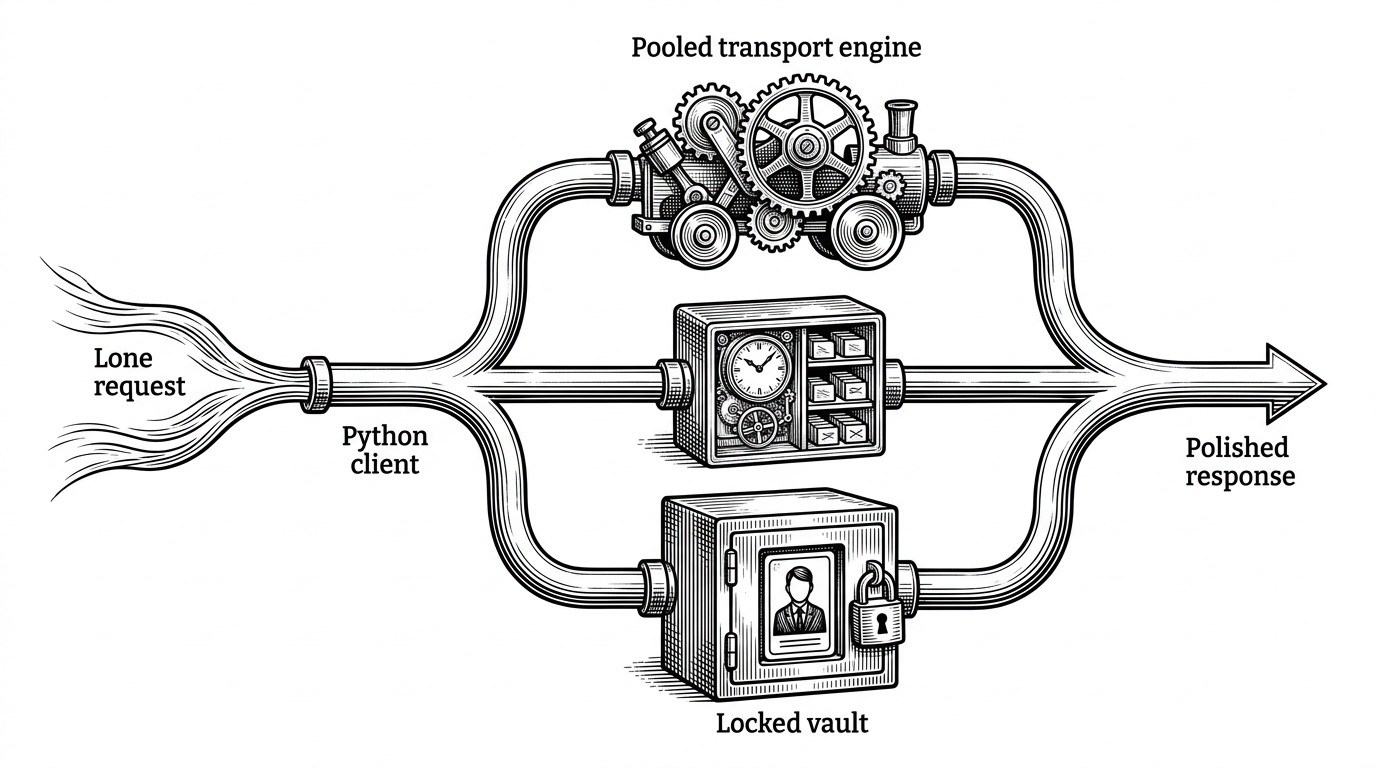
- LinkGrid Agent is less like a wrapper and more like a set of deliberate product constraints that happen to speak Python.
- Its shared async transport and tiny TTL cache are the real performance story, because they keep repeated requests cheap without adding infrastructure.
- The default persona is not decoration, it is a policy boundary embedded directly in the client.
- The repo sits in a narrow middle ground between heavyweight AI frameworks and bare HTTP shims.
Why this SDK feels smaller than it is
LinkGrid Agent looks like a simple async Python SDK, but the code is doing three jobs at once. It reuses network connections, keeps repeat work in memory, and ships with a default identity that is already opinionated before the caller writes a prompt.
That combination matters because it changes the shape of the client. This is not a generic API wrapper that forwards bytes and gets out of the way. It is a thin layer that tries to make repeated calls cheaper, safer, and more predictable.

A global AsyncClient is doing more work than it looks like
_global_client = None
_client_lock = asyncio.Lock()

async def get_client():
    global _global_client
    if _global_client is None:
        async with _client_lock:
            if _global_client is None:
                _global_client = httpx.AsyncClient(http2=True)
    return _global_client
That pattern is doing a lot of work. The lock prevents duplicate initialization, the global client keeps connections warm, and HTTP/2 gives the transport room to reuse a single session for repeated calls. For a small SDK, that is a big lever.
The cache is tiny, manual, and intentional
The cache logic is not trying to be a platform. It is an in-memory TTL map with a five-minute window and a cleanup rule that keeps the store bounded. That is a strong signal about the repo's philosophy: keep state local, cheap, and easy to reason about.
if len(_response_cache) > 100:
    oldest_key = min(_response_cache.keys(), key=lambda k: _response_cache[k][1])
del _response_cache[oldest_key]| Approach | What it buys | What it avoids |
|---|---|---|
| Tiny TTL cache | Low latency on repeat requests | Redis, disk state, and extra ops |
| Shared memory only | Simple deployment | Cross-process durability |
| Bounded cleanup | Predictable memory use | Unbounded growth |
The point is not sophistication. The point is that the cache matches the rest of the client. The repo keeps the dependency surface small, so the cache follows the same rule instead of outsourcing state management to a second system.
The default prompt is part of the product
This is where LinkGrid Agent becomes more than infrastructure. The default configuration hardcodes a persona, and that means the SDK is enforcing identity before the application layer has a chance to negotiate it. In practical terms, the client is not only sending requests. It is also defining how the assistant should speak and what it should not reveal.
That is unusual for a library, but it is coherent for a product ecosystem. If the goal is to make every downstream integration feel like the same assistant, then the client is a policy boundary, not just a transport shim.
A lot of SDKs treat prompt settings as caller-owned. LinkGrid Agent pushes that control downward. That choice makes the repo opinionated, and it also makes the product story clearer: this is a branded assistant surface, not a neutral API gateway.
Streaming is treated like a first-class path
The streaming path is built as a real user experience, not an afterthought. Buffer sizing, SSE handling, and explicit error branches all point to a client that expects long-lived responses and wants to keep them moving cleanly through the pipe.
buffer_size = 8192

try:
    async for chunk in response.aiter_bytes(buffer_size):
        ...
except (httpx.RequestError, json.JSONDecodeError, httpx.HTTPStatusError):
    ...
That kind of code tells you who the client is for. It is for repeated conversational interactions, where responsiveness matters and where failures need to be contained without collapsing the whole flow.
What it looks like next to heavier AI client patterns
LinkGrid Agent sits between two familiar extremes. It is lighter than framework-heavy stacks and more opinionated than a raw HTTP wrapper. That middle ground is the point.
| Dimension | LinkGrid Agent | Framework-heavy AI SDK | Bare API wrapper |
|---|---|---|---|
| Dependency weight | Very low | High | Very low |
| Async-first design | Yes | Sometimes | Usually minimal |
| Connection reuse | Explicit shared client | Abstracted away | Often caller-managed |
| Streaming support | Built in | Built in | Variable |
| Cache strategy | Tiny manual TTL | Often externalized | Usually absent |
| Persona control | Hardcoded default prompt | Config-driven | Caller-owned |
| Operational complexity | Low | Medium to high | Low |
The interesting comparison is not feature count. It is control. Heavy frameworks buy abstraction, while bare wrappers buy simplicity. LinkGrid Agent chooses a narrow band in the middle, where the transport is optimized, the cache is explicit, and the identity layer is already decided.
What this repo signals about its stage
The maturity signals are mixed in a useful way. The versioning is still early, the contributor set is small, and the code shows some rough edges. At the same time, the package has clean type hints, thoughtful async resource management, and modern publishing setup through trusted PyPI release tooling.
That combination reads as an active, focused project rather than a finished platform. It is the kind of repository where the technical choices are already clear, but the surrounding ecosystem still feels like it is being assembled.
The takeaway: this is an SDK shaped like a product decision
LinkGrid Agent is interesting because it treats a Python client as a place to concentrate policy. The transport is pooled, the cache is bounded, and the persona is locked down. Those are not random implementation details. They are the product's shape, expressed in code.
If you want to understand the repo in one sentence, this is it: small code can still make big decisions, and here those decisions are about speed, state, and identity.