PoloNX/SwitchU and the Underground Art of Console UI Engineering
How a custom C++ framework and a clever two-process architecture hijacked the Nintendo Switch to resurrect the beloved Wii U interface.
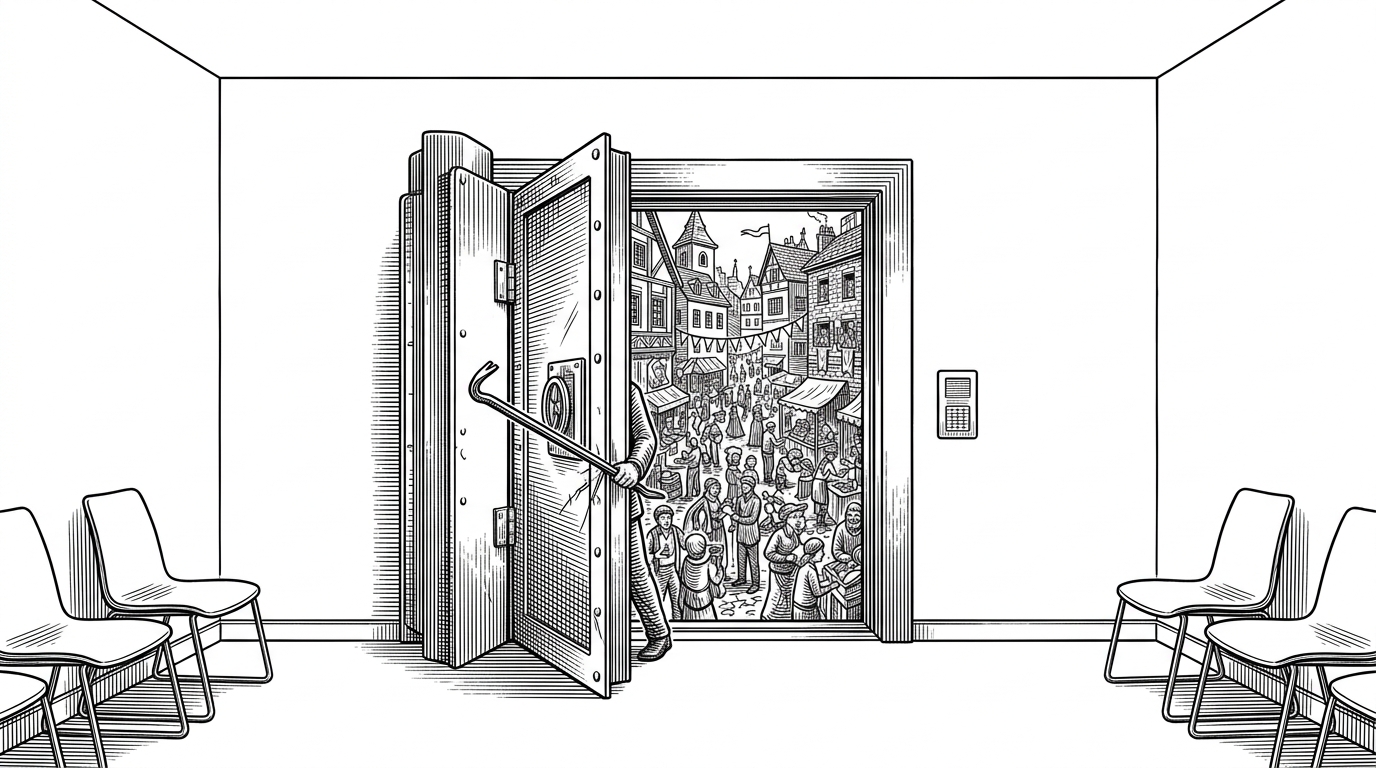
- SwitchU circumvents the Nintendo Switch's strict single-applet limitation by splitting itself into a persistent background daemon and an on-demand foreground UI.
- The project abandons heavy generic UI libraries in favor of a bespoke C++20 framework built directly on the console's Maxwell GPU.
- To prevent fatal system crashes, the custom OS must manually reconstruct deeply nested save data hierarchies before allowing any game to boot.
- A flexible Xmake build system allows developers to compile the exact same codebase as either a safe testing app or a dangerous system-replacing daemon.
The Nostalgia Hack
The Nintendo Switch operating system, Horizon OS, is famously sterile. It is a silent, minimalist grid designed to get out of the way as quickly as possible. The Wii U, by contrast, was a chaotic, socially dense, audio-rich environment anchored by the WaraWara Plaza. For a specific subset of developers, the silence of the Switch is a canvas begging to be painted over.
A project to reimplement qLaunch with a new interface resembling that of the Wii U is currently in development for the Switch Here is a preview of SwitchU, developed by @PoloNX https://t.co/5pbxec1Ikc
SwitchU is not a simple skin. It is a fundamental system-level modification that replaces the native home menu entirely. Achieving this required bypassing the artificial constraints of a console designed to prevent exactly this kind of tampering.
The Two-Applet Dance
The hardest technical hurdle in replacing the Switch home menu is the console's strict applet model. Horizon OS only permits one Library Applet to hold focus at a time. If a custom menu tries to launch a game, the system must kill the menu to free up resources, leaving nothing to return to.
SwitchU solves this by splitting itself in two. It runs a persistent background daemon as a System Applet and an on-demand UI as a Library Applet. When the user presses the HOME button, the daemon intercepts the signal and spawns the menu. When a game launches, the menu hands control back to the daemon, which orchestrates the transition.
Forging NXUI on Locked Metal
Generic UI libraries like Dear ImGui are too heavy or aesthetically rigid to recreate the Wii U's frosted glass look. Instead, the developer built NXUI, a bespoke C++20 framework. It abstracts rendering and input handling, pushing pixels through custom GLSL shaders via the deko3d backend to leverage the Switch's Maxwell GPU.
The Silent Guardian of Save Data
If a custom homebrew launcher tries to start a game, it usually crashes. The official OS normally handles the invisible work of building nested save data directories before a title boots. SwitchU must do this manually. The code meticulously constructs the Account, Device, and Cache data hierarchies dynamically, ensuring the game finds exactly what it expects upon launch.
The Xmake Escape Hatch
Developing a system-level replacement on a console means every bug causes a hard crash and a tedious reboot. To maintain velocity, SwitchU utilizes Xmake to manage its complex build targets.
| Feature | Standard Homebrew | SwitchU Architecture |
|---|---|---|
| Execution Context | Foreground App | System Applet + Library Applet |
| System Privileges | Userland | Root/Admin equivalent |
| Crash Consequence | Return to OS | Hard Console Reboot |
| Rendering Target | High-level wrappers | Low-level deko3d |
By toggling a single flag, the developer can collapse the entire multi-process system into a safe, monolithic application for rapid UI iteration, saving countless hours of reboot cycles.