last_year_project: The Fitness Coach That Thinks in Angles, States, and Timers
A deep dive into an AI exercise system that keeps pose tracking local, turns motion into finite-state logic, and uses simple math to do surprisingly disciplined coaching.
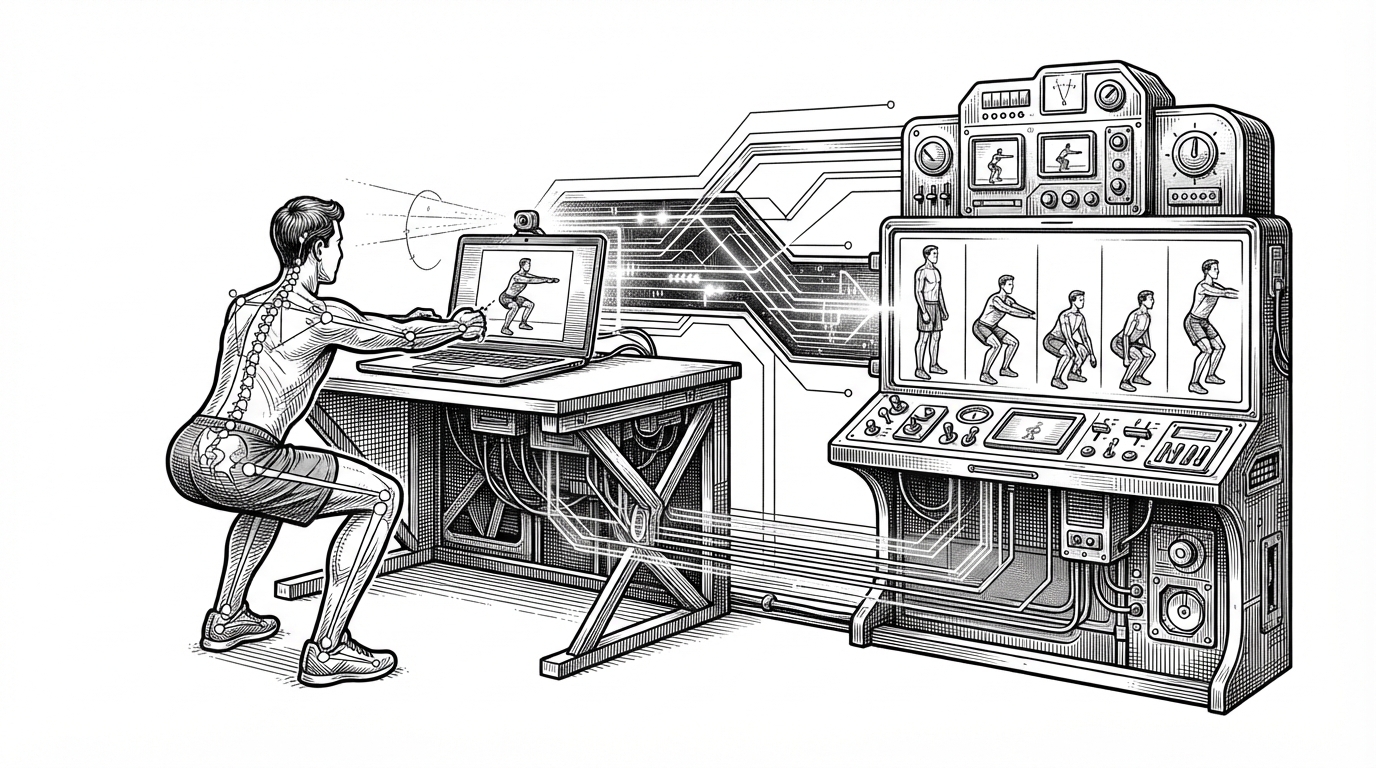
- last_year_project treats exercise as a control problem, not a recognition demo.
- Its biggest advantage is that joint-angle math, smoothing, and state machines make coaching deterministic and explainable.
- Running pose logic in the browser keeps feedback immediate and keeps video on device.
- The architecture is narrow by design, which is exactly why it can be reliable for curls, holds, and other constrained movements.
A workout coach that never guesses
The most interesting thing about last_year_project is not that it sees a body. It decides what that body is doing, frame by frame, with a chain of explicit rules. A curl only counts when the angle, the timing, and the posture all agree.
That makes the system feel less like an AI demo and more like a control loop. Webcam motion comes in noisy. The software smooths it, measures it, classifies it, and only then decides whether to speak, count, or warn.
Why the math matters more than the model
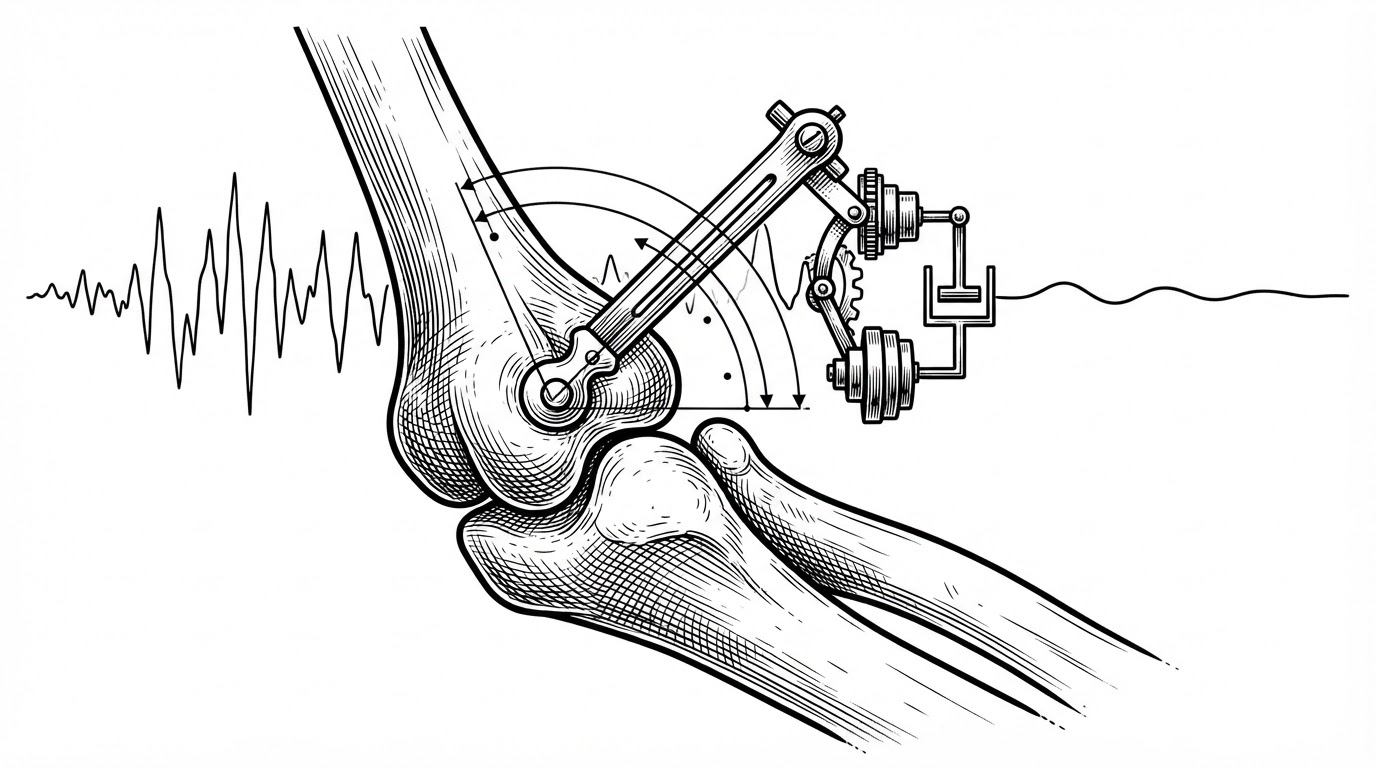
The geometry choice is the first clue that this repo values stability over spectacle. Instead of relying on a more fragile angle trick, it uses vector dot products and arccos to keep joint angles in a predictable 0 to 180 degree range. That matters when an elbow flexion curve should not suddenly flip because a webcam frame jitters.
// Stable joint angle calculation
function calculateAngle(a: Point, b: Point, c: Point): number {
  const ab = { x: a.x - b.x, y: a.y - b.y };
  const cb = { x: c.x - b.x, y: c.y - b.y };

  const dot = ab.x * cb.x + ab.y * cb.y;
  const magAB = Math.hypot(ab.x, ab.y);
  const magCB = Math.hypot(cb.x, cb.y);

  const cosine = dot / (magAB * magCB);
  const angle = Math.acos(Math.min(1, Math.max(-1, cosine)));

  return angle * (180 / Math.PI);
}

// EMA smoothing reduces frame-to-frame jitter
smoothed = alpha * current + (1 - alpha) * previous;
That math gets paired with exponential moving average smoothing, which is doing more work here than a casual reader might expect. Webcam pose estimates wobble. A rep counter cannot afford to wobble with them. Smoothing turns raw signal noise into something the thresholds can trust.
Movement becomes a state machine
This is where the repo stops being a pose tracker and becomes a rule engine. The curl tracker does not ask whether the model thinks the arm looks like a curl in some vague sense. It waits for a sequence: extended, curling_up, peak, lowering_down. That sequence is what makes the rep count feel disciplined instead of approximate.
The same pattern appears in the other trackers. Tree pose is not just a snapshot of balance. It is a progression through phases, with timers, leg switching, and completion logic that make the exercise legible to the machine.
| Question | State-machine approach | Typical opaque fitness AI |
|---|---|---|
| How a rep is represented | A named sequence of thresholds and phases | A learned score or confidence output |
| When feedback happens | At explicit transitions and timer gates | Whenever the model emits a response |
| How cheating is handled | Rules such as body swing or incomplete extension | Often folded into a single confidence drop |
| What the user can inspect | The state and the trigger are visible | The decision is harder to explain |
| Where it works best | Constrained movements with clear form criteria | Broader scenarios with less deterministic motion |
That difference is subtle but important. A state machine is narrower than a model, but it is also more honest. If the exercise has clear phases, the software can say exactly why a rep counted or failed.
The browser is the backend for feedback
The architecture keeps the hard part local. The frontend owns the camera, pose model, smoothing, and rep logic. The backend handles the things that benefit from persistence: accounts, schedules, exercise records, and doctor-patient coordination. In practice, that means the user gets immediate feedback without shipping every frame to a server first.
| Dimension | Browser-side exercise engine | Cloud-heavy fitness AI |
|---|---|---|
| Latency | Immediate local feedback | Depends on network and server round trips |
| Privacy | Video can stay on device | Video often traverses a remote service |
| Cost | More device work, less server load | More backend infrastructure and inference cost |
| Failure mode | Narrow, deterministic, explainable | Broader, but harder to debug |
| User trust | Easier to reason about what happens locally | Requires more confidence in the service pipeline |
What it gets right, and what it gives up
The tradeoff is obvious once you look at the architecture honestly. A deterministic system is strong when the movement is constrained and the rules are well chosen. It is weaker when the motion is messy, the camera is poor, or the exercise does not fit the predefined state machine.
That is not a flaw so much as a boundary. The project is choosing repeatability over generality. It will almost always be better at a narrow exercise than a vague all-purpose coach, because it knows exactly what kind of motion it is trying to measure.
- Local inference gives quick feedback, but it asks more of the client device.
- State machines are transparent, but they are less flexible than learned judgments.
- Calibration improves fairness across body types, but it also narrows the startup flow.
- Voice cue prioritization reduces noise, which makes the coaching feel calmer and more usable.
That last point is easy to miss. The project is not just counting. It is curating feedback. Prioritized cues, calibration frames, and distance-normalized checks all point to the same design instinct: reduce noise until the user can actually act on what the system says.
Why this architecture feels durable
The repo’s strongest quality is not novelty. It is discipline. Angle math instead of guesswork. Smoothing instead of jitter. Thresholds instead of vibes. Those choices add up to software that can explain itself, which is rare in fitness products and even rarer in AI products.
That is why last_year_project feels more durable than a flashy demo. It treats human movement as something that can be modeled, checked, and improved in software without pretending the model has magic intuition. The result is a coach that feels specific enough to trust.