Legal-Simplifier: The Open-Source Legal Copilot That Speaks Hinglish and Caches the Fine Print
A fast, document-grounded tool for turning contracts into plain language, scoring risk, and answering follow-up questions without losing context.

Priyanshi's ultimate goal is to become a competent technology entrepreneur and use NLP to create sustainable solutions that make the world a better place to live.
- Legal-Simplifier is interesting because it turns legal review into a grounded conversation instead of a one-shot summary.
- Its real product trick is not the model, but the loop that extracts text in the browser, hashes it, caches analysis, and reuses that result in chat.
- The Hinglish layer matters because the app is built for comprehension, not just translation, which fits how many Indian users actually read legal text.
- The project is strongest when it is transparent and localizable, but it still leaves hard questions about legal accuracy, evaluation, and liability.
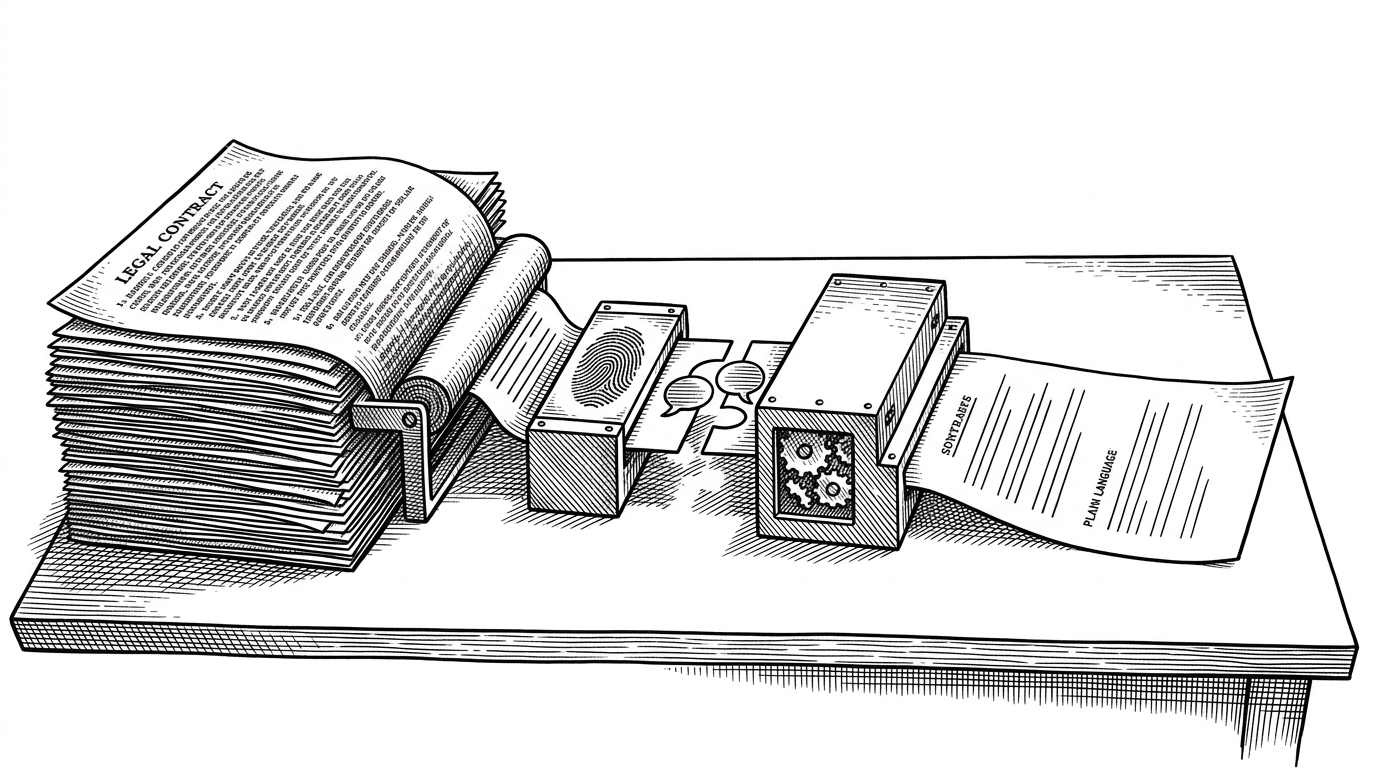
Most legal AI tools promise simplification. Legal-Simplifier does something more specific: it tries to make legal review feel like a fast, cached conversation for Indian users who live between English contracts and everyday comprehension. That distinction matters. It is the difference between a demo and a tool with a job to do.
When a contract becomes a conversation
The obvious feature is document simplification. The more interesting one is continuity. A user uploads a PDF, gets a risk score, sees clause-level explanations, and can keep asking questions without starting over.
That makes the app feel less like a summarizer and more like a legal copilot with memory. The interface is trying to solve a trust problem as much as a language problem: it wants the answer to stay attached to the document that produced it.
Why this is built for Indian users, not just generic AI users
The repo’s language support is the giveaway. Legal-Simplifier explicitly supports Hindi, English, and Hinglish, which is a better fit for many Indian users than a single clean English translation. Legal documents may arrive in formal English, but understanding often happens in a hybrid register.
That is a product insight, not just a localization checkbox. It acknowledges that comprehension and source language are not the same thing.
| Typical legal AI tool | Legal-Simplifier |
|---|---|
| One language, usually polished English | Hindi, English, and Hinglish support |
| Generic plain-language output | Output shaped for Indian users |
| One-shot summary | Follow-up chat grounded in the same analysis |
| Black-box convenience | Open-source transparency and customization |
The clever part: the app does not re-read the same document twice
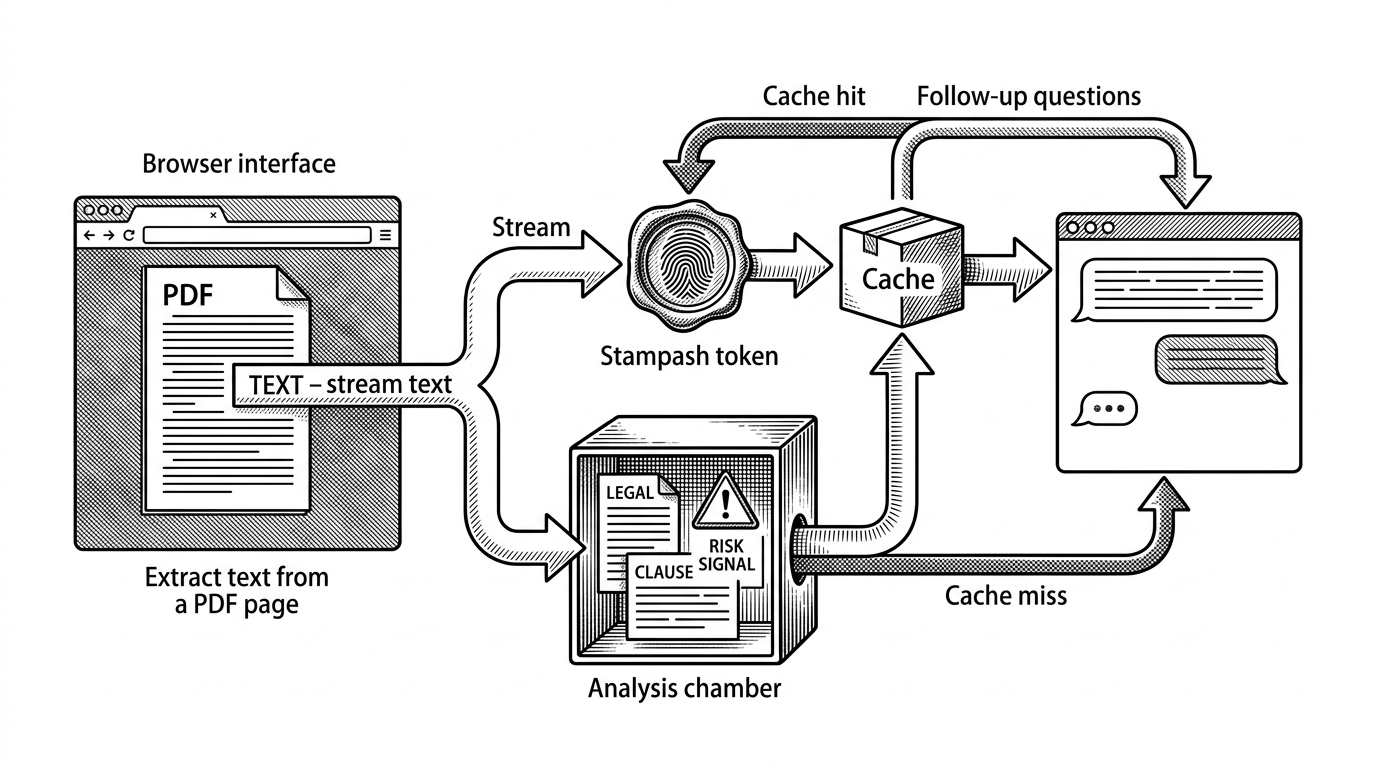
The core efficiency trick is SHA-256 document caching. Before paying for another model call, the backend hashes the document text and checks whether the same user has already analyzed that exact content. If the hash matches, the app can return the stored analysis instead of running Groq again.
That saves latency and API cost, but it also shapes the product experience. Users are not punished for revisiting the same contract, and the system does not behave like a stateless chatbot that forgets everything between questions.
const textHash = crypto.createHash('sha256').update(documentText).digest('hex');
const cached = await Analysis.findOne({ userId, textHash });

if (cached) {
  return res.json({ analysis: cached, cached: true });
}

const analysis = await analyzeDocument(documentText, language);
await Analysis.create({ userId, textHash, ...analysis });
return res.json({ analysis, cached: false });
How the analysis pipeline stays grounded
The app’s technical stack is straightforward, but the ordering is what matters. PDF.js extracts text in the browser. The backend sends that text to Groq for structured analysis. MongoDB stores the result. The chat route then injects the stored analysis into the system prompt so follow-up answers stay tied to the original clauses, summary, and risk score.
That is the right architecture for a legal assistant. The model is not asked to reinvent the document every time. It is asked to reason over a fixed, already analyzed artifact.
The repository also shows an important product choice: it favors lightweight client-side extraction over heavy server-side document processing. That keeps the backend simpler and reduces unnecessary file handling on the server.
What the risk score is really doing
Legal-Simplifier converts a numerical risk score into a letter grade and safety rate. That is a design move, not just a UI flourish. It turns a slippery model output into something a non-expert can read quickly.
There is a trade-off. Simplifying uncertainty can make the output feel more decisive than it really is. But for a consumer-facing legal tool, the alternative is often worse: technically correct language that no one can act on.
| Output shape | User effect |
|---|---|
| Raw risk score | Hard to interpret at a glance |
| Letter grade plus safety rate | Fast mental model for non-experts |
| Clause list only | Useful but incomplete |
| Score plus clauses plus chat | Actionable and contextual |
Open source versus commercial legal simplifiers
In the commercial lane, tools like Junia AI Legalese Translator, Legalese Decoder, and Docusign AI sell convenience and polish. In the research lane, projects like lex-simple explore legal text simplification from a more academic angle. Legal-Simplifier sits between them.
Its edge is transparency. You can inspect the flow, swap the model layer, localize the language strategy, and adapt the app to a specific legal context. That is not just an open-source virtue. It is a practical advantage in a domain where trust matters.
| Tool | Positioning | What it optimizes for |
|---|---|---|
| Legal-Simplifier | Open-source legal copilot | Grounded chat, caching, Hinglish support |
| Junia AI Legalese Translator | Commercial translator | Fast plain-language conversion |
| Legalese Decoder | Commercial review tool | Broad document understanding |
| Docusign AI | Enterprise signing feature | Contract comprehension inside a workflow |
| lex-simple | Research project | Legal text simplification methods |
Who built it, and what that tells us
That quote fits the repository. Legal-Simplifier is not trying to be a broad legal platform. It is a narrow, socially legible tool with a local audience, a clear language problem, and a practical technical shortcut in the cache layer.
What Legal-Simplifier gets right, and what it leaves open
It gets four things right. It respects the user’s language. It grounds chat in prior analysis. It avoids redundant work with hashing. It presents output in a form a layperson can use quickly.
What remains open is the hard part of any legal AI product: evaluation, liability, and trust. A clearer interface does not guarantee legal correctness. It just makes the system easier to use honestly, which is a strong place to start.