ShopMate: The MERN Storefront That Refuses to Be Simple
A full-stack e-commerce system that pairs React and Node with Postgres, webhook-driven inventory updates, and a hybrid recommendation engine built for real commerce workflows.

- ShopMate is really a commerce control system, because it treats payment confirmation and inventory updates as linked state changes rather than checkout side effects.
- Its Postgres-first backend favors relational integrity, which makes nested orders, joins, and audit-friendly payment records easier to reason about.
- The recommendation stack splits the job in two, using Gemini for intent and KNN for similarity, which is a sharper design than forcing one technique to do everything.
- The repo aims past portfolio polish and into operational completeness with schema bootstrapping, Swagger, tests, Docker, JWT, and rate limiting.
The MERN Stack, Rewritten for Commerce
ShopMate looks like a familiar storefront app until you notice what it optimizes for. The interesting part is not the catalog UI, but the way the backend behaves like a small commerce platform: relational data, webhook-confirmed payments, and a recommendation layer that splits semantic intent from product similarity. That combination makes the repo feel less like a demo and more like an opinionated operating model.
The label says MERN, but the architecture tells a different story. React and Node are there, yet the database choice and payment flow show a project that cares more about correctness than stack branding.
Why Postgres Beats Fake Simplicity
ShopMate’s database choice is the first sign that the repo thinks like a commerce system. Orders, payments, users, and products are naturally relational, and that matters when a single purchase has to stay coherent across several tables.
| ShopMate with Postgres | A typical starter MongoDB stack |
|---|---|
| Orders, payments, and products are modeled as related tables. | Related data is often reconstructed across documents or app logic. |
| Nested order payloads can be shaped with joins and JSON functions. | Nested payloads are usually assembled after the fact in code. |
| Schema discipline supports payment and inventory integrity. | Flexibility is high, but invariants need more application-layer enforcement. |
| The data model matches the business problem. | The stack is often chosen first, then the model is adjusted later. |
That choice shows up in the server code too. Instead of leaning on document-shaped shortcuts, ShopMate uses SQL patterns like json_agg and json_build_object to return structured order data in one pass. For commerce, that is not just neat. It is safer and easier to debug.
The Payment Flow Waits for the Money to Land
This is the sharpest design choice in the repo. ShopMate does not treat the checkout click as proof of payment. It creates a payment intent, stores a pending record, then waits for Stripe to confirm success before it marks the order paid and reduces stock.
That sequencing matters because ecommerce is full of false positives. People abandon carts, cards fail, webhooks arrive late, and duplicate events happen. By making the webhook the source of truth, ShopMate protects inventory from the most common failure mode in online checkout: assuming intent is the same as settlement.
The result is a cleaner mental model for admins too. The dashboard is not guessing whether an order “probably” went through. It is reading a confirmed state transition.
Two Recommendation Engines, Two Different Jobs
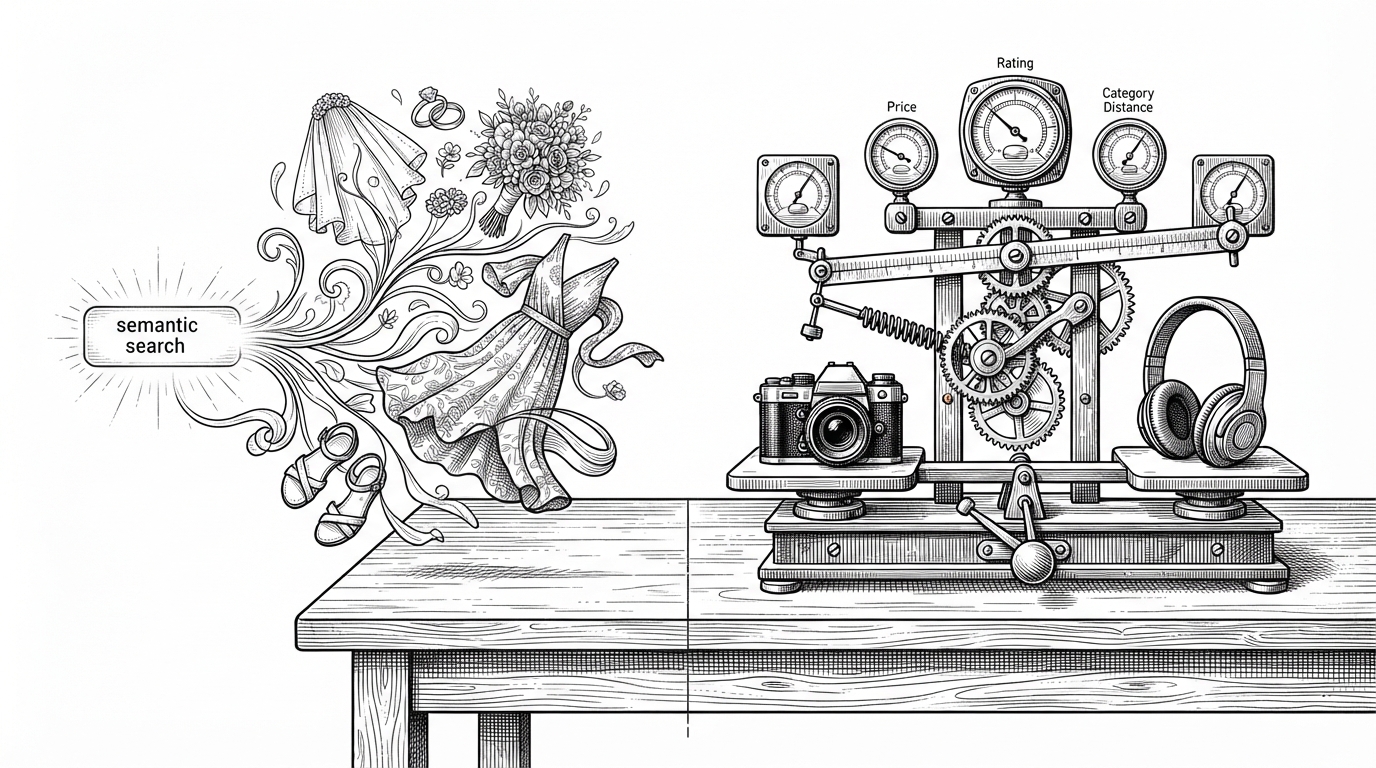
ShopMate’s discovery stack is more interesting than a single AI search box. Gemini handles meaning, while KNN handles proximity. That split is practical, because “show me something for a summer wedding” and “show me products similar to this one” are not the same question.
Gemini is the semantic layer. It takes a broad prompt and maps it to products that fit the intent, even when the words do not match product titles exactly. KNN is the structural layer. It compares features like price, category, and rating to find near neighbors in a more deterministic way.
| Gemini semantic search | KNN similarity search |
|---|---|
| Best for vague intent and natural language. | Best for product-to-product recommendations. |
| Understands context, mood, and use case. | Respects measurable feature distance. |
| Helpful when the user starts with a concept. | Helpful when the user starts with an item. |
| Can feel broad if the prompt is underspecified. | Can feel narrow if the feature set is thin. |
The hybrid design is the point. One engine broadens the top of the funnel. The other tightens the results once the catalog shape is known. ShopMate is not pretending AI can do everything. It is using the right tool for the right layer.
The Self-Provisioning Backend
ShopMate reduces setup friction by creating its own schema on startup. The backend calls a table creation routine during server boot, which means a new developer can get moving without first wiring a separate migration workflow.
// server startup
await createTables();
app.listen(PORT, () => {
  console.log(`Server running on ${PORT}`);
});

// the intent
// ensure Users, Products, Orders, Payments, and related tables exist
// before the API starts serving requests
That trade-off is familiar. Self-provisioning is easy to adopt and hard to ignore, but migrations give you more control as the schema evolves. ShopMate chooses speed to first run, which is a strong signal that developer experience is part of the product philosophy.
What ShopMate Gets Right About Product Maturity
A lot of starter ecommerce repos stop at the catalog and cart. ShopMate keeps going. The repo includes Swagger, tests, Docker, JWT, rate limiting, an admin dashboard, and CI/CD support. Those are not decorative extras. They are signs that the project expects to be used, not just admired.
| ShopMate | A simpler starter store |
|---|---|
| Payment confirmation, inventory updates, and order state are separated cleanly. | Checkout often writes stock immediately and hopes for the best. |
| AI search and similarity search are intentionally split. | One search method is usually forced to cover all discovery cases. |
| Schema bootstrapping lowers setup friction. | Manual environment setup is left to the reader. |
| Operational pieces like docs, tests, and containerization are present. | Polish is concentrated in the UI, not the system boundary. |
That is why the repo stands out. It does not just sell products. It tries to preserve the truth of a sale across the whole system.