mseb: Audio finally gets its benchmark
MSEB turns a fractured field of sound embeddings into one contract for datasets, encoders, metrics, and leaderboards.
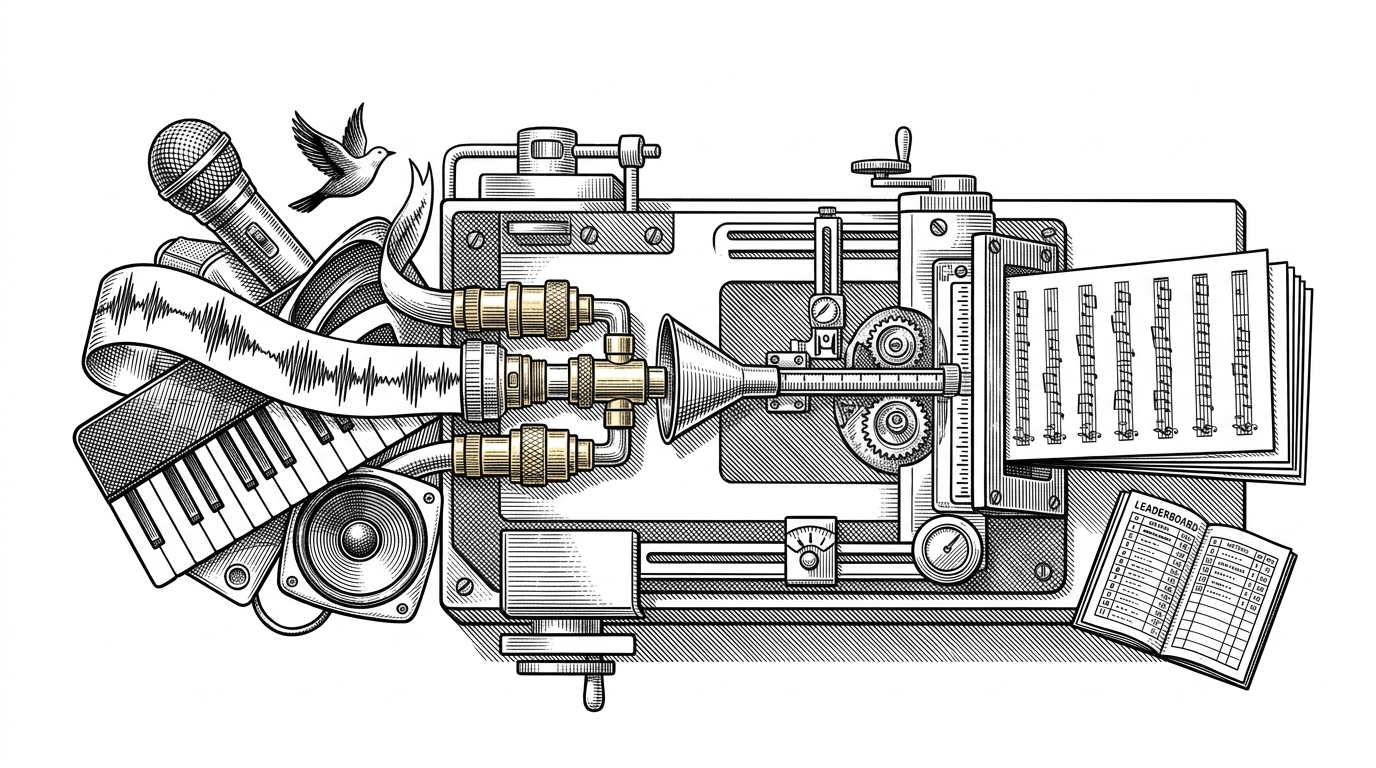
- MSEB matters because it turns audio evaluation into a shared contract instead of a pile of one-off task demos.
- The repository's registry design makes datasets, encoders, and evaluators swappable, which is what lets very different audio models meet on equal ground.
- Its real edge is technical normalization, especially resampling, streaming, and JIT-accelerated alignment metrics.
- MSEB pushes audio evaluation toward multi-step semantic pipelines, not just single-model classification.
Audio AI has a scorekeeping problem. Every lab can demo a model, but very few teams can compare sound embeddings on the same ground without rebuilding the whole evaluation stack. MSEB is Google Research's answer, and the bet is simple: if text got a common benchmark in MTEB, audio needs one too.
Why this benchmark exists
The project is open source, Python-first, and intentionally modular. The repo is licensed under Apache 2.0, ships a leaderboard, and even warns that it is not an officially supported Google product. That combination says a lot: this is meant to be useful infrastructure, not a polished showcase.
MSEB encompasses realistic tasks and datasets that reflect practical applications across diverse technologies and sound categories. Initial experimental findings indicate substantial headroom for enhancing prevalent information extraction methodologies.
The registry is the product
MSEB does not behave like a single benchmark script. It behaves like a set of contracts. Datasets yield a shared `Sound` object, encoders sit behind a common interface, evaluators stay stateless, and results are flattened into a form that can feed analysis or the public leaderboard. That architecture is the point, because it lets the team swap pieces without changing the rules of the game.
The interesting detail is how much of the repo is spent on glue that prevents bad comparisons. `mseb/datasets/` adapts sources like BirdSet and FSD50K. `mseb/encoders/` wraps Whisper, Gecko, Gemini, Wav2Vec, and even LLM-backed paths. `mseb/evaluators/` turns embeddings into scores for retrieval, clustering, transcription, and alignment-heavy tasks. In other words, the framework is built to keep the benchmark honest before it ever gets to the leaderboard.
Normalization is where benchmarks usually break
Audio is messy in ways text is not. Sample rates drift, bit depth changes, clips vary wildly in length, and alignment can be expensive enough to dominate runtime. MSEB's `resample_sound` utility, its streaming `BatchIterator`, and its typed `Sound` objects are the unglamorous parts that make the benchmark fair instead of merely convenient.
The encoder story is more ambitious than it looks
The `CascadeEncoder` is the tell. It lets one model turn audio into text, then hands that text to another embedding model. That means MSEB is not just asking whether an encoder can classify a clip. It is testing whether meaning survives a chain of models, which is much closer to how modern AudioLLM systems will actually be used.
How it compares
| Dimension | MSEB | HEAR | Task-specific datasets | MTEB |
|---|---|---|---|---|
| Scope | Audio embeddings across speech, retrieval, classification, and reasoning | Broad audio representation tasks | One task, one dataset family | Text embeddings across many tasks |
| Architecture | Registry of datasets, encoders, and evaluators | Benchmark suite with shared evaluation | Separate pipelines per task | Task adapters around one text benchmark |
| Differentiator | Cascade encoders and LLM-based audio paths | Established broad baseline coverage | Precise task fit | Mature playbook for shared evaluation |
| Trade-off | More engineering, but one contract | Less model-chain experimentation | Fragmented comparison | Different modality, not directly comparable |
Compared with HEAR and older task-specific datasets, MSEB pushes toward a bigger contract. Compared with MTEB, it borrows the idea of a shared evaluation surface, then adapts it for audio's alignment problems. The result is less a new leaderboard than a new way to define a fair contest.
The benchmark is also an engineering paper
The implementation shows real performance work. In `mseb/metrics.py`, Numba JIT compilation accelerates dynamic time warping and continuous edit distance, which are exactly the kinds of O(N x M) operations that become painful on long audio sequences. The leaderboard side is equally pragmatic: nested scores are flattened into tabular outputs that can feed CSVs, dashboards, or reporting pipelines without bespoke cleanup.
That is the real value of MSEB. It is not only a benchmark with more datasets. It is a framework that treats evaluation itself as infrastructure, with strict typing, tests, streaming data handling, and fast metric cores all aimed at one question: can a single audio representation generalize across tasks that used to live in separate silos?