GABRIEL Turns LLMs Into a Measurement Stack
OpenAI's toolkit treats ratings, rankings, extraction, and de-identification as repeatable research workflows instead of ad hoc prompts.
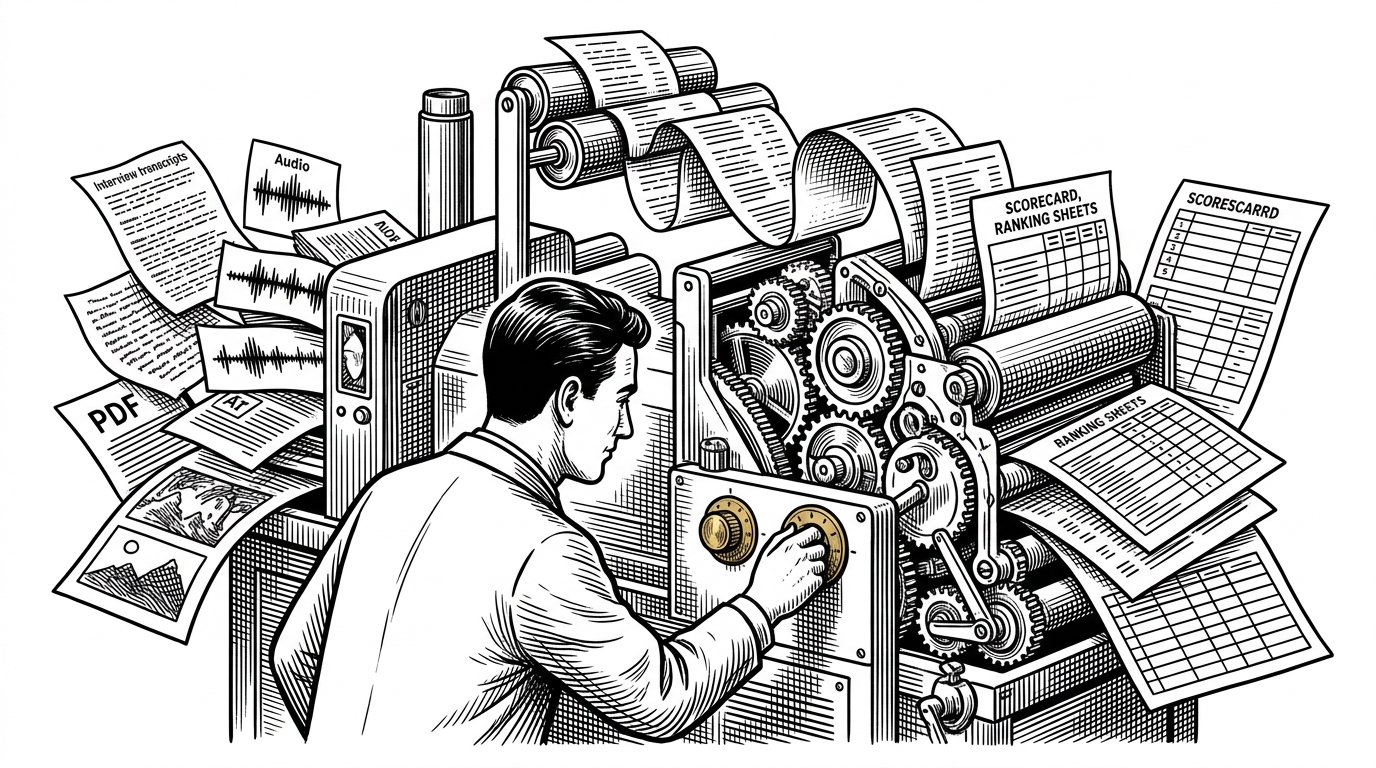
- GABRIEL's core move is to treat LLM outputs as measurement, which makes qualitative coding repeatable instead of improvisational.
- Its task-config design, hashing, and checkpointing turn expensive model runs into resumable jobs that survive interruption.
- The ranking path is unusually rigorous because it combines prompt shuffling with Bradley-Terry math to fight bias and expose uncertainty.
- Multimodal loaders and aggressive async orchestration make the library fit for large corpora, not just one-off prompts.
Most LLM tools help you ask a question. GABRIEL helps you measure an answer. That distinction matters when the work is not a single prompt but a research protocol that has to survive retries, reruns, and scrutiny.
A measurement tool, not a chatbot
GABRIEL (Generalized Attribute Based Ratings Information Extraction Library) turns messy qualitative corpora into analysis-ready datasets with GPT. It handles prompting, batching, retries, checkpointing, and audit trails so you can treat “ask the model” workflows like any other measurement instrument.
That framing is the whole trick. OpenAI positions GABRIEL as infrastructure for economists and social scientists who need to turn text, images, and audio into structured data at scale. The library packages the annoying parts of that job, including retries, checkpointing, audit trails, and consistent prompting, so researchers can focus on the measurement itself.
The task system is the product
- `rate` turns a rubric into numeric scores.
- `rank` converts pairwise judgments into a formal ranking model.
- `classify` maps text into discrete labels.
- `extract` pulls structured fields from raw media.
- `deidentify` strips sensitive information.
- `deduplicate` removes repeated items.
- `whatever` lets teams reuse the pipeline for custom measurement jobs.
| Criterion | Manual coding | GABRIEL |
|---|---|---|
| Throughput | People read and code items one by one. | Async calls let the library process large corpora in parallel. |
| Repeatability | Coder drift and fatigue can change results. | Stable hashes and checkpointing make runs resumable and reproducible. |
| Output shape | Notes and codes often need cleanup before analysis. | Results come back as tidy DataFrames ready for statistics. |
| Bias control | Rules depend on training and attention. | Prompt shuffling and structured ranking reduce position effects. |

How the pipeline stays reproducible
The core loop is straightforward. A row enters as a DataFrame, gets a stable identifier, is rendered through a Jinja2 template, and then moves through async OpenAI calls. The response is parsed back into structured output and written to disk, so the next run can skip anything that already has the same hash.
That hash is more than bookkeeping. It turns every input into a cache key, which means a broken run can resume without wasting money on unchanged rows. In research terms, that is the difference between a demo and an instrument.
GABRIEL effectively addresses this bottleneck by enabling researchers, particularly economists and social scientists, to extract meaningful numerical insights from such data efficiently and at scale.
GABRIEL also tries to tame model bias at the prompt level. The shuffled Jinja2 filter randomizes option order so position effects do not quietly skew ratings. In `rank.py`, the Bradley-Terry model turns pairwise wins and losses into z-scores and standard errors, which is a serious way to say the output is not just a preference, it is a statistic.
Scale is the moat
The default concurrency is aggressive, with some tasks configured for hundreds of parallel calls. That choice tells you the target user is not scoring a dozen transcripts. It is someone processing archives, surveys, or media collections where latency and failure recovery are first-order design problems.
The library is modality-aware too. Audio, PDF, and image utilities mean the same measurement logic can run over transcripts, slides, screenshots, and recordings. That is a strong product decision, because the bottleneck is rarely just text.
The oddest-looking feature, `whatever()`, is also one of the most practical. It lets teams keep GABRIEL's batching, retries, and logging while swapping in a custom measurement job, which is exactly what mature tooling should do when the next question does not fit the standard templates.
Where it sits among alternatives
A generic wrapper can call a model, but it usually stops where the hard research work begins. GABRIEL goes further by bundling stable IDs, resumability, prompt validation, multimodal ingestion, and outputs that are already shaped for analysis. That is why it reads less like an SDK and more like a measurement stack.