`joylarkin/microblog`: The Static Repo That Preserves a Social Feed Like a Fossil Record
A tiny GitHub archive that hides a bigger idea: Micro.blog can emit a machine-readable trail of posts, and open web standards turn that trail into something durable, portable, and searchable.
 preserved container for social identity." data-prompt="Create an editorial illustration rendered entirely in black ink on a pure white background.
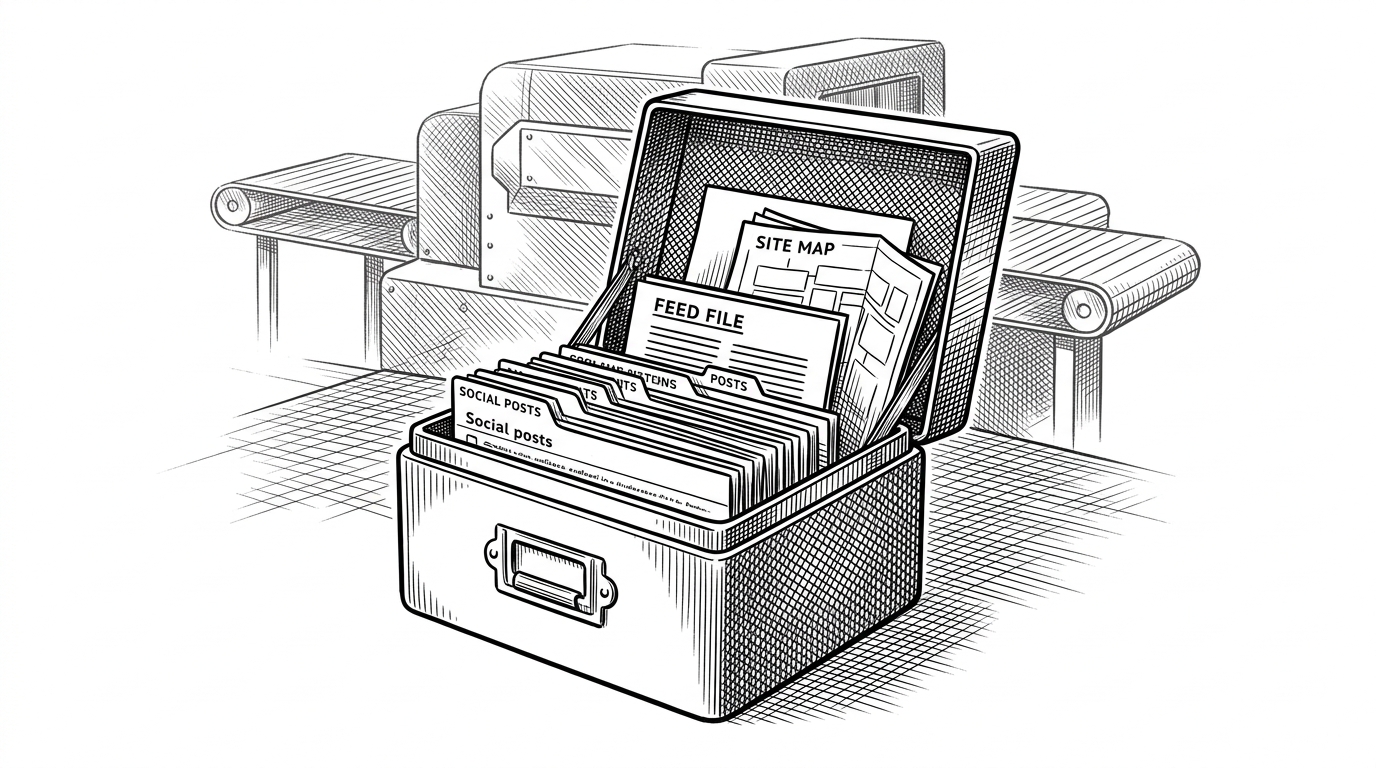
The image depicts a small metal archive box on a desk, open just enough to reveal neatly stacked index cards labeled with tiny social posts, a printed feed file, and a folded site map. Behind it, faintly implied through crosshatching, is a larger machine with conveyor belts labeled only by shape and function, but the box itself is the focus. The artist uses tightly packed crosshatching lines layered at different angles to build up shadow and form, with clean open areas of white for highlights. The line work has the quality of a classic metal engraving, precise and deliberate, with varied line weights where bold contour lines define shapes and finer interior lines create tonal depth. The overall style evokes vintage newspaper editorial illustrations from The Economist or Wall Street Journal. No color, no gradients, no grey fills. Only black lines on white. The background MUST be pure white #FFFFFF. No paper texture, no cream, no off-white, no noise, no grain. Perfectly clean flat white background." loading="lazy">
preserved container for social identity." data-prompt="Create an editorial illustration rendered entirely in black ink on a pure white background.
The image depicts a small metal archive box on a desk, open just enough to reveal neatly stacked index cards labeled with tiny social posts, a printed feed file, and a folded site map. Behind it, faintly implied through crosshatching, is a larger machine with conveyor belts labeled only by shape and function, but the box itself is the focus. The artist uses tightly packed crosshatching lines layered at different angles to build up shadow and form, with clean open areas of white for highlights. The line work has the quality of a classic metal engraving, precise and deliberate, with varied line weights where bold contour lines define shapes and finer interior lines create tonal depth. The overall style evokes vintage newspaper editorial illustrations from The Economist or Wall Street Journal. No color, no gradients, no grey fills. Only black lines on white. The background MUST be pure white #FFFFFF. No paper texture, no cream, no off-white, no noise, no grain. Perfectly clean flat white background." loading="lazy">
- This repository behaves like a preservation layer, not a working microblog, because the value is in the exported artifact rather than the edit history.
- The strange part is the ghost architecture: Hugo metadata is present, but the source tree is missing, which makes the repo look like an endpoint for a build pipeline.
- `index.html` and `feed.json` form a dual-format archive, so the same posts can serve humans, crawlers, and feed readers without extra infrastructure.
- The real product is an exit path, because the content can survive the service that published it.
A GitHub Repo That Acts Like a Backup, Not a Project
At first glance, `joylarkin/microblog` barely looks like a project at all. It is a flat static archive with an `index.html`, a `feed.json`, and a README. But that is the point. This repository behaves like a digital lifeboat, a place where a social feed can land as durable files instead of evaporating inside a platform.
That changes the meaning of the repo. It is not a place where the site is authored. It is the place where the site is preserved. The difference is subtle on disk and huge in practice.
The Hidden Trick: Output Lives Here, Source Lives Somewhere Else
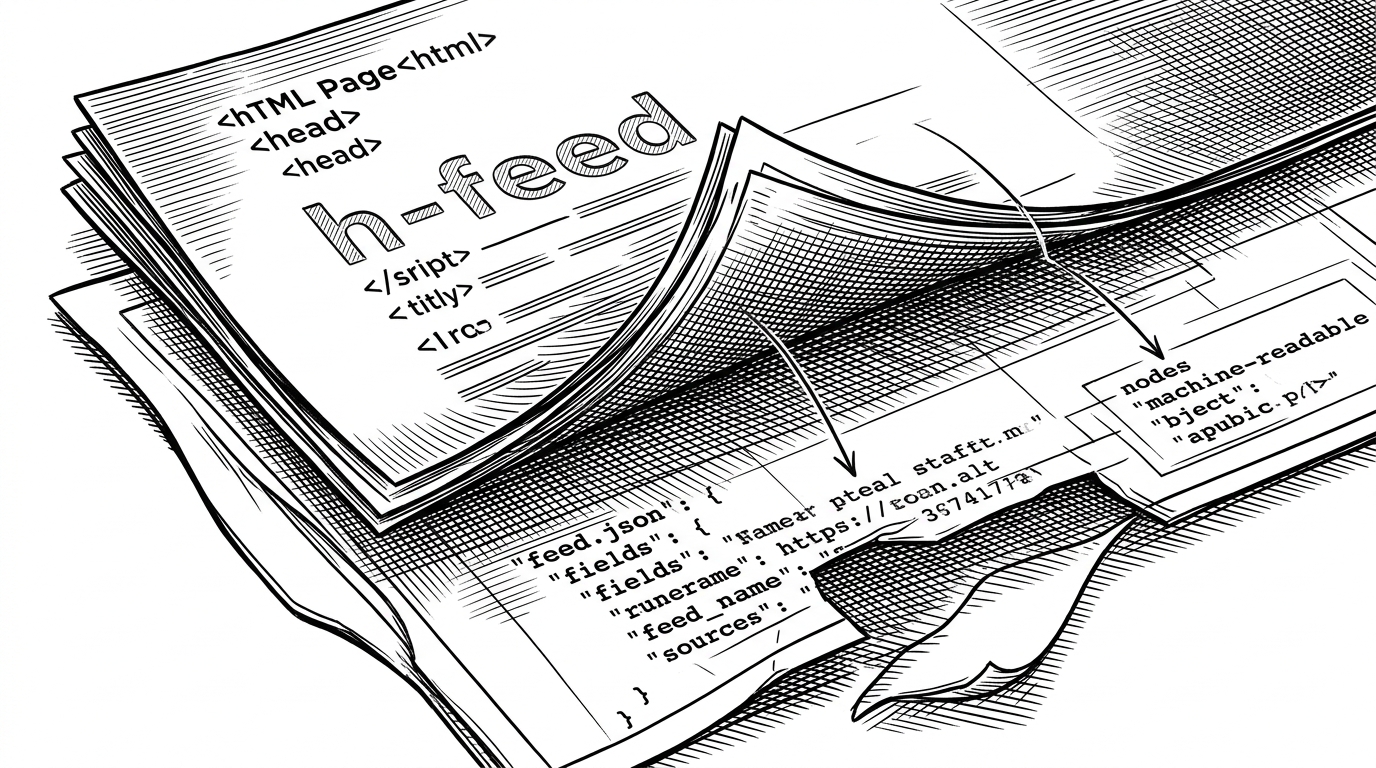
The strangest clue is the metadata. `index.html` carries Hugo fingerprints, but the repository does not show a Hugo source tree. No `content/` folder. No `layouts/`. No build system to inspect. That mismatch suggests a build-to-repo workflow, where Micro.blog or some upstream process generates the finished artifact and GitHub stores the result.
<meta name="generator" content="Hugo 0.91.2" />
<div class="h-feed">
That is why this repository feels like evidence. It records that a process happened, but it does not expose all of the machinery. In editorial terms, that makes the archive more interesting than a normal static site. The source of truth is upstream. The repo is the proof that the truth was safely exported.
Why feed.json Matters More Than It Looks
If `index.html` is the face of the archive, `feed.json` is its spine. JSON Feed is machine-readable by design, which means the content can be moved, indexed, mirrored, or republished without first being scraped out of HTML. That is a powerful property for a backup. A backup that can be consumed by tools is better than one that only sits there.
In practice, this turns preservation into an API surface. The archive does not merely store posts. It offers structured data that other software can understand. That is a big reason open standards matter here. They make the content portable without forcing a heavyweight application layer to stay alive forever.
| Model | Ownership | Portability | Infrastructure burden | Machine readability | Exit strategy |
|---|---|---|---|---|---|
| `joylarkin/microblog` archive | High. Files live in the repo. | High. HTML and JSON can be copied elsewhere. | Very low. Static files only. | High. Feed and microformats are present. | Strong. The archive can outlive the service. |
| Platform-only microblog account | Low. The platform owns the container. | Low. Export options vary and are often limited. | Low for the user, high dependence on the platform. | Usually low. Data is optimized for the platform UI. | Weak. Leaving can mean losing context and structure. |
| Self-hosted `microblog.pub` | High. You control the instance. | High, but you must keep the server running. | Medium to high. You maintain software and hosting. | High. ActivityPub and IndieWeb support are built in. | Good, but only if the server stays maintained. |
The comparison makes the trade-off plain. This repo is not the most powerful system. It is the simplest system that still gives the owner an escape hatch.
Microformats Make the HTML Valuable to Machines
The `h-feed` class is easy to miss, but it matters. Microformats turn ordinary HTML into structured data without needing a second syntax or a client-side app. A crawler, reader, or IndieWeb tool can extract meaning from the page as written. Humans get a normal page. Machines get a semantic graph.
That is the quiet elegance of the repository. It does not force a choice between readability and interoperability. It treats them as the same requirement.
| Format | Human value | Machine value | Failure mode |
|---|---|---|---|
| Plain HTML | Readable in any browser | Weak unless annotated | Can look fine but be semantically thin |
| HTML with Microformats | Readable and structured | Strong extraction path | Depends on conventions, not heavy tooling |
| App-centric frontend | Potentially polished | Often hidden behind JS | Can degrade if the app or API disappears |
This is also why the archive feels durable. A feed reader can ingest `feed.json`. A crawler can parse the `h-feed` markup. A future maintainer can reconstruct the intent without reverse-engineering a bespoke app.
The Real Comparison Is Not Static Site vs. Social Platform
The better comparison is leverage. A platform-only account offers convenience but weak exit power. A self-hosted microblog gives maximum control but asks you to run real infrastructure. This repository sits in the middle. It keeps the content portable, keeps the runtime dead simple, and avoids turning preservation into a systems administration problem.
That middle position is the clever part. It is not trying to beat Micro.blog or replace a self-hosted stack. It is trying to make sure that the social output survives whatever happens next.
What This Repo Suggests About the Future of Personal Publishing
The broader lesson is bigger than one user or one archive. Personal publishing gets stronger when it can be reduced to durable primitives: HTML, feeds, and a versioned repo. Those primitives are not glamorous. They are just hard to kill.
That is the real promise here. If the platform disappears, the content can still be parsed, preserved, and republished. In a web full of brittle, app-shaped identities, that is a serious kind of ownership.