The WebGL Antidote: How meodai/heerich Renders 3D in Pure SVG
By discarding the GPU in favor of a custom polygon clipping engine, this zero-dependency library brings architectural voxel art to pen plotters and generative designers.
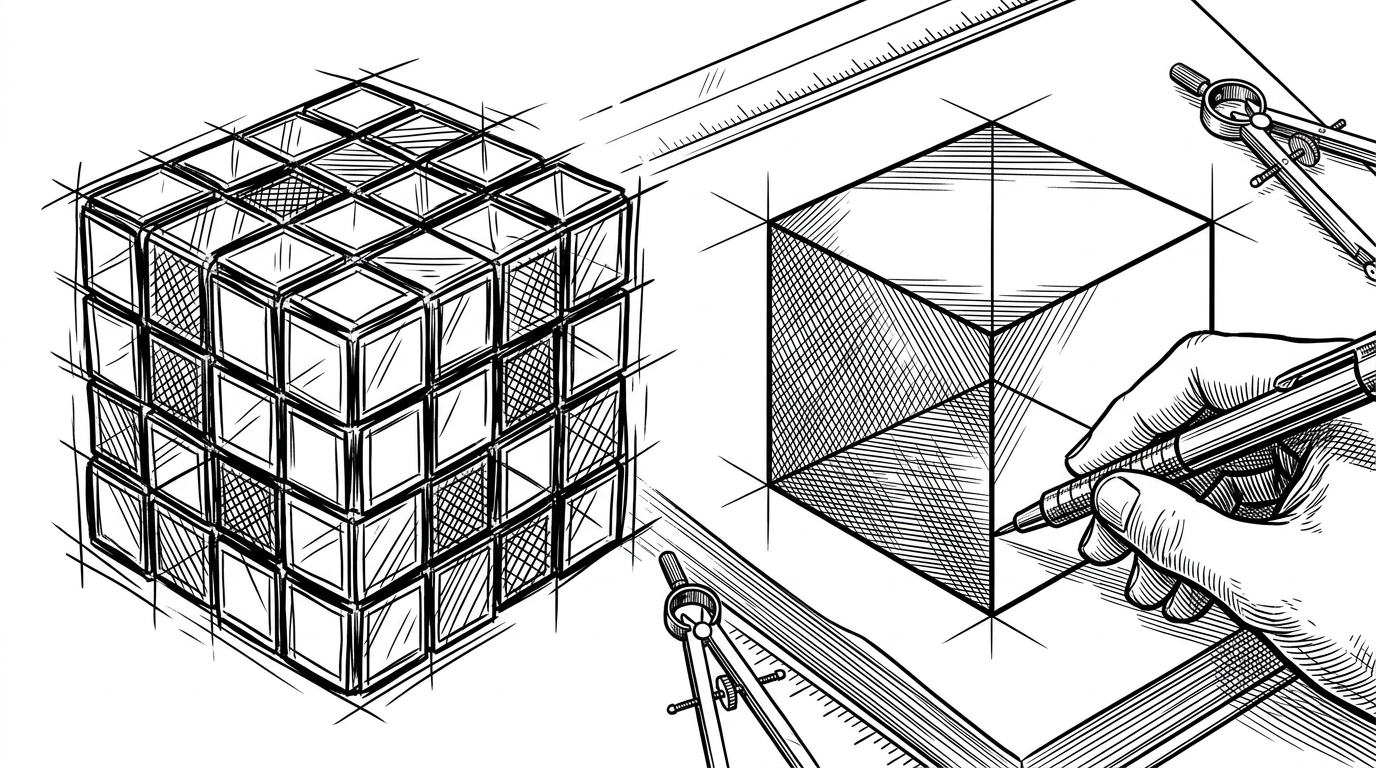
- Heerich bypasses WebGL entirely to generate perfect, resolution-independent 3D SVG markup.
- The engine solves occlusion mathematically using spatial grids and convex subtraction instead of a standard raster Z-buffer.
- Memory is optimized through a flat Float64Array that handles voxel coordinates for complex constructive solid geometry.
- A custom bilinear warp engine maps flat 2D SVG paths onto isometric 3D planes for precise texture wrapping.
The GPU Bypass
Standard 3D on the web relies on WebGL to push millions of pixels to a canvas. Heerich takes the opposite approach. It accepts a massive CPU performance penalty to output pure, infinitely scalable SVG markup. This makes it a tool for mathematical precision rather than real-time framerates. For generative artists and developers looking to send architectural forms to physical drawing machines, perfect vector lines are far more valuable than high frame rates.
| Feature | WebGL (Three.js) | meodai/heerich |
|---|---|---|
| Rendering Target | Canvas (Raster) | SVG (Vector) |
| Depth Sorting | Z-Buffer (GPU) | Polygon Clipping (CPU) |
| Scaling | Fixed Pixel | Infinite Vector |
| Primary Use Case | Interactive Screen | Plotters & Print |
The Hidden Line Problem
Without a raster Z-buffer, you cannot simply paint pixels over each other to hide objects in the background. The engine relies on a custom 2D polygon clipping engine in src/bsp.js to solve this. It uses a spatial grid and convex subtraction to physically slice and remove hidden polygons before they ever reach the DOM. This ensures that hidden lines do not bleed through the gaps of front-facing polygons.
Carving the Grid
Instead of traditional polygonal meshes, the engine uses a voxel grid. Data is stored in a flat Float64Array to reduce garbage collection pressure. Constructive Solid Geometry operations, like carving a sphere out of a box, are achieved simply by deleting coordinate keys from a central map. This functional approach allows developers to build complex forms with minimal memory overhead.
Warping the Flat World
The addition of src/decal-warp.js allows developers to map standard 2D SVG paths onto 3D voxel faces. It uses sophisticated bilinear interpolation to stretch and project flat coordinates into isometric or perspective views. A custom tokenizer even converts complex arcs into cubic bezier curves to maintain perfect geometric fidelity without relying on heavy external matrix libraries.
From Screen to Pen
The library draws its name from 1960s minimalist sculptor Erwin Heerich. Today, the generative art community uses this engine to bridge the gap between digital generative code and physical pen plotters. By producing clean vector lines with proper occlusion, artists can send 3D architectural forms directly to physical drawing machines.
Playing around with @meodai Heerich library, this thing is fun. I might plot one of these this week. https://t.co/17jIBcJztJ