game-creator: The AI Game Studio That Teaches Agents to Read Their Own Games
An opinionated browser-game pipeline that turns prompts into deployed Phaser or Three.js games, then uses text-state serialization, event buses, and automated QA to keep AI agents from getting lost in the code.
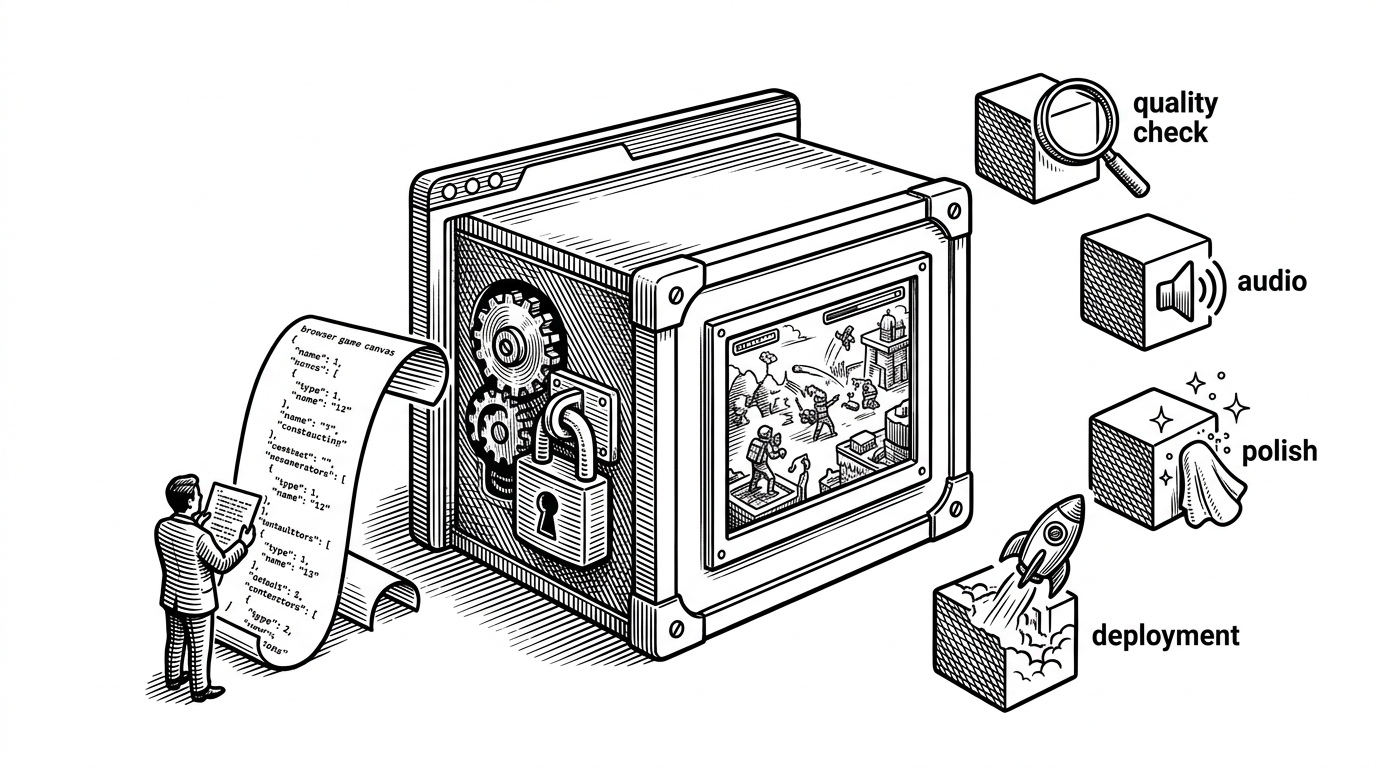
- game-creator’s real breakthrough is not prompt-to-game output, but making browser-game state readable enough for AI agents to inspect and repair.
- Its strict EventBus, constants, and subagent workflow are guardrails for machine labor, not just style preferences.
- The repo treats polish, audio, QA, and deployment as part of the game system, which makes it better at shipping disposable browser games than generic AI coding agents.
- This is a pipeline for fast, inspectable, monetizable games that can be rebuilt and re-shipped without the agent getting lost in its own code.
The game is no longer a black box
The most revealing idea in game-creator is not that it can generate games. It is that it makes a game legible to an AI agent after the game is already running. The function window.render_game_to_text() turns the moving, visual mess of a browser canvas into a state readout the agent can actually reason about.
That matters because Canvas is opaque. If an AI writes a game and then cannot inspect what happened after a move, it is effectively guessing. This repo closes that loop: the runtime speaks in text, the QA agent reads that text, and the orchestrator decides whether to fix, polish, or ship.
A game studio made of subagents
The repo does not ask one model to do everything. It splits labor into roles: creator, QA, deployer, reviewer, and related support steps. That is a management system, not a monolithic prompt. The orchestrator delegates code writing, then insists on verification after each code-modifying stage.
`/make-game` is an orchestrator that delegates all code writing to subagents and runs a QA subagent after every code-modifying step:
That division is doing real work. It keeps creation, judgment, and deployment separate enough that an AI can fail in one lane without contaminating the others. In practice, that is how you get from rough scaffolding to a playable build without collapsing into spaghetti.
The pipeline is the product
The interesting part is not only that the repo automates game creation. It is that it automates the handoffs that usually break AI-generated software: asset injection, visual polish, audio, runtime checks, and publication. Each phase has a purpose, and each purpose has a different subagent or verification step attached to it.
Why the repo is so strict
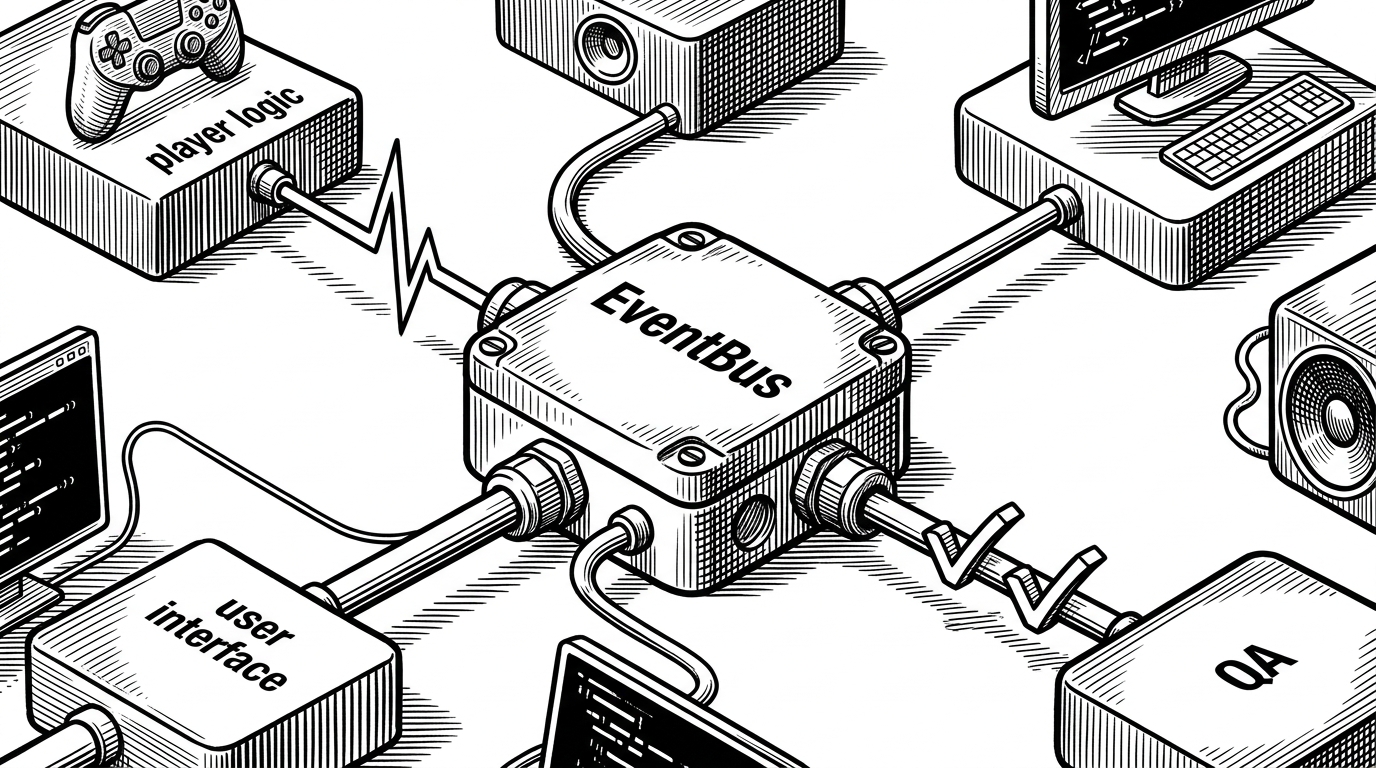
The rules are unusually narrow: EventBus only, centralized constants, no direct cross-imports, no magic numbers. That can sound rigid until you see the target user. This is not just for humans. It is for agents that need predictable seams so they do not create code they cannot later understand.
| Dimension | Traditional ad hoc AI code | game-creator |
|---|---|---|
| Module communication | Direct imports and hidden coupling | EventBus with named events |
| Tuning game feel | Scattered numbers in logic files | Centralized constants |
| Debugging | Mostly visual or manual | Text state plus QA passes |
| Workflow | One-shot generation | Staged orchestration with verification |
| Agent safety | Easy to drift into spaghetti | Guardrails that keep edits local |
The constraints are the feature. They reduce freedom in exchange for repeatability, which is exactly what machine-assisted production needs. A smaller surface area means fewer surprising interactions when an AI touches the codebase again.
The juice comes after the mechanics
The repo separates playable structure from game feel. Once the mechanics exist, the workflow adds particles, transitions, screen shake, and other polish moves that give the project momentum. That matters because a lot of AI-generated output is technically correct and emotionally dead.
In other words, this is not just a generator. It is a staged repair process for blandness. The system first gets the game working, then makes it feel alive.
// Central idea: keep the game readable and tunable
export const PLAYER = {
  SPEED: 240,
  JUMP_VELOCITY: -420,
};

export function render_game_to_text(state) {
  return JSON.stringify({
    player: { x: state.player.x, y: state.player.y },
    score: state.score,
    mode: state.mode,
  });
}
Audio is code, not an asset
The choice to use Strudel.cc for procedural audio is a subtle but important move. Instead of treating music as an opaque file dropped into the build, the repo treats audio as something the agent can generate, revise, and tune in the same workflow as gameplay.
| Audio approach | What it gives you | Why it matters here |
|---|---|---|
| Static MP3 assets | Fast playback, but fixed behavior | Harder for agents to revise or synchronize |
| Procedural Strudel patterns | Music as editable code | Fits the same inspectable workflow as gameplay |
| Web Audio API | Low-level control | Useful for runtime effects and reactive sound |
That is a better fit for this project than a separate asset pipeline. If the whole point is machine-readable production, then music should also be machine-writable.
Built to ship, not just to compile
The QA and deployment loop is the other half of the story. Playwright checks, runtime verification, architecture checks, visual review, and deployment targets like here.now all point to the same goal: a game that can leave the repo without human babysitting.
Go from game idea to deployed, monetized browser game in minutes — not hours.
That is a strong claim, but the architecture is clearly arranged to support it. Build checks catch broken output. Runtime checks catch games that launch but do not behave. Gameplay verification asks whether the interaction changed state the way it should.
What this replaces, and what it does not
This repo is not replacing Phaser or Three.js. It is building on top of them. It is also not a general-purpose AI coding agent. Raw agents can write code, but they do not automatically inherit game-specific structure, QA discipline, or a deployment path.
| Approach | Strength | Weakness |
|---|---|---|
| Traditional engine workflow | Maximum creative control | Human-heavy iteration |
| General AI coding agent | Broad flexibility | Easy to drift, hard to verify |
| game-creator | Opinionated end-to-end pipeline | Less freedom, more structure |
That trade-off is the whole bet. If you want one-off artistic control, use the engine directly. If you want a system that can keep producing inspectable browser games at speed, the strictness is the point.
The shape of disposable games
The broader implication is not just faster game development. It is a different category of game production. These are games built to ride a moment, show up quickly, and monetize while the topic is still hot.
That favors short cycles, topical ideas, and repeatable templates. It also explains why the repo includes a full pipeline rather than a clever generator. Disposable games are not disposable if they are hard to ship. The workflow is the product that makes the content model possible.
the formula for viral games hasn't changed. make it simple. make it unfair. make people scream. now you can vibe code one in minutes with one skill npx skills add OpusGameLabs/game-creator https://t.co/4Tbxef8NDH