cog-official-openai-clip: The 12-Second Way to Ship CLIP
A production-minded wrapper around OpenAI’s multimodal model, where the real problem is not inference. It is getting a 3.4GB model to wake up fast, stay cached, and return useful embeddings through a tiny Cog API.
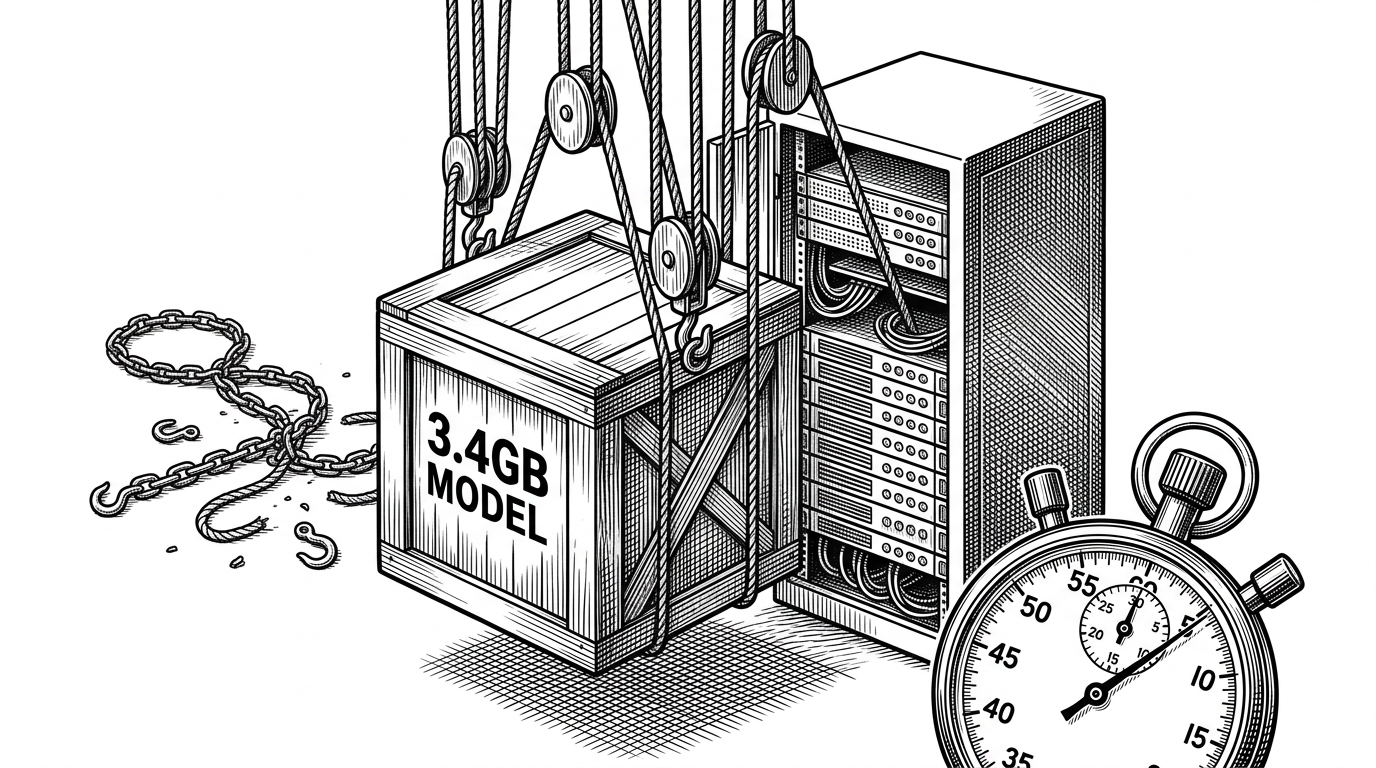
- This repo treats cold-start latency as the product, not a deployment footnote, by turning a heavy model download into a cached parallel transfer.
- The code wraps CLIP’s embedding core in production plumbing, including filesystem control, input normalization, moderation, and billing hooks.
- Its real value is operational clarity, because a shared text-image space becomes useful only when the API is small, predictable, and fast to wake up.
- Compared with research-first CLIP repos, this one reads like a deployment template for multimodal inference rather than a model demo.
CLIP is the easy part. The hard part is making a 3.4GB model feel ordinary enough that nobody notices it. cog-official-openai-clip is interesting because it attacks that problem directly: it treats startup time, caching, and request routing as the real product.
Most CLIP implementations take 2+ minutes to start because they download a 3.4GB model every time. We store the model weights in a Google Cloud bucket and download them in parallel, so the model loads in about 12 seconds.
The boot path is the product
CLIP turns text and images into the same 768-dimensional space, which is why it works for search, tagging, and similarity matching. But the implementation that matters here is not the math. It is the way the repo makes that math available as a service without a long cold start.
In a Cog app, the serving surface is deliberately small. `predict.py` owns the model lifecycle, `cog.yaml` defines the container, and the setup path is tuned to avoid expensive default download behavior. That matters because a model can be architecturally elegant and still feel broken if every fresh container spends minutes pulling weights.
What the repository wraps around CLIP
- `predict.py` is the orchestrator that decides whether a request becomes text features or image features.
- `helpers/download` handles parallel retrieval and retry logic so weight loading does not become a single-thread bottleneck.
- `helpers/images` and `helpers/video` normalize messy inputs before they reach the tensor path.
- `helpers/moderation` and `helpers/billing` show that the repo thinks like a production service, not just a model wrapper.
That helper layout is the giveaway. This is not a tiny research notebook repackaged as a web app. It is a service boundary with separate concerns: downloading, preprocessing, moderation, telemetry, and tests.
How it compares
| Project | Deployment shape | Startup behavior | What it optimizes for |
|---|---|---|---|
| OpenAI CLIP original | Research code and model reference | Not opinionated about serving | Discovery and experimentation |
| OpenCLIP | Open-source model family and training ecosystem | Depends on how you package it | Flexibility, training, reuse |
| cog-official-openai-clip | Cog service with cached weights and a tiny API | Designed to come up quickly | Production latency, predictable inference |
The distinction is practical, not philosophical. Research CLIP asks, "How do we learn a good joint embedding?" This repo asks, "How do we make that embedding available before the user gives up?"
That is why the details around downloads matter so much. Parallel transfer, local cache control, and a strict request surface are the difference between a promising multimodal model and a tool people can actually build on.
Why this repo matters
There is a lot of ML code that proves a model can work. There is much less code that proves a model can be lived with. predict.py and its helper modules show the difference: the model itself stays simple, while the service around it absorbs the ugly parts of reality.
That is the lesson here. Multimodal search, moderation, and recommendation do not usually fail because the embedding math is bad. They fail because the system is slow, fragile, or awkward to ship. This repository is an argument that deployment discipline is part of the model.