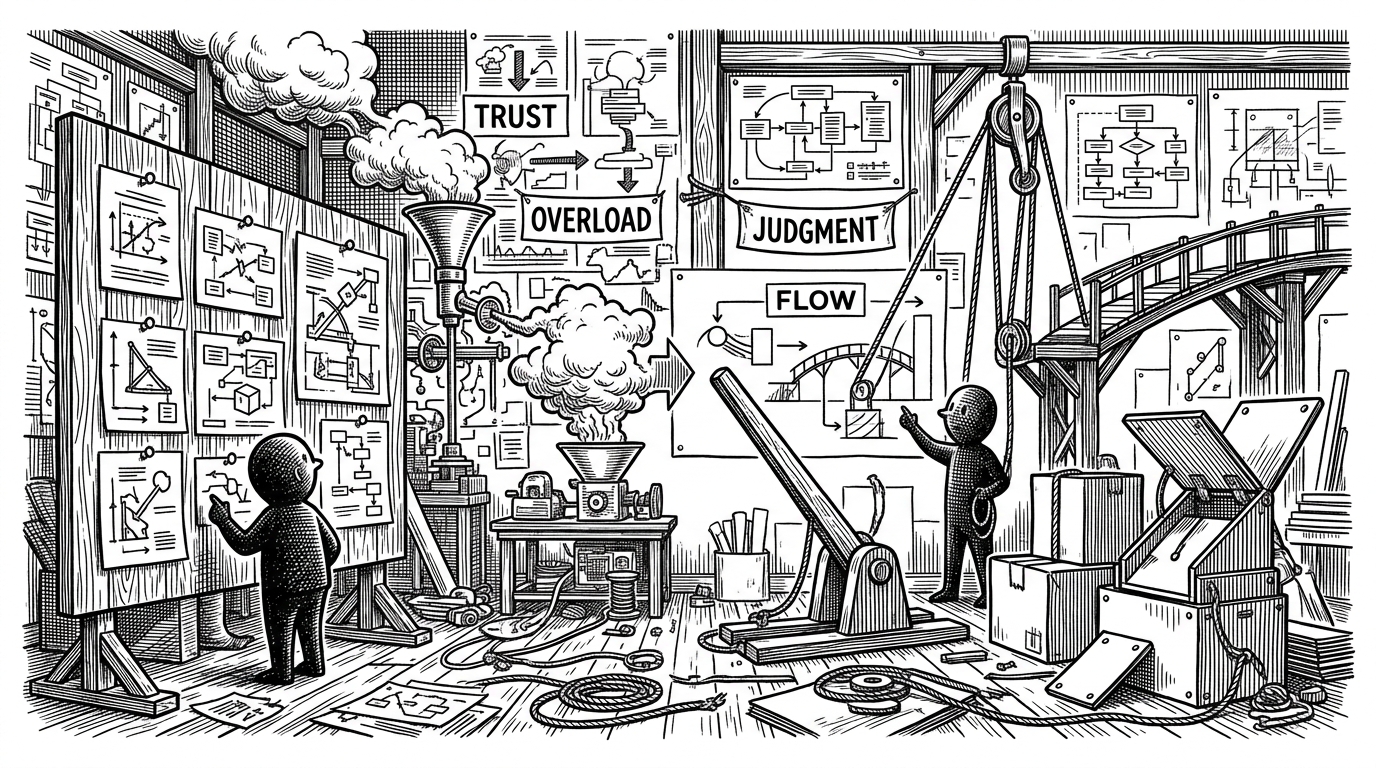
obs-mcp: Turning Claude into an OBS Technical Director
A protocol-first MCP server that maps OBS WebSocket v5 into safe, structured tools, so an AI assistant can switch scenes, mute sources, and drive a live production without falling apart when OBS does.
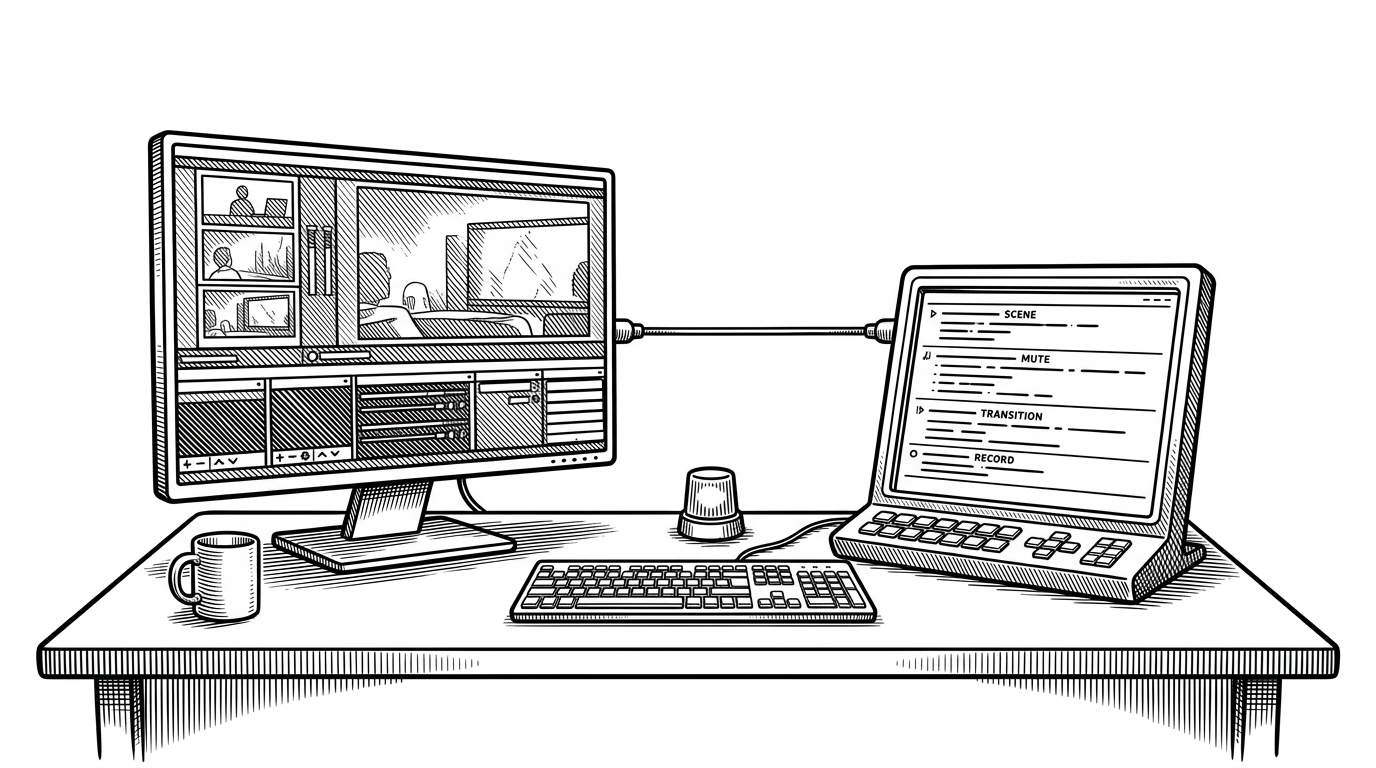
- obs-mcp matters because it turns an LLM into an operator of a live, stateful desktop app, not just a generator of commands.
- Its core bet is protocol-first tooling: many OBS WebSocket v5 actions become structured MCP tools instead of one brittle catch-all API.
- The server is built to stay useful when OBS is offline, which makes the whole system feel like infrastructure rather than a demo.
- The project points to a bigger shift in MCP, where assistants can safely control local software with real operational constraints.
The director who never touches OBS
The useful trick here is not that OBS can be controlled from code. OBS has been scriptable for years. The shift is that Claude can now act like a live technical director, asking for scene changes, audio mutes, transitions, and recording controls in plain language while the server translates those requests into OBS actions.
That makes obs-mcp interesting in a way most glue code is not. It sits between a conversational model and a stateful broadcast app, where timing matters, state changes matter, and failure is not theoretical.
Why OBS is a hard target for AI control
OBS is not an API-first backend. It is a live desktop application with scenes, sources, hotkeys, authentication, and a moving target of runtime state. If the app disappears and returns, the control plane has to recover without dragging the whole assistant session down with it.
| Control mode | Setup burden | Natural language | Restart resilience | Automation depth | Best fit |
|---|---|---|---|---|---|
| Manual clicking in OBS | Low | No | Depends on the operator | High, but human-limited | One-off changes and ad hoc production |
| Stream Deck or hotkeys | Medium | No | Good for local bindings | Medium | Fast muscle-memory workflows |
| Raw OBS WebSocket scripting | High | No | Depends on the script | Very high | Custom automation and integrations |
| obs-mcp through MCP | Medium | Yes | Built for reconnects | High | Assistant-driven live control |
The protocol-first bet
The repo does not expose a vague chatbot wrapper around OBS. It maps a broad slice of OBS WebSocket v5 into discrete MCP tools, which is a very different choice. The payoff is that the assistant gets specific capabilities, not a single command bucket that has to be interpreted every time.
That design shows up in the codebase structure. The TypeScript side is modular, with tool groups for scenes, sources, streaming, recording, and general operations. The project also carries a parallel Python tree and a split protocol JSON set under docs, which suggests that the API surface is being treated like something to model, not something to hand-wave.
Inside the bridge: MCP on one side, OBS on the other
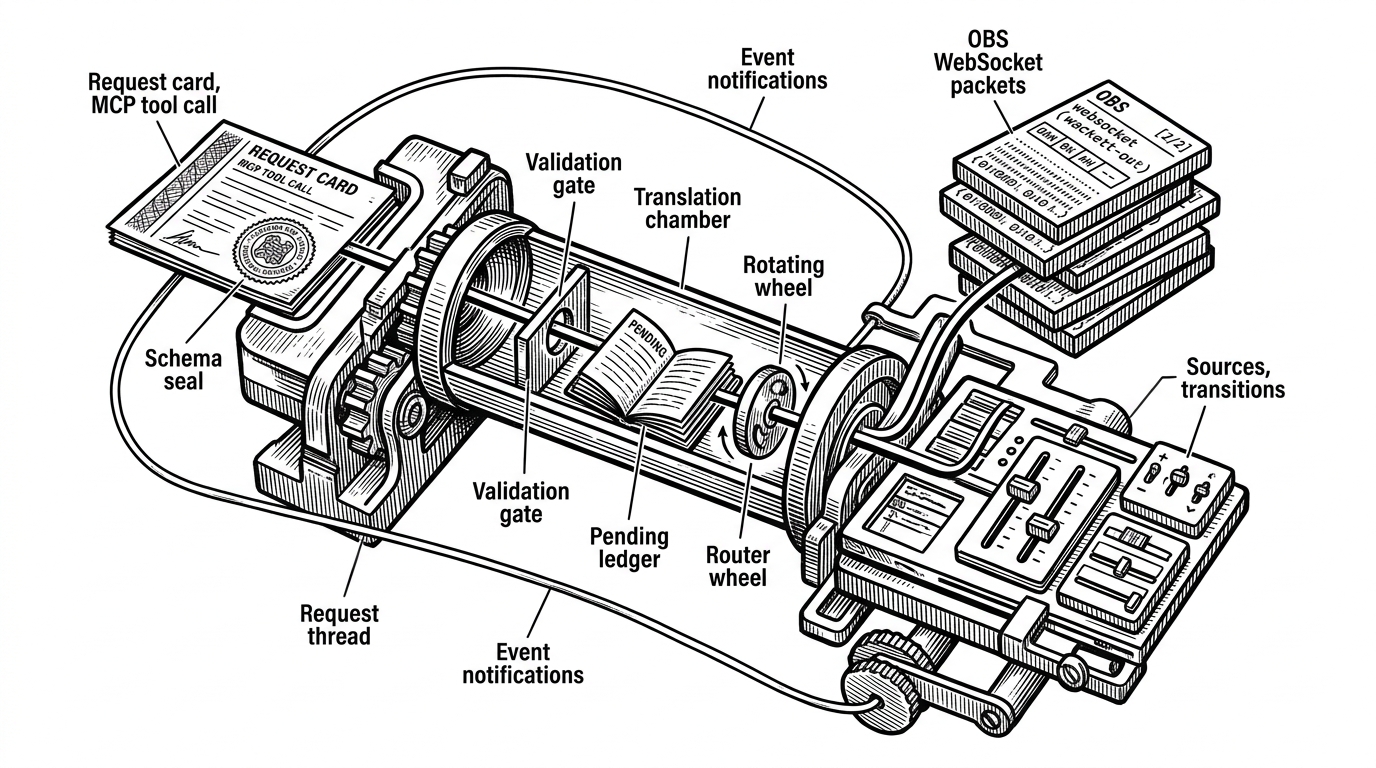
The architecture is more interesting than a simple client-server sketch. On one side, the MCP host talks over stdio. On the other, the server maintains a WebSocket connection to OBS, with a custom client handling the handshake, authentication, event stream, and request-response correlation.
Model request
  -> MCP tool call
  -> Zod validation
  -> OBS request with ID
  -> pendingRequests map stores promise
  -> OBS WebSocket response
  -> promise resolves
  -> MCP content block returns to the client

OBS events flow separately
  -> EventEmitter
  -> tool state updates / notifications
That request map matters. WebSockets are asynchronous, but the assistant still needs a clean response for the exact call it made. By pairing each outbound request with an ID and resolving the right promise when the reply comes back, the server keeps the conversation deterministic even when OBS is noisy.
How it stays alive when OBS disappears
This is the most production-minded part of the repo. The server is designed to keep running even if OBS is closed, restarted, or temporarily unreachable. A watchdog checks the connection, retry logic backs off, and the MCP process stays alive instead of collapsing into a dead session.
| Failure case | Naive wrapper | obs-mcp behavior |
|---|---|---|
| OBS is not running at startup | Server fails hard | MCP server stays up and retries in the background |
| OBS closes during a session | Tooling breaks immediately | Reconnect loop keeps looking for OBS |
| A request is in flight during reconnect | State is ambiguous | Pending request tracking and retry logic reduce drift |
| The assistant keeps asking for actions | Calls are blocked or crash | The MCP side remains available and can recover |
That matters because the whole point of local control is that local software is messy. A cloud API can assume availability. OBS cannot. If you want an AI assistant to operate a live studio, resilience is not a nice-to-have. It is the feature that makes the rest believable.
Why this is different from scripts, Stream Decks, and direct WebSocket calls
| Approach | Strength | Weakness | What obs-mcp adds |
|---|---|---|---|
| Scripts | Flexible and familiar | Can get brittle fast | A structured MCP interface with schemas and tool discovery |
| Stream Decks and hotkeys | Fast for operators | Requires manual mapping | Natural language control and broader automation |
| Direct OBS WebSocket calls | Close to the metal | More integration work | A ready-made assistant-facing control plane |
| obs-mcp | Assistant-friendly and resilient | Still tied to OBS and MCP clients | A protocol-first bridge that survives app churn |
The result is not a universal replacement. It is a better fit for a specific job: structured, recoverable, assistant-driven control of a real desktop production tool. That is a narrower claim than magic, and a more useful one.
What this project suggests about the future of local software control
OBS is a good proof case because it is familiar, operationally complex, and unforgiving. If MCP can handle a tool like this, then the pattern is bigger than broadcast software. It can become a practical control layer for other local apps that have state, timing, and failure modes that do not fit a plain chat interface.
That is the real significance of obs-mcp. It shows that an LLM does not have to be a fuzzy assistant on top of software. With the right protocol boundary, it can be a reliable operator inside a messy real-world workflow.