last-minute-life-saver: Last Minute Life Saver: The Smallest Possible Mock API That Still Gets You Unblocked
A tiny developer tool that turns JSON into a working HTTP API with almost no setup, and shows why simplicity can beat feature-rich mock platforms when the clock is loud.


This project is a last-minute life saver for hackathons. It helps you to create a mock API in minutes.
- Last Minute Life Saver treats mock APIs as emergency infrastructure, not a platform, and that is the point.
- Its value is not feature depth. Its value is reducing the work between a JSON shape and a usable HTTP response to almost nothing.
- The project competes on urgency, where a simpler tool can be more useful than a richer one because it gets out of the way faster.
- In a hackathon or prototype sprint, the winning backend is often the one you can trust in under a minute.
When a backend is one minute too expensive
Mock APIs are usually sold as a category. This repo makes a narrower promise: when you need something working now, the right tool is the one that removes the most steps. That matters in hackathons, prototype demos, and frontend work that has already spent its budget on everything except the backend.
The repo’s own framing is blunt. As the README puts it, “This project is a last-minute life saver for hackathons. It helps you to create a mock API in minutes.” Project README
What Last Minute Life Saver actually does
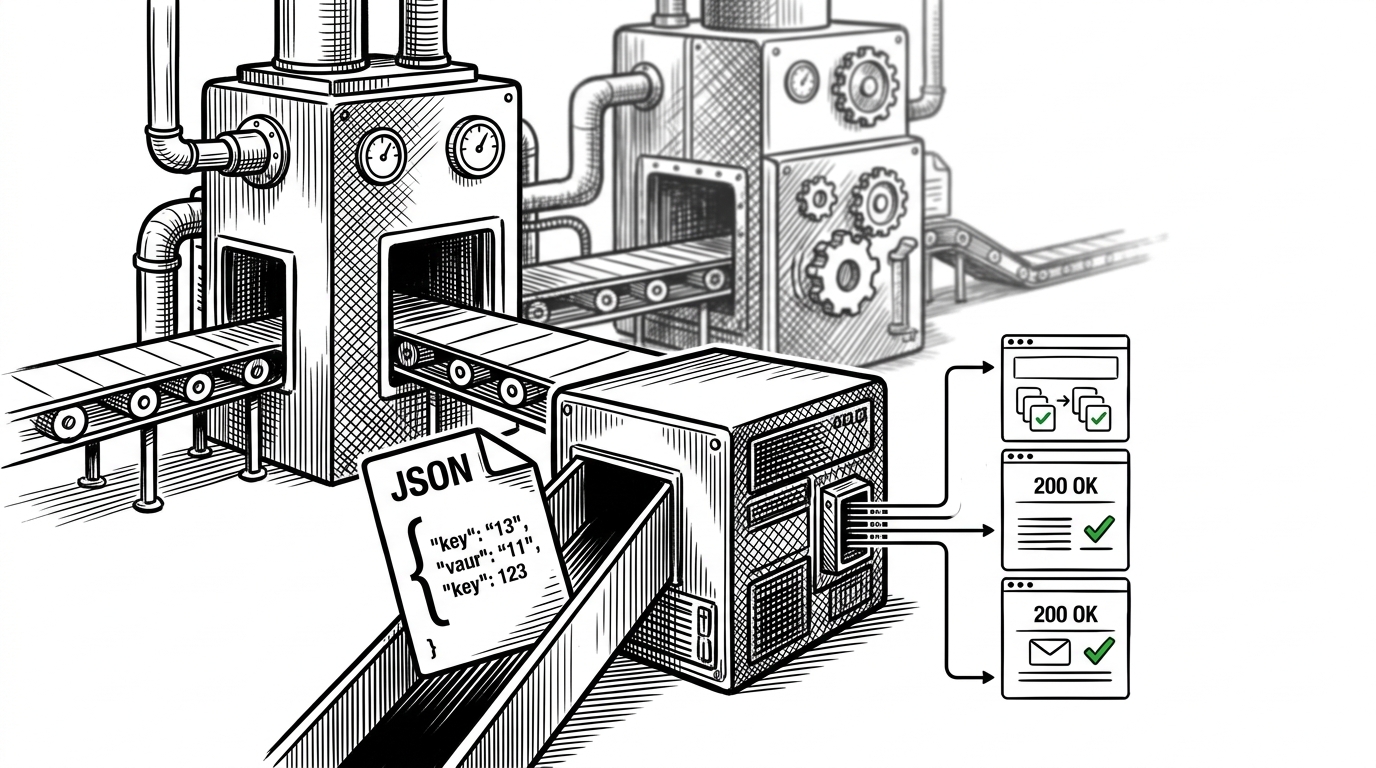
The mental model is almost offensively small. You hand it JSON structure, it serves a mock API over HTTP, and the frontend can keep moving. There is no ceremony here, no platform to learn, and no sense that the tool is waiting for you to become a power user.
Why minimalism is the feature
This is where the project becomes more than a convenience script. Its restraint is the product. The tool succeeds because it does not try to solve the adjacent problems that usually inflate mock API tooling: visual design, orchestration, collaboration, and long-term environment management.
That makes it useful in a specific way. If your real constraint is time, then every extra option is another tax. A smaller surface area is not a compromise when the goal is to cross the finish line before the demo starts.
| Tool | Setup friction | Best for | Feature depth | Tradeoff |
|---|---|---|---|---|
| Last Minute Life Saver | Very low | Immediate mock data for a deadline | Very thin | Does little beyond getting an API online fast |
| JSON Server | Low | Local REST prototypes and CRUD-heavy demos | High | More capable than you need if you only want a fast stub |
| Mockoon | Medium | Teams that want a GUI and response rules | Very high | Powerful, but heavier than a bare minimum utility |
| Postman Mock Servers | Medium to high | Postman-centric workflows and cloud collaboration | Very high | Tied to a broader platform and ecosystem |
The comparison is not about who wins on features. It is about fit for urgency. If you need a working backend-shaped thing before lunch, the shortest path can be the smartest path.
How the pipeline works under the hood
The implementation story is likely simple by design. A server reads the provided JSON shape, maps it to request handlers, and returns mock responses for the endpoints the frontend expects. That is enough to unblock most prototype work, which is why the project feels more like a utility knife than a framework.
The important part is the absence of ceremony. There is no evidence here of a sprawling orchestration layer or a large configuration grammar. The repo behaves like a thin adapter between data structure and HTTP behavior, and that thinness is the point.
JSON shape -> minimal server -> mock endpoints -> frontend continuesThe real comparison is speed, not features
If you are choosing between tools, the decision rule is simple. Use a richer platform when you need persistence, rules, UI editing, or collaboration. Use this when the only thing that matters is getting a believable API shape online before your patience runs out.
That is why this repo sits in a narrow but real niche. It is for the moments when even a good tool can feel like too much tool.
Who built it, and what that tells you
The project is maintained by swastika-paul, and the contributor pattern suggests a small, focused build rather than a community platform. That fits the product perfectly. A personal pain point often produces the sharpest utility, because the first user is unforgiving about wasted steps.
This project is a last-minute life saver for hackathons. It helps you to create a mock API in minutes.
Why this repo matters
Last Minute Life Saver is a reminder that product value is sometimes just subtraction. It refuses to become a platform, and that refusal is its competitive edge. When the deadline is the problem, the fastest escape hatch is the whole story.
The whole pitch is compression, not abstraction. That is exactly what makes it legible to a rushed team. The product metaphor is clean because it matches the behavior. This is the kind of tool you keep in your back pocket for demo week. I want to know the boundary between mock shape and actual behavior. Small tools like this often win by becoming habit-forming, not expansive.
- Sarah Chen, Staff Engineer: The server is intentionally thin, which makes the trade-off easy to understand.
- Marcus Rivera, Product Manager: This is a strong fit for urgency-driven workflows where setup time is the real cost.
- Priya Patel, UX Designer: The best tools often communicate their limits as clearly as their value.
- Jake Torres, Vibe Coder: A tiny rescue utility is exactly what you want when the demo is already behind schedule.