Diffusion_Code: The One-Line Repo That Exposes the Whole Diffusion Stack
A bare README turns into a map of the hidden machinery behind diffusion models, and why so many simple AI projects are anything but.

- This repo works because its emptiness functions like a negative-space diagram of diffusion engineering.
- A real diffusion project is a pipeline, not a single model, and each step depends on the last.
- The root README tells you almost nothing about implementation quality, but it does tell you how much is still missing.
- The first real milestone is reproducibility, not polish.
Most repo names are promises. This one is almost a dare: # Diffusion_Code and nothing else. That tiny surface area is useful because diffusion is one of those fields where the hard part is not the idea, it is the machinery that turns noise into outputs.
# Diffusion_CodeA repo that says almost nothing, and still tells you a lot
The repository currently exposes a single README and no source tree. In practice, that makes it less like a software project and more like a label on an empty drawer. That emptiness is the editorial point: you can already see the shape of the work by noticing everything that is absent.
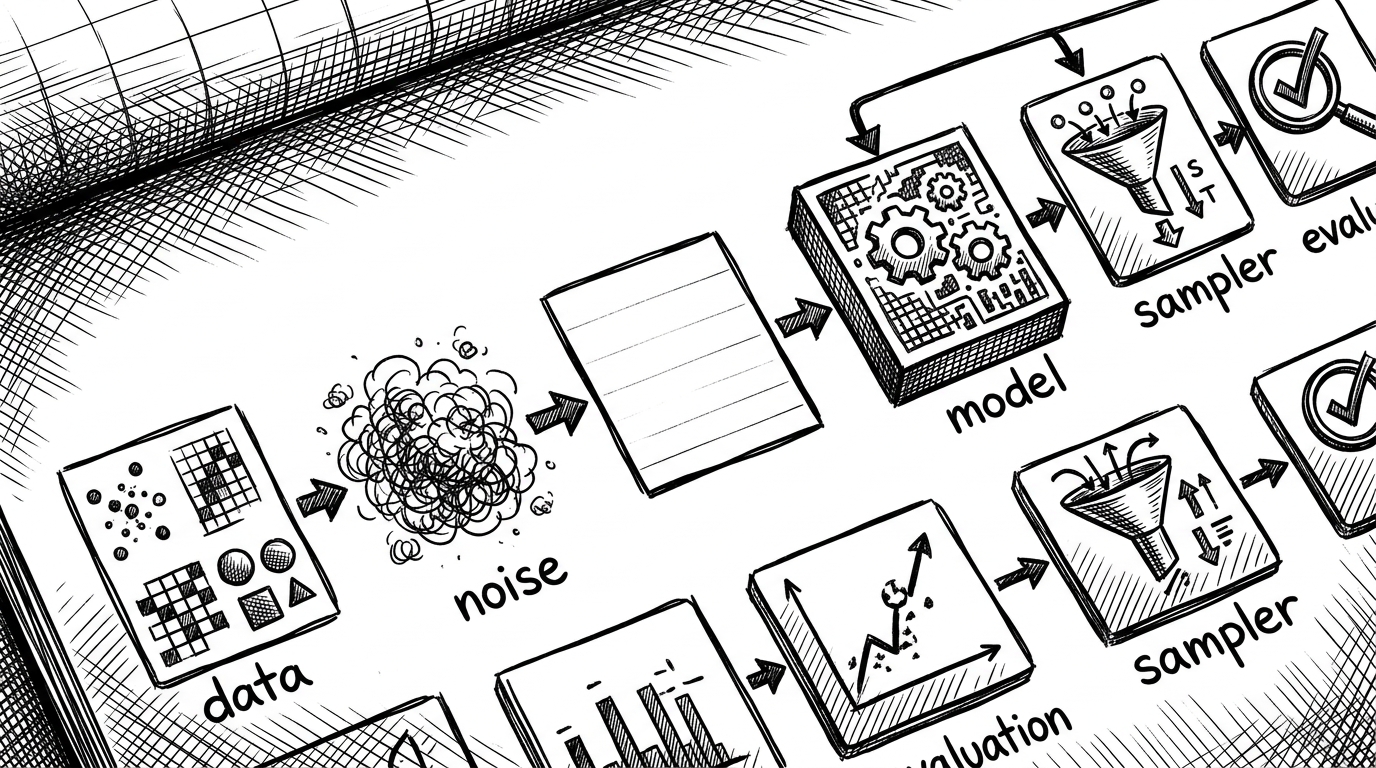
The point is not that each box is conceptually hard. The point is that each box depends on the previous one behaving well, and small implementation choices cascade through the whole pipeline. In diffusion work, the repo root is the least informative layer because the real project lives in the coordination between components.
Why the root folder is the wrong place to judge the work
A name and a README can tell you what the author intended, but not whether the system can actually learn or sample. That is especially true in machine learning repos, where the important logic usually sits in data preprocessing, scheduler settings, loss functions, and inference code. If those pieces do not line up, the top level is just branding.
Who is wanshuiyin?
The public trail for wanshuiyin is thin, and that is worth stating plainly. There is no public bio here to build a big origin story on, so the repository itself has to carry the narrative weight.

Diffusion_Code versus a finished diffusion stack
| Dimension | Diffusion_Code now | Minimal from-scratch diffusion | Hugging Face diffusers |
|---|---|---|---|
| Surface area | One README and no source tree. | A few focused scripts or notebooks. | A broad library surface with pipelines, schedulers, and utilities. |
| Hidden complexity | All implied, none shown. | Visible, but still hand-built. | Abstracted behind reusable components. |
| Intended audience | People reading intent from a name. | Learners and experimenters. | Teams that want a production-ready toolkit. |
| Learning value | Teaches you how much is missing. | Teaches the core mechanics directly. | Teaches how the ecosystem packages those mechanics. |
| Maintenance burden | Near zero, because there is little to maintain. | Moderate, because every part is owned by the author. | Higher, because the abstraction layer must stay stable. |
| What a reader can infer today | The project is a placeholder or a start signal. | The project can probably run a small experiment. | The project aims to save time and reduce implementation risk. |
The comparison is not about size alone. It is about what kind of truth the repo tells the reader. A skeleton repo is honest about its incompleteness, a minimal from-scratch implementation is honest about its learning goals, and a framework like diffusers is honest about the engineering cost of making the whole stack reusable.
What would make this repo worth watching
- A training script that wires together data loading, noise scheduling, optimization, and checkpoint saving.
- A model definition that makes the architecture and loss function explicit.
- A sampling path that can generate output from a saved checkpoint without manual intervention.
- A short evaluation note that states dataset, metrics, and inference settings well enough for someone else to reproduce the result.
Until those pieces exist, the repo is a placeholder. Once they do, the name stops being a promise and starts being a claim. That is the real test for a diffusion project, not whether the root folder looks tidy.