TurboVLA: The Robot Policy That Ditches the LLM Bottleneck
A compact vision-language-action model that uses bidirectional fusion and chunked continuous control to hit real-time performance on consumer hardware.
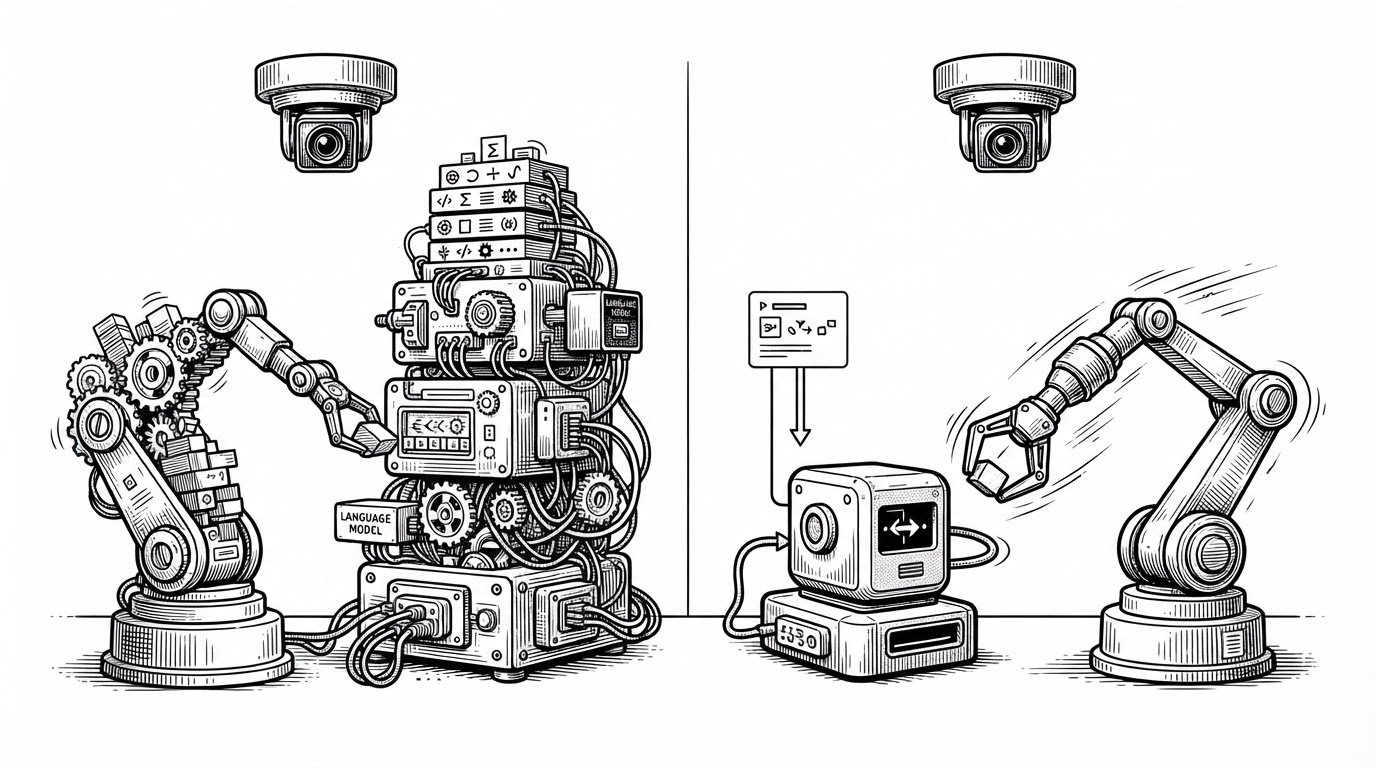
- TurboVLA argues that robotics gets faster and lighter when it stops routing control through a giant language model.
- Its bidirectional vision-language bridge is the technical bet that lets perception and instruction shape each other before action is predicted.
- The action head predicts a chunk of continuous control steps at once, which is how the repo avoids autoregressive latency.
- The project matters because it shows a plausible edge-capable path for language-conditioned manipulation without server-scale hardware.
TurboVLA’s bet: robotics should not wait on a language model
TurboVLA is interesting because it rejects the default robotics stack. Instead of turning robot control into a long language-generation problem, it treats instruction following as a direct vision + language → action pipeline.
That matters in robotics because latency is not an abstract benchmark number. It changes whether a policy can react to drift, contact, or a moving object in time. TurboVLA’s claim is simple: you can cut out the LLM bottleneck without cutting performance.
What the repo is actually building
This is not a one-file demo. The repo is organized like a research codebase with distinct layers for modeling, training, evaluation, and third-party adapters.
turbovla/models/holds the vision encoder, text encoder, fusion layers, and action head.turbovla/training/contains the training loops and recipe support.experiments/packages benchmark configs for LIBERO and RoboTwin.third_party/wires in adapters and runtimes for comparison baselines.
That structure matters because the project is doing two jobs at once. It is a model implementation, but it is also a systems argument about what a practical robotics policy should look like.
The part that matters: bidirectional fusion
The conceptual center of TurboVLA is the VisionLanguageInteraction block and its BiAttentionBlock. The model does not simply concatenate image tokens and text tokens, then hope a decoder sorts it out. It lets the two streams query each other directly.
That symmetric exchange is the reason the fusion layer is interesting. Vision can condition on instruction words, but language can also be sharpened by visual evidence. In robotics, that is not a small difference. It changes how the model grounds commands like “grasp the red block” against actual scene structure.
How TurboVLA turns fused context into motion
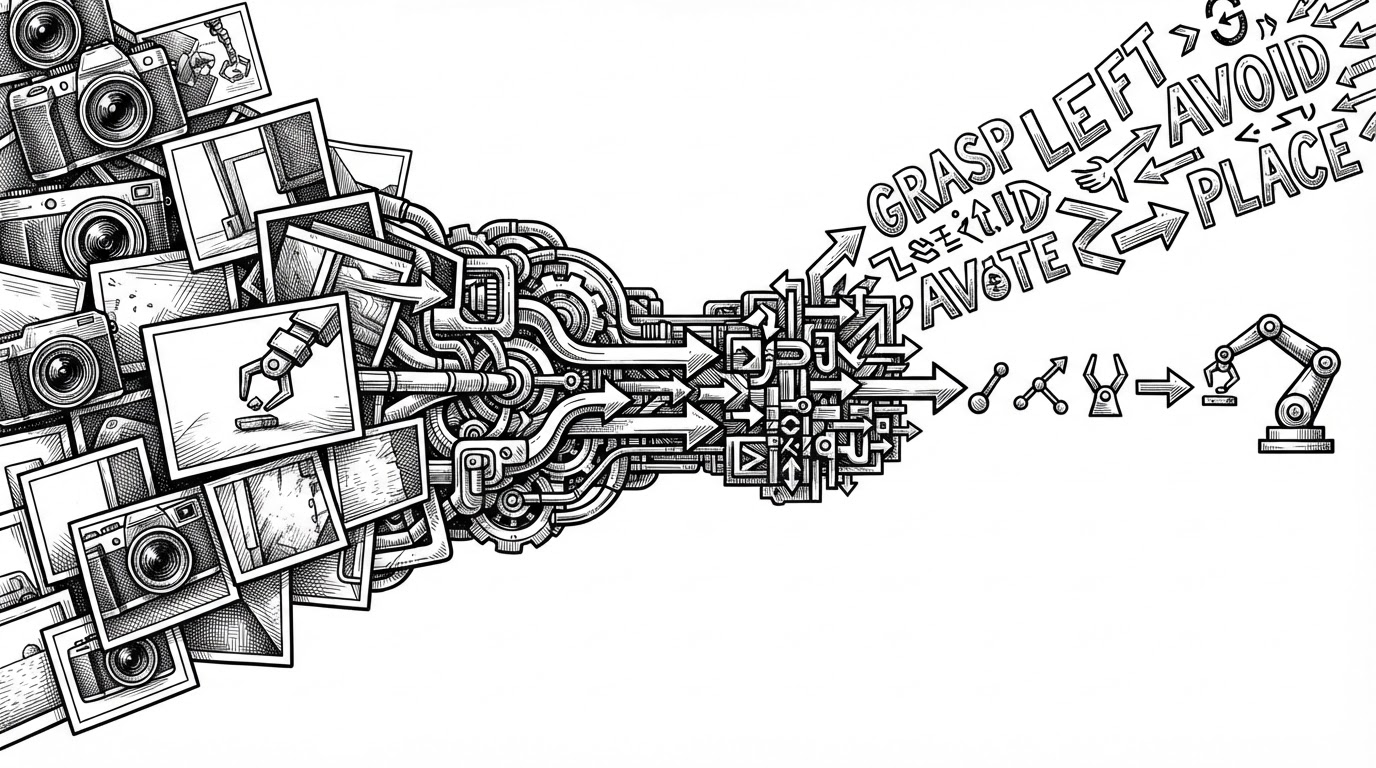
Once the model has shared context, the action head takes over. StateProjection injects the robot’s current proprioceptive state, and ACTDecoder predicts a fixed horizon of future actions as one chunk.
That is the speed trick. Autoregressive systems pay a step-by-step decoding cost. TurboVLA predicts a block of continuous control signals together, then smooths them for execution. The result is a policy that behaves like control software, not a text generator pretending to be one.
# Conceptual flow from the repo
state_tokens = StateProjection(proprio_state)
fused_memory = VisionLanguageInteraction(image_tokens, text_tokens)
action_chunk = ACTDecoder(
    memory=fused_memory,
    state=state_tokens,
    horizon=12,
)
executed_actions = smooth(action_chunk)
The horizon matters because it sets the loop structure. Instead of waiting for a model to speak one action token at a time, the system commits to a short future trajectory and executes it as a compact burst.
Instead of using a large language model as the central interface between perception and action, TurboVLA independently encodes visual observations and language instructions, directly exchanges information between them through lightweight bidirectional vision-language interaction, and predicts continuous action chunks with a compact decoder.
Why the encoders and masking details matter
TurboVLA’s efficiency story is not just one clever layer. It is a stack of smaller choices that all push toward lower latency and lower memory use.
- DINOv3 handles vision, which gives the model a strong visual backbone without relying on a massive multimodal decoder.
- BERT handles language, keeping the instruction path compact and familiar.
- Frozen components and bf16 autocast reduce VRAM pressure.
- Special-token masking helps the text side focus on the parts of the instruction that matter.
The repo also supports multi-view inputs, which is the right robotics assumption. A wrist camera and a fixed overhead camera do not say the same thing, and the model needs to deal with both without collapsing into a single flat token soup.
TurboVLA versus the usual suspects
TurboVLA is not trying to win by being the largest or the most famous. It competes by collapsing latency, memory, and action generation into a simpler control loop.
| Model | Core approach | Action generation style | Typical deployment profile | Why TurboVLA is different |
|---|---|---|---|---|
| TurboVLA | Direct vision-language interaction plus compact action decoding | Continuous action chunks | Single consumer GPU, real-time control | Skips the LLM-centered control loop |
| OpenVLA | LLM-backed vision-language-action policy | Autoregressive token-style actions | Heavier GPU footprint, slower control | Keeps the policy lighter and faster |
| RT-2 | Large closed vision-language-action system | Tokenized action reasoning | Server-scale, not local-first | Avoids the giant decoder bottleneck |
| π0 | Flow-matching continuous control | Continuous actions | Strong performance but different design trade-off | Matches the efficiency narrative with a smaller footprint |
| TinyVLA / VLA-Adapter | Lightweight adaptation on top of VLA stacks | Usually still tied to heavier backbones | Research-efficient but often bottlenecked | Moves the bridge itself, not just the adapter |
That comparison is the real point. TurboVLA does not just trim parameters. It changes where information lives, how often the model has to speak, and how fast the robot can respond.
TurboVLA provides a favorable trade-off among manipulation performance, inference latency and model scale, thereby lowering the hardware barrier to deploying language-conditioned manipulation policies in latency-sensitive and resource-constrained robotic systems.
Why this matters beyond one benchmark
The bigger implication is that robotics may be entering an efficiency-first phase. If a 0.2B model can deliver competitive LIBERO results while staying light enough for consumer hardware, then the field has less reason to treat giant language models as mandatory middleware.
That does not make LLMs irrelevant. It does mean they are no longer the obvious center of the stack for every embodied task. TurboVLA is a good sign for labs and teams that care about real-time manipulation, modest hardware budgets, and deployment that does not require a server room.