CyberArch-Dotfiles Turns Arch Linux Into a Playable HUD
A deep look at the diegetic desktop that fuses Hyprland, AGS, Quickshell, and a custom C++ window decoration plugin into one cohesive Cyberpunk-inspired workstation.
- CyberArch-Dotfiles is compelling because it uses game logic, not just game styling, to organize an entire desktop.
- Its strongest move is the translation layer that turns raw machine state into a coherent fictional HUD.
- The custom C++ Hyprland plugin matters because it pulls the illusion down into window geometry instead of leaving it as an overlay.
- This project is less about minimalism or portability than about immersion, consistency, and a very specific user experience.
The desktop that thinks in game mechanics
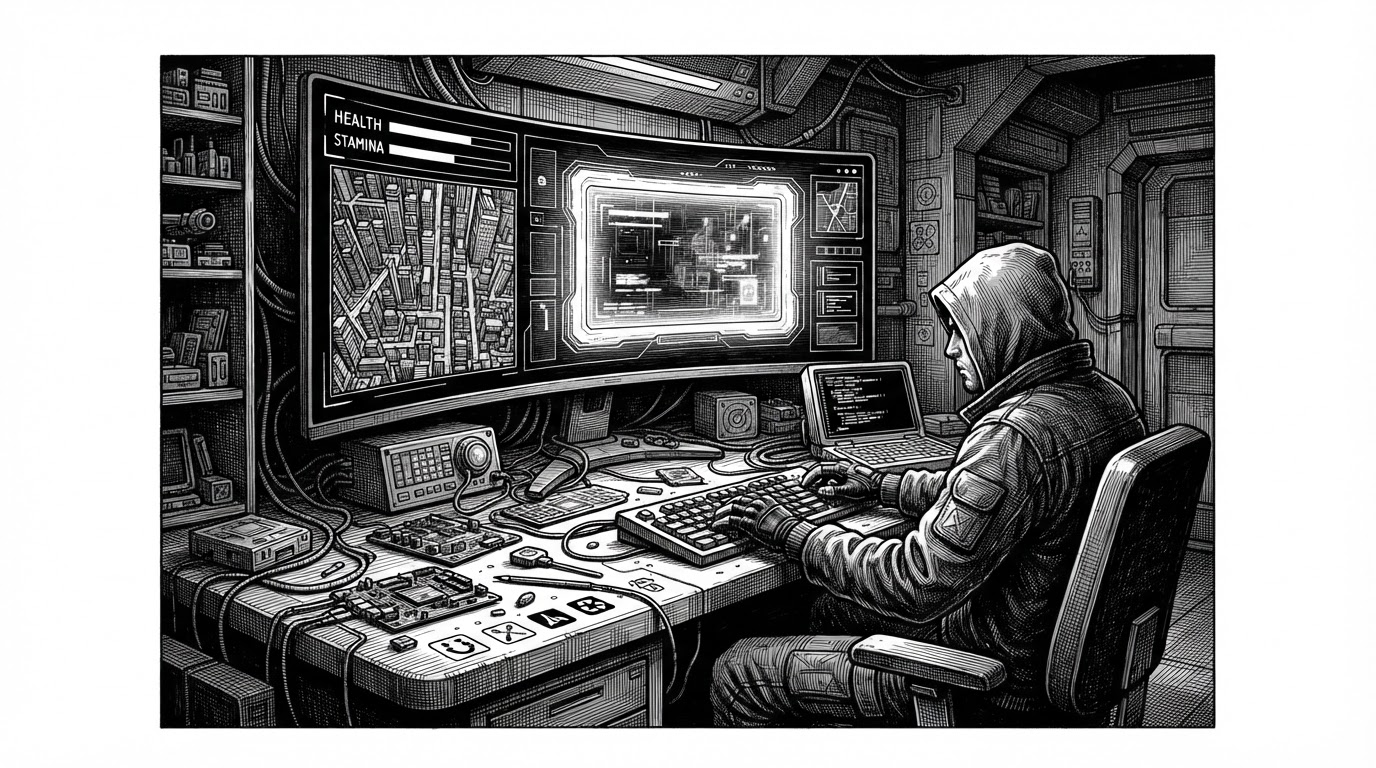
CyberArch-Dotfiles is not a wallpaper pack with ambition. It is a desktop that translates ordinary Linux chores into the language of Cyberpunk 2077: CPU becomes health, memory becomes level, updates become Street Cred, and the window chrome itself starts to feel native to the fiction. The result is a workstation that reads like a HUD, but still works like Arch Linux.
That distinction matters. Plenty of dotfiles look cohesive in a screenshot, then fall apart the moment you use them. CyberArch is interesting because it tries to make the interface world coherent across layers that are usually disconnected.
This is my attempt to recreate Cyberpunk 2077 UI entirely on Hyprland, using AGS/Astal to build the HUD similar to the in-game overlay including the widgets, minimaps, and more themed features.
Why diegetic UI is the real innovation
Diegetic UI means the interface belongs to the world it is describing. In a game, a health bar makes sense because it lives inside the fiction. CyberArch borrows that idea for the desktop, and that is why it feels stranger and more deliberate than a standard themed panel.
The project is not trying to look like Cyberpunk. It is trying to make the desktop behave as if it were built by the same design system that produced Cyberpunk. That is a different claim, and a harder one to pull off.
The stack split that makes the illusion hold
The project’s architecture is what keeps it from becoming a collage. High-level HUD logic lives in TypeScript through AGS and Astal. Quickshell handles the lockscreen and login layer. A custom C++ Hyprland plugin handles the window decoration pieces that most desktop themes fake with overlays.
Real signal      →  Translation layer         →  Fictional output
CPU load         →  Astal widget logic        →  Health bar
Battery          →  HUD state mapping         →  Stamina bar
Workspace status  →  Shell and compositor      →  Location or status feed
Window events     →  Hyprland plugin hooks     →  Cyberbars frame and chrome
Weather API       →  Widget data binding       →  City readout / minimap
Package updates   →  Update hooks and labels   →  Street Cred status
That split matters because it changes the feel of the interface. A CSS overlay can suggest a theme. A compositor-level decoration can change how the window itself behaves. CyberArch leans on both, but the C++ layer is what makes the result feel native instead of pasted on.
| Layer | Role | Why it matters |
|---|---|---|
| TypeScript and Astal | Widget logic and telemetry mapping | Handles the HUD semantics and data binding. |
| Quickshell | Lockscreen and login UI | Extends the same visual language beyond the desktop. |
| C++ Hyprland plugin | Window decoration and event hooks | Moves the cyber bars into compositor geometry. |
| Shell and assets | Automation, audio, and theming | Keeps the fiction consistent across startup and interaction. |
How the HUD maps reality to fiction
The mappings are simple, but the consistency is what makes them convincing. CPU becomes health. Battery becomes stamina. Memory becomes level. Workspace state turns into location or status. Weather becomes a city readout. Package updates become Street Cred. None of those choices are random skinning.
They work because they preserve the logic of the metaphor. A player already understands that health is something to protect, stamina is something to manage, and Street Cred is something that changes your standing. CyberArch uses those same mental shortcuts to make system state feel legible at a glance.
| Real signal | Fictional meaning | Why it works |
|---|---|---|
| CPU | Health | It conveys immediate risk and load. |
| Battery | Stamina | It suggests limited endurance. |
| Memory | Level | It reads as accumulated capacity. |
| Workspace | Location or status | It gives the desktop spatial structure. |
| Package updates | Street Cred | It gamifies maintenance without hiding the task. |
| Weather | City feed | It makes the desktop feel situated in a world. |
The C++ plugin is the sharpest part
Most desktop rice setups stop at panels. CyberArch goes deeper by attaching custom decorations through Hyprland itself. The `cyberbars` plugin listens for compositor events, then renders bars as part of window geometry instead of as floating UI chrome.
That is why the project feels credible. The title bar is not a skin laid over the window. It behaves like a native extension of the compositor, which makes the whole desktop feel more physically integrated.
this is really what I want to see instead of rounded-radiusslop.
What it is better than, and what it is not
Compared with a conventional Hyprland setup, CyberArch is much more opinionated. Compared with an AGS-heavy shell like Caelestia or HyprLuna, it is more committed to a single fictional universe. Compared with automation-first setups like JaKooLit NixOS-Hyprland, it cares less about general-purpose convenience and more about immersion.
| Project type | Primary goal | Trade-off |
|---|---|---|
| Conventional Hyprland dotfiles | Practical customization | Usually less cohesive visually. |
| Caelestia / AGS shell | Polished desktop shell | Strong UI design, weaker narrative specificity. |
| JaKooLit NixOS-Hyprland | Ease of installation and automation | Less bespoke in the UI layer. |
| CyberArch-Dotfiles | Diegetic immersion | More specialized and more complex to maintain. |
That is the real takeaway. CyberArch is not trying to be the best desktop for everyone. It is trying to be the most convincing desktop for one particular idea, and it is willing to build a whole stack to support that idea.
Why this project matters beyond the cyberpunk aesthetic
The broader lesson is not about fandom. It is about interface design. When the metaphors in a system match the user’s mental model, the whole environment becomes easier to read and harder to forget.
CyberArch-Dotfiles shows that desktop customization can be a systems-design exercise. It is a reminder that the best interfaces do not just look coherent. They act coherent.