Victory Fork Skips CPU Emulation Entirely. That's the Point.
How a Windows runtime runs Xbox Series binaries natively and translates only the shader and OS boundaries.

Playable, slowly: about 11 world frames per second at the first boat mission at 1,500 to 3,300 draws (usual frame 88 ms), 8.5 at 3,300 and more (115 to 120 ms); the console runs 30.
- Victory Fork runs the console's CPU code natively because Xbox Series silicon is x86-64, the same family as a desktop PC.
- The emulation lives at two boundaries: shader bytecode translated from GFX10 to DXIL, and Xbox OS services high-level-emulated.
- A translation funnel counts every shader program through decode, control-flow recovery, resource resolution, and emission, so failures are measured rather than guessed.
- The fork's README documents what does not work yet, down to frame rates and missing ray-traced lighting.
The Console Is a PC in a Costume
Every emulator you have used does the same thing first. It reads foreign instructions and translates them, one at a time, into something the host CPU understands. Victory Fork does not. The Xbox Series X|S CPU is a Zen 2 x86-64 part, the same family as the chip in a desktop tower. So the title's binary is, in a real sense, a PC binary wearing a console costume.
The project's check_cpu_features function requires AVX2 and says so plainly: Xbox Series binaries are compiled for Zen 2. There is no interpreter in the path. The loader maps the title's executable into memory, binds its imports, and lets the host CPU run the instructions directly. An escape hatch (VICTORY_SKIP_CPU_CHECK=1) exists for emulated CPUs such as Intel SDE, but the default assumption is silicon parity.
a compatibility layer that runs an Xbox Series title natively on Windows from files the user supplies.
Where the Emulation Actually Lives
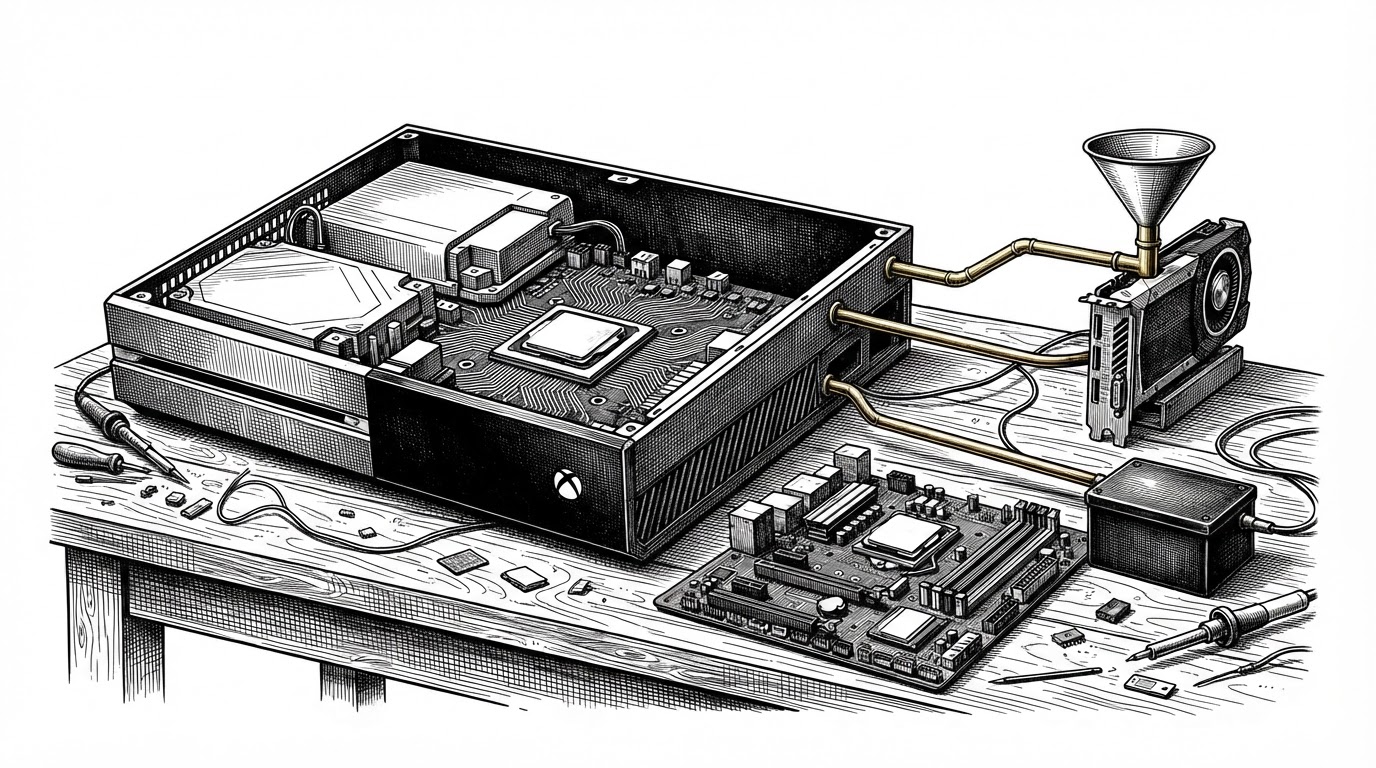
Skip the CPU and the question becomes: what is left to emulate? Two seams. The first is the GPU. The console's RDNA2-family shader bytecode has to be decoded, rebuilt, and re-emitted as DXIL for the host's Direct3D 12 driver. The second is the operating system. Xbox system services (the console's D3D12 dialect, its audio codec, its video codec, its lifecycle) are high-level-emulated, meaning the runtime intercepts the calls and answers them itself.
The CPU path has zero translation gates. The GPU and OS paths carry all of them. That asymmetry is the whole architecture, and it is why the project reads less like a virtual machine and more like a translator bolted onto a native binary.
The Shader Funnel
The technical heart of the project is a funnel. In translate.rs, a struct called Tally counts every shader program as it passes through each stage of the pipeline. The counters read like a checkpoint log: containers, programs, translated, structured, tracked, loaded, built, emitted, validated, pipelines.
The stages themselves are the work. Decode the console's GFX10 machine code. Recover control flow, distinguishing divergent per-thread lane_branches from uniform_branches. Resolve descriptors by tracing which root parameters they reference, with failures landing in untraced_used or unlisted buckets. Patch I/O for vertex, pixel, and export stages. Emit DXIL. Validate it with dxil.dll. Create the host pipeline.
The failure reporting is the clever part. The fail method runs in two modes: list mode writes one line per program, while the default keeps only the first example per distinct failure reason. That turns thousands of shaders into a short list of causes, each with one exemplar. Triage becomes reading, not scrolling.
There is also an offline warming trick. Shaders are hashed by their container, not by whatever file carries them, so a cache built offline matches the key the runtime looks up. The code comment states the reason directly: hash the container, not the rest of its carrier.
Tally::merge is about sixty lines of manual field-by-field addition, because each worker thread keeps its own tally and they are summed at the end. Adding a counter means updating merge. It is error-prone, but it keeps locks off the hot path.
A Fork With a Paper Trail
The origin arrives late because the seam is the story. fxceless's fork builds on VIctory, created by Marvisak, and now follows the VIctory-NVIDIA line from trustno1-coder. It ports patches from xss3009 and Vice-Tay, and used XCL as a reference for how the same title behaves under a different layer.

The culture shows in the code. In play.rs, a settings table lists about sixty VICTORY_* variables, each group commented by subsystem, and some entries record measurements rather than intent. One comment explains why textures are placed in the first block that fits instead of the fullest block: changing that would change how often an empty block is given back to the card, which has not been counted yet. Negative results stay in the record.
Environment hygiene is deliberate. Every VICTORY_* variable is cleared and reapplied at each run, because a restart from the game's own menu would otherwise inherit the last run's settings. Nothing is written beside the program or into the title's folder. Settings, logs, and NVIDIA files go under %LOCALAPPDATA%\victory. DLSS files are fetched only after a one-time consent prompt.
What It Doesn't Do Yet
The README is unusually honest for a genre built on hype. It reports playable but slow: about 11 world frames per second at the first boat mission on one RTX 4070 test machine, where the console runs 30. It lists missing ray-traced lighting and shadows, black shadowed areas, and device-loss instability after extended play.
The repository also states plainly that it contains no game files, and that it is not affiliated with the game's developer or publisher. A maintainer who publishes a failure inventory is telling you exactly how much to trust the rest of the numbers.
This repository contains no game files, code or assets.
Specialized vs General
The comparison that matters is not which fork is faster. It is what each one is for. The VIctory lineage, including this fork, is tailored to a single title. XCL aims at broad Xbox Series compatibility, described as being in the spirit of Wine or Proton. That is a difference in engineering goal, not in maturity.
Reported frame rates are not like-for-like benchmarks. Builds, scenes, settings, and hardware all differ. Treat them as qualitative signals about goals and maturity, not a ranking.
| Project | Scope | Reported status | Differentiator |
|---|---|---|---|
| fxceless/victory-fork | Title-specific fork | Playable early sections, about 11 FPS on one RTX 4070 | Rendering and performance fixes, experimental ray tracing |
| VIctory | Title-specific runtime | Active development | Loader, runtime services, D3D12 backend, shader recompiler |
| VIctory-NVIDIA | NVIDIA-oriented VIctory line | About 17 FPS open-world on an RTX 4070 at 2560x1440 | NVIDIA-focused branch later adopted by fxceless |
| XCL | General Xbox Series layer | Several titles reported working | Breadth across titles, in the spirit of Wine or Proton |