XCL Doesn't Emulate Xbox Games. It Rewrites Them.
A Rust compatibility layer runs Xbox Series X|S code natively on Windows and compiles the console's RDNA2 shaders into Direct3D 12, one instruction at a time.

- XCL runs Xbox Series X|S games without a CPU emulator because both the console and the PC are x86-64 machines, so the game's own code executes at native speed.
- The project's real engineering is a from-scratch Rust compiler that decodes the console's RDNA2 GPU machine code and re-emits it as Direct3D 12's DXIL.
- XCL follows Wine's playbook: it reimplements the console's system libraries rather than emulating hardware, and it draws a hard line at game data, SDK code, and keys.
- A game can reach its menus while its rendering pipeline remains incomplete, so booting and playing are two different milestones.
The Emulator That Refuses to Emulate
XCL maps an Xbox Series X|S executable directly into a Windows process and lets its x64 code run. There is no instruction translator, no interpreter loop, no just-in-time recompiler warming up in the background. The game's own machine code executes on the host CPU at the speed the host CPU allows.
That sounds impossible until you notice the obvious. Xbox Series X|S consoles and Windows PCs both run AMD x86-64. The two machines speak the same CPU language. So the classic emulator problem, the one that consumed decades of work on the original Xbox and the Xbox 360, simply evaporates. There is nothing to translate.
The gap is on the other side of the machine. Xbox Series consoles carry AMD RDNA2 GPUs, and their shaders ship as RDNA2 machine code. Windows PCs running Direct3D 12 want DXIL, a different intermediate representation entirely. Nothing on a normal PC understands the console's shader binaries. Closing that gap is where XCL lives or dies.
There is no CPU emulation: the game's x64 code runs natively, and XCL provides its own, independently written implementations of the console system libraries the PC does not have
Wine, But for a Console
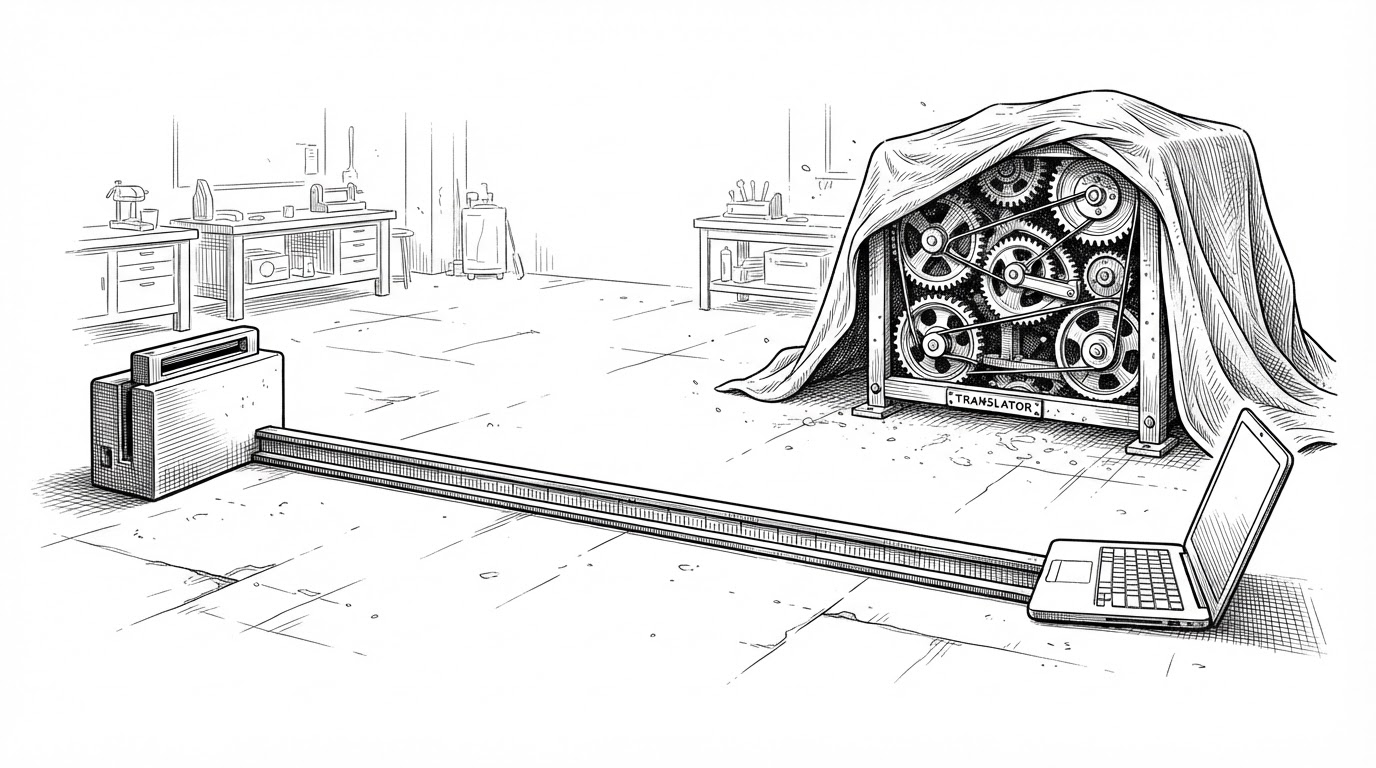
XCL borrows its entire strategy from Wine. Instead of simulating hardware, it reimplements the platform's software. Where a game calls into the console's kernel, its game runtime, or its Direct3D variant, XCL answers with a module it wrote itself in Rust: kernelx, XGameRuntime, d3d12_xs. The game never knows the difference.
XCL is a compatibility layer that runs Xbox Series X|S (GDK) games you own on a Windows PC - in the spirit of Wine/Proton.
The boundary the project draws around itself is the interesting part, and it is not a footnote. XCL states that it does not download, decrypt, or unpack game packages, and that it contains no SDK code, keys, or game data. It works only with games a user already owns and has unpacked. That line is what lets an ambitious project operate in the open.
XCL is also not alone. VIctory runs Xbox Series titles natively and translates shaders. A community fork of VIctory targets NVIDIA hardware. Leonida Continued and Xbox2Windows take the static-recompilation route, translating machine code ahead of time. The whole cluster has become a lightning rod for attention, complete with a Discord takeover dispute, a viral streamer who the team says is not affiliated, and a wave of clickbait claiming a brand-new retail game runs on PC. XCL is one contender in a crowded field, not a lone wolf.
The Shader Compiler Is the Whole Ballgame
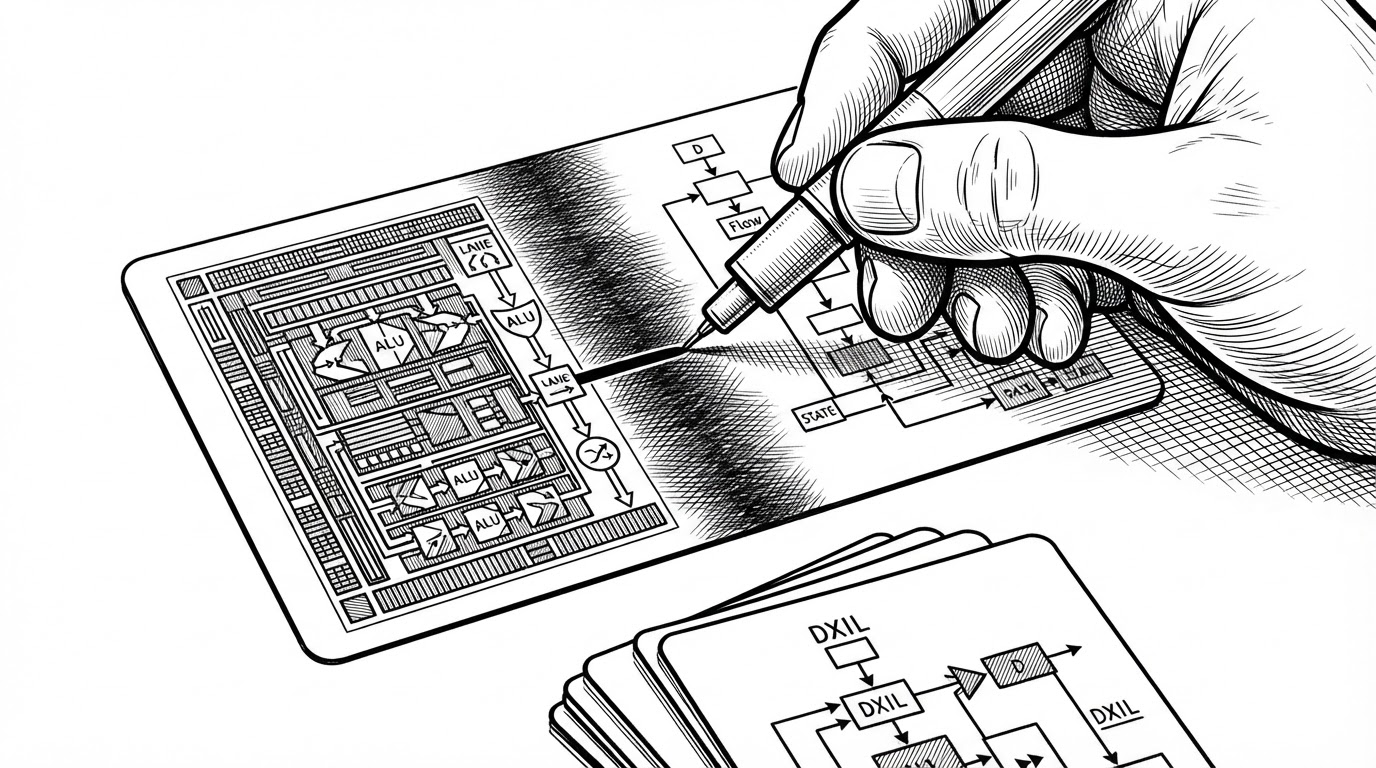
A console shader arrives as a blob of RDNA2 GPU machine code. Windows wants DXIL. These are not dialects of one language. They are different languages with different assumptions about how work is parallelized across lanes, how registers behave, and what the memory model guarantees. Bridging them is not a shim or a lookup table. It is a compiler.
The pipeline in crates/xcl/src/gpu/ runs like a textbook compiler. It decodes RDNA2 instructions, lifts them into static single assignment form so every register write becomes one named value, builds a control flow graph from branches and loops, then runs a series of lower_* passes that translate RDNA2 semantics into something DXIL-shaped. A hand-written bitstream writer packs the result into a DXBC container the driver will accept.
Two helper modules make the semantics concrete. lane_masks.rs tracks how RDNA2 distributes work across GPU lanes, and x64_masks.rs handles the register behavior that DXIL expects. GPU instruction sets encode parallelism and memory assumptions that do not map one-to-one onto DXIL, so the compiler carries that context through its middle stages instead of pretending the two languages line up.
// The shape of a lowering pass: one RDNA2 semantic family
// rewritten into DXIL-friendly intermediate representation.
// Names follow the lower_* convention used across gpu/dxil/.

pub fn lower_vector_ops(
    func: &mut Function,
    masks: &LaneMasks,
) -> Result<(), LowerError> {
    for inst in func.instructions_mut() {
        match inst.opcode() {
            Rdna2Op::LaneSelect => inst.rewrite_dxil(masks.select_form())?,
            Rdna2Op::VectorAdd  => inst.rewrite_dxil(DxilOp::Add)?,
            _ => continue,
        }
    }
    Ok(())
}
The naming is honest about what is happening. This is not a wrapper around a driver feature or a clever use of an existing tool. It is a translation layer built from the ground up in a language chosen for control over memory and bit layout.
Loading an Xbox Executable as If It Were a DLL
Before any shader runs, the game has to load. XCL's PE loader maps a console executable into the host process the way Windows maps a DLL, without letting any of the game's code execute until the environment is ready.
The sequence is careful. It parses the image, reserves memory at the executable's preferred base address, copies headers and sections into place, applies DIR64 and HIGHLOW relocations, then resolves imports. One detail is easy to miss and hard to get right: the module is registered with the loader before imports are resolved, so a game DLL that imports from a DLL that imports back terminates instead of recursing forever. Cyclic imports are the norm in a real game, not the exception.
Then there is the TLS callback. XCL registers one in the .CRT$XLY section, a PE mechanism rather than a Windows API you call at runtime. The Windows loader fires it on every thread start and thread exit, which is how the game's own TLS callbacks and DllMains get delivered. It is a quiet piece of plumbing that most compatibility layers get wrong, and getting it right is the difference between a game that loads and a game that hangs on the first thread it spawns.
Rebuilding the Console, One API at a Time
Everything the console offers that Windows does not, XCL has to supply. The hle/ directory is that supply line. d3d12x/ provides the console's Direct3D variant with two backends, a real renderer and a null one for testing. dstorage/ builds DirectStorage on top of miniz_oxide. There are modules for the game runtime, for BCPack texture compression, for XMA2 audio, for Bink video, and for the console kernel.
Most calls reach these replacements through the game's import table, which XCL rewrites during load. For the rest, the calls that bypass the import table entirely, XCL falls back to inline hooks. The comment in the hooking module names the cases directly: file APIs called by the CRT, and exception machinery. These are the calls a game makes without ever going through its own import list.
// Inline hooks cover the calls that never touch the import table:
// CRT file calls, exception machinery, and similar bypasses.

pub fn hook(
    module: &str,
    func: &str,
    detour: unsafe extern "system" fn() -> isize,
) -> Result<usize, String> {
    let addr = resolve_export(module, func)?;
    let detour = unsafe { RawDetour::new(addr, detour as _) }?;
    detour.enable()?;
    let trampoline = detour.trampoline() as usize;
    ORIG.store(trampoline, Ordering::Release);
    std::mem::forget(detour); // trampoline stays live for the process
    Ok(trampoline)
}
How XCL Compares
The projects chasing Xbox Series titles on PC split along one axis: what they do with the CPU. Some run x64 code natively, some statically recompile it ahead of time, and one older project emulates a different console generation entirely. XCL sits firmly in the native camp, and its distinguishing work is the shader compiler.
| Project | Approach | Target | Graphics path | Status claim |
|---|---|---|---|---|
| XCL | Native x64 plus RDNA2 to DXIL compiler | Xbox Series GDK | Direct3D 12 | Selected titles playable |
| VIctory | Native x64 plus shader translation | Xbox Series GDK | Direct3D 12 | Early scenes render |
| VIctory community fork | Same approach, NVIDIA focused | Xbox Series GDK | Direct3D 12 | Prologue at low frame rates |
| Leonida Continued | Static recompilation plus asset export | Xbox Series GDK | Vulkan | Does not boot |
| Xbox2Windows | Static recompilation of selected code | Xbox Series GDK | Desktop DXIL | Test programs only |
| Xbox Emulator | Runtime platform rebuild | Xbox Series GDK | Unspecified | No game run yet |
| Xenia | CPU and GPU emulation | Xbox 360 | Its own renderer | Mature for a different generation |
| Wine / Proton | Syscall and library compatibility layer | Windows apps | Native Windows APIs | Mature for a different platform |
Every status claim in that table is the project's own, drawn from the cited comparison rather than from independent testing. Star counts and progress notes move quickly, so treat the column as a snapshot of what each team says about itself, not as a scoreboard.
What Works, What Doesn't
XCL's own compatibility notes list Minecraft Preview and Unicorn Overlord as playable. Fortnite and XDefiant are said to work to the extent their online services allow. A newer, unnamed retail title reaches its menus and settings screens, but the project says its 3D world is incomplete and not playable. These are the project's claims, and they should be read as such.
The gap between those two cases is the whole story of a compatibility layer in progress. A game can boot, load its assets, and draw a menu while individual rendering pipelines are still missing or wrong. Reaching the main menu proves the loader, the runtime, and a slice of the graphics path. Rendering a full 3D world proves dozens more. Booting is not playing, and the project is unusually clear about the difference.
That is the honest shape of the project. The CPU problem was solved by noticing it was never a problem. The GPU problem was solved by writing an entire compiler. The remaining work is the long tail of a console's software surface, one API and one rendering pipeline at a time.