VIctory-NVIDIA Runs an Xbox Game on Windows by Asking Windows First
The Rust compatibility layer spends less time emulating than you'd expect. Mostly, it negotiates: with the D3D12 runtime, with NVIDIA Streamline, and with whatever GPU you happen to own.
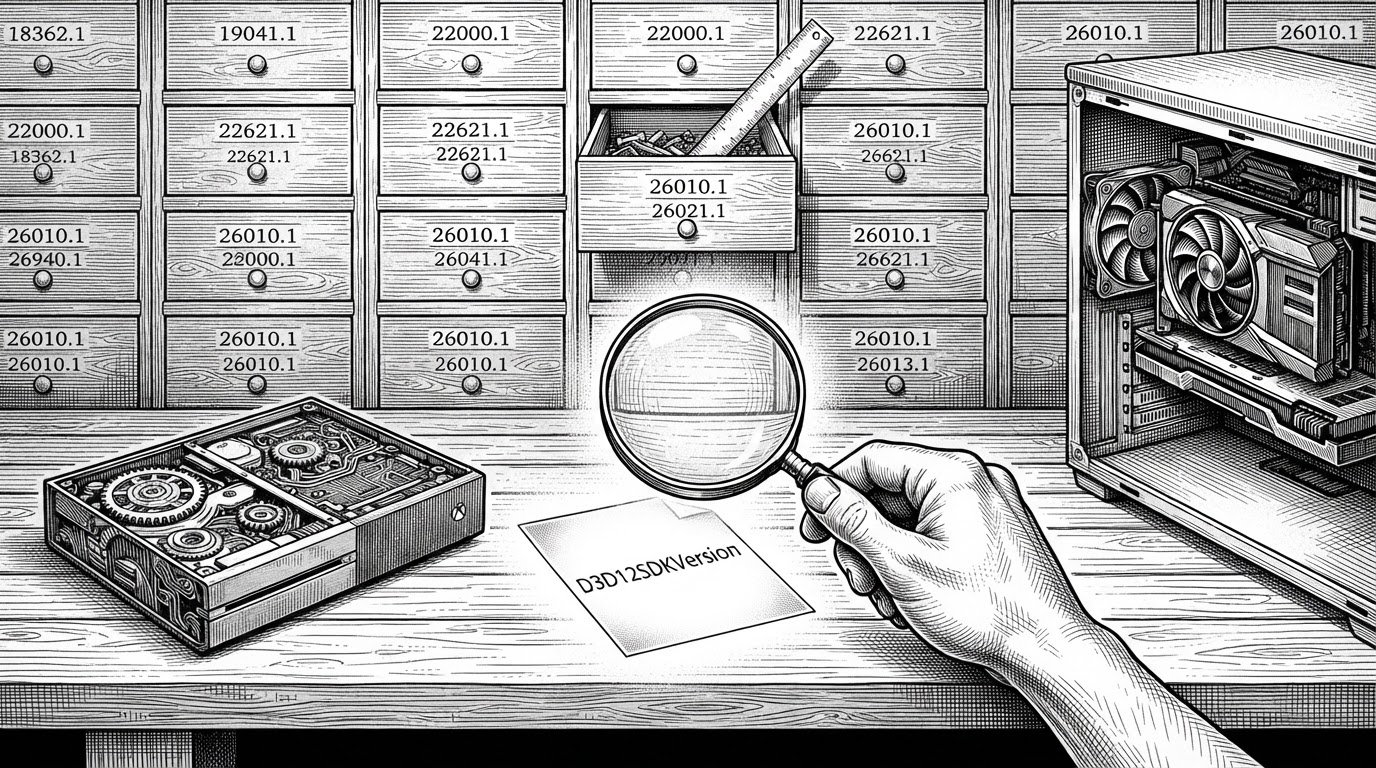
- VIctory-NVIDIA's defining move is negotiation, not translation: it reads Windows' own D3D12Core.dll to decide which runtime version to request, because guessing wrong means the game never launches.
- The layer asks before it commits, querying NVIDIA Streamline for what is actually available and degrading a missing feature instead of aborting the run.
- Its code comments are a decision log, citing specific GPUs, Windows builds, and previous fixes that turned out to be wrong.
- It is a fork of a fork, part of a distributed research collective that trades patches across a dozen sibling projects.
The Sixteen Bytes That Decide Whether the Game Starts
Most compatibility layers begin with translation. This one begins with a question. Before a single console instruction is decoded, victory.exe reads a file it did not write, on a machine it has never seen, to find out which version of Direct3D 12 it is allowed to ask for.
The mechanism is Microsoft's Agility SDK protocol. Windows looks for an exported symbol named D3D12SDKVersion in the host executable and uses its value to pick which D3D12 runtime to load. Get it wrong and the loader returns 0x887E0003. The game does not start. There is no partial credit.
So VIctory-NVIDIA does not guess. main.rs exports the symbol as an AtomicU32 so the value can be written at runtime, then parses the PE headers of System32\D3D12Core.dll by hand: e_lfanew at offset 0x3c, PE32+ magic 0x20b, the export directory at data-directory slot 112, RVAs mapped to file offsets through the section table. It scans for the VS_FIXEDFILEINFO signature 0xFEEF04BD to read the file version, finds the exported D3D12SDKVersion, and requests min(installed, 614).
The ordering is the fragile part. An ordinary import would load d3d12.dll before main runs, so the version set inside main would be ignored. build.rs defers that load until first use, which is what makes the whole handshake possible.
What VIctory-NVIDIA Actually Is
It is a Rust compatibility layer that runs a user's own dump of an Xbox Series build of a modern title on Windows PCs. It translates the console's GPU work, compiled for AMD RDNA 2, onto the host's Direct3D 12 driver, then layers NVIDIA-specific features on top: DLSS upscaling and frame generation through NVIDIA Streamline, native 2560x1440 output via byte-level patches to the retail executable, an FSR 3 fallback for non-DLSS cards, and an F1 settings menu plus F3 stats panel drawn inside the game's own window.
The README is blunt about scope. It ships no game files and no vendor binaries. Users supply their own legally obtained copy; optional NVIDIA, AMD, and Microsoft components are fetched from the vendors' own GitHub repositories after a yes/no prompt, then verified. The workspace is a Cargo workspace: apps/victory is the CLI, victory-gpu is the largest crate, victory-hle emulates console OS modules like audio and video playback, and victory-shader handles DXBC and DXIL parsing. Rust is more than 99% of the tree. The PowerShell and Batch files exist only as launchers and downloaders, and they are compiled straight into the binary with include_str!.
This repository contains no game files, code or assets.
A Fork of a Fork of a Fork
The lineage is the strangest part of the story. The README records that it moved to foxhound as its base, reporting nearly twice the performance in the same rooms at higher resolution on the same PC. Everything NVIDIA-specific is an addition on top of that base, not an unrelated implementation.
It credits fxceless's pull requests 1189 and 927 for interface rendering and character facial animation fixes, and CGBJ's renderer for enabling the ray-tracing structure builder on NVIDIA. It names Belobug's, DexNom's, Kelvaroq's, Neptune, and others as projects it built, ran, compared, or drew on.
That is not a normal dependency tree. It is a distributed research collective: several people running the same console build on different GPUs, publishing patches and screenshots, and pulling each other's fixes forward. A compatibility layer for one title is too large for one person, so the scene shares the load.
Every Subsystem Is a Negotiation
Zoom out from the handshake and the same pattern repeats across the codebase. run.rs loads Streamline before anything of the title or the host GPU, with Asked::from_env() producing a request and streamline::init returning what is actually available. The upscaler is chosen from that result. A requested feature the host cannot provide degrades instead of aborting the run.
CPU gating requires AVX2, because Series binaries are compiled for Zen 2. The check is written as a pure, unit-testable function wrapped in a platform-specific one, and its error message names the escape hatch (VICTORY_SKIP_CPU_CHECK=1) and Intel SDE, so the failure is actionable rather than a wall.
title_executable accepts a file or a folder, prefers names starting with game, and refuses to guess when several match. play.rs clears every VICTORY_* variable before applying its own table of about 70 settings, so no stale state leaks between runs. Settings are environment variables set before the process starts, which is why the F1 menu saves to a file and restarts the process.
| Subsystem | What it asks | What it does when the answer is no |
|---|---|---|
| D3D12 runtime | Which SDK version does System32\D3D12Core.dll export? | Requests min(installed, 614) so the loader does not return 0x887E0003 |
| NVIDIA Streamline | Which upscaling and frame generation features are actually available? | Chooses the upscaler from the available set and degrades missing features |
| CPU | Does this machine have AVX2? | Refuses to start with a message naming VICTORY_SKIP_CPU_CHECK=1 and Intel SDE |
| Title executable | Which file is the game? | Prefers names starting with game, and refuses to guess when several match |
| Environment | What did the last run leave behind? | Clears every VICTORY_* variable before applying its own table |
The Code Comments Are the Real Documentation
The habit that separates this codebase from most is cultural, not technical. Comments are written as a decision log. They cite specific GPUs (RTX 3060, 3080 Ti, 5080, 5070), specific Windows builds (22623, 19045, 22000), and specific dates. Several of them explain a previous fix that turned out to be wrong.
changed_copy diagnoses FPS-unlock mods by BLAKE3-hashing sibling files against native_1440p::RETAIL_BUILD and telling the user exactly which file to copy back. The comment cites issue #6 of the public repository. A VICTORY_HOME comment explains issue #472: a restart cleared the variable, so saves landed in %LOCALAPPDATA%. A VICTORY_HELPER_PRIORITY comment credits foxhound and records a measured 74.8 to 63.8 ms improvement. A VICTORY_TEXSPK_PASS_MS comment cites foxhound PR #13.
This is a codebase that remembers its mistakes in public. The comments are also the only documentation a contributor gets, which makes them load-bearing.
My VIctory-NVIDIA settings kept resetting every restart through VILauncher 😅 Fix: grabbed victory.exe from the releases on trustno1-coder/VIctory-NVIDIA, ran it from the game folder and imported my save. Everything sticks now. How it plays on my RTX 4070 👇 (1/3)
This project is best one to me, test on 14700K +5090Dv2+64GDDR4.
How It Compares
The niche is narrower than the word "emulator" suggests. VIctory-NVIDIA is an NVIDIA-oriented fork with measured settings, graphics fixes, DLSS and frame generation, and play-oriented controls, built on top of a more general base. The table below places it against its base and the neighboring projects its README names. Cells that no available source establishes are marked as such rather than guessed.
| Project | Focus | DLSS / frame generation | Ray tracing | User-facing controls | Target hardware |
|---|---|---|---|---|---|
| VIctory-NVIDIA | NVIDIA-tuned fork with measured settings | Yes, via Streamline, plus FSR 3 fallback | Broken on this base | F1 settings menu, F3 stats panel | RTX |
| foxhound (base) | General compatibility base | Yes, via Streamline | Estimated indirect light and reflections in place of ray tracing | None described | General |
| XCL | General Xbox Series X|S compatibility layer | Not established in available sources | Not established | Not established | General |
| Leonida | Evaluated by the VIctory-NVIDIA authors | Not established | Not established | Not established | Not established |
Performance figures and repository counts across this ecosystem are time-sensitive and project-reported. Read the table as positioning, not as a benchmark.
What It Doesn't Do
The README is unusually candid about the limits, which buys the rest of its claims credibility.
- Ray tracing is not in a usable state on this base.
- Frame generation needs available VRAM and works only while the game window is focused.
- The first run of a new build stutters while graphics pipelines compile.
- The reported test is a single PC: Ryzen 7 9800X3D, 64 GB RAM, RTX 5070 12 GB, 1440p with DLSS Quality, at 26 to 30 rendered FPS in the opening rooms.
Those numbers are project-reported on one machine, not independently benchmarked. The same honesty applies to the shader pipeline: translate.rs does not just succeed or fail, it tallies why each shader fails, stage by stage, so a developer can see where the funnel narrows. Compatibility is treated as an empirical coverage problem, and the tooling says so out loud.