OpenGauss: The Swarm That Proves Itself Right
How math-inc is using multi-agent orchestration to bridge the gap between LLM intuition and the absolute rigor of Lean 4.

Open Gauss is a project-scoped Lean workflow orchestrator from Math, Inc. It gives `gauss` a multi-agent frontend for the `lean4-skills` `prove`, `draft`, `autoprove`, `formalize`, and `autoformalize` workflows, while staging the Lean tooling, MCP/LSP wiring, and backend session state those workflows need.
- OpenGauss replaces conversational AI interfaces with a multi-agent swarm that treats Lean 4 compiler errors as routing signals for specialized workers.
- The system decouples mathematical logic from orchestration by lifting CLI commands into managed backend processes that support persistent sessions and state recovery.
- A custom threading bridge prevents event loop deadlocks by offloading blocking agentic tool executions to a dedicated background worker.
- The architecture utilizes a modular skill registry to separate project-scoped environment staging from specific mathematical workflows like formalization and proving.
The Compiler is the Judge
Most AI coding agents operate on vibes. If the generated Python script runs without throwing a runtime error, the agent considers the job done. Formal mathematics does not afford this luxury. When dealing with the Lean 4 theorem prover, close enough is indistinguishable from wrong. The compiler demands absolute logical perfection.
This creates a severe bottleneck for standard large language models. An LLM might hallucinate a plausible-looking proof, but the Lean compiler will reject it instantly if a single logical step is invalid. Standard conversational agents usually give up after a few failed attempts. OpenGauss abandons the conversational model entirely. Instead, it treats the compiler's rejection as a routing signal for a distributed swarm of specialized workers.
By orchestrating multiple agents in a continuous loop, OpenGauss ensures that human intervention is only required when the machine has exhausted all logical permutations. The agent is trapped in a loop with a compiler that never accepts a flawed premise.
Lifting Commands to the Swarm
OpenGauss is not a chatbot. It is a command-line interface that acts as an operating system for proving theorems. When a user types a command like /prove, the system does not simply send a prompt to an API. It lifts that command into a managed backend process.
The orchestrator inspects the local directory, detects the Lean project structure, wires up the Language Server Protocol (LSP), and stages the environment. Only then does it spawn a child agent to tackle the mathematical objective. If the proof takes hours, the user can detach and later use /swarm attach to check the agent's progress.
This decoupled architecture allows the system to remain provider-agnostic. A sophisticated runtime provider resolves where to send requests based on API key prefixes. It can route heavy reasoning tasks to Anthropic's Claude while sending rapid, iterative checks to a local vLLM instance running DeepSeek.
The Async Bridge: Patching the Engine
Building a robust orchestration layer in Python requires navigating the notorious complexities of the asyncio event loop. Many underlying agentic tools assume they operate in the main thread and freely call asyncio.run(). When OpenGauss attempts to coordinate these tools within its own asynchronous lifecycle, it risks triggering deadlocks and runtime errors.
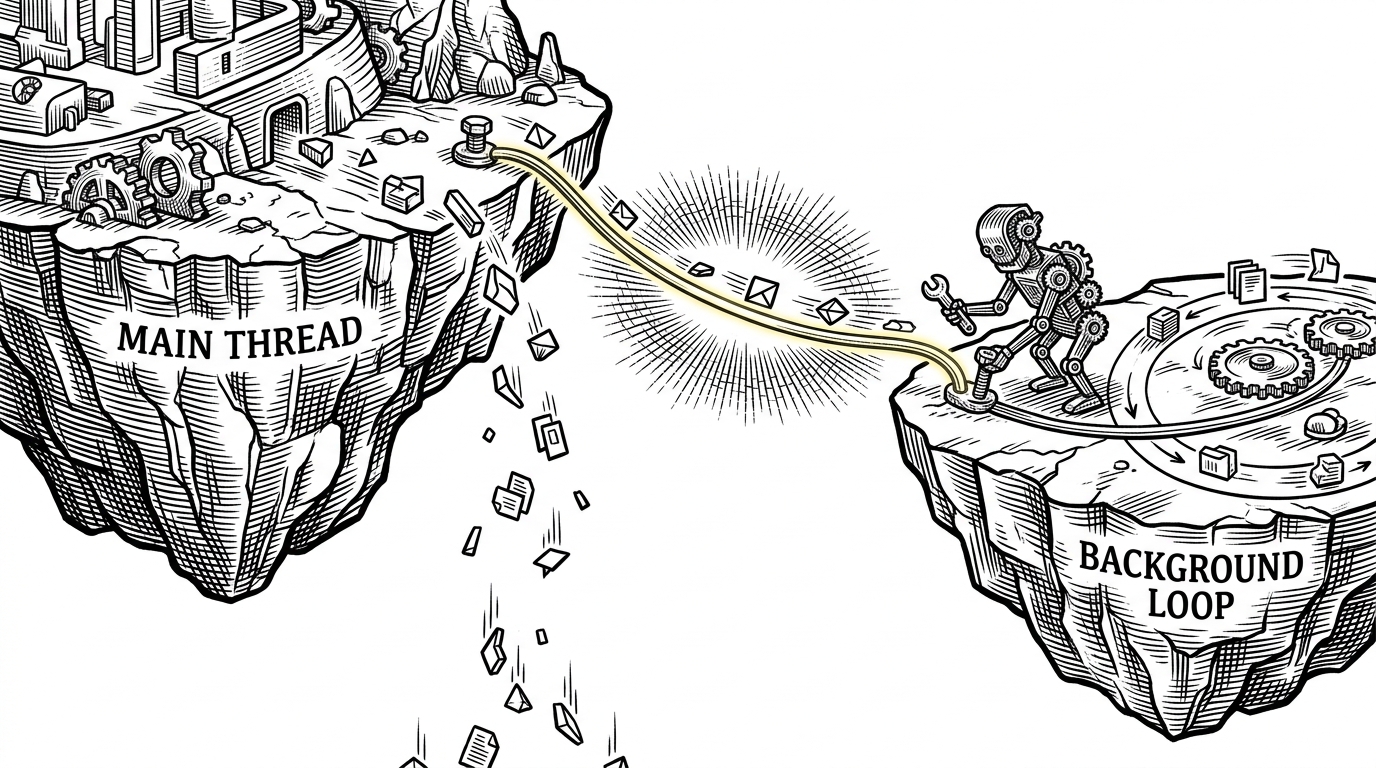
The engineering team solved this by implementing a surgical monkey-patching strategy in environments/patches.py. By intercepting calls that would normally crash the application, OpenGauss offloads the blocking operations to a dedicated background thread known as the _AsyncWorker. This allows the primary orchestrator to remain responsive while child agents grind through complex verifications.
class _AsyncWorker:
    def __init__(self):
        self.loop = asyncio.new_event_loop()
        self.thread = threading.Thread(target=self._run_loop, daemon=True)
        self.thread.start()

    def _run_loop(self):
        asyncio.set_event_loop(self.loop)
        self.loop.run_forever()

    def run_coroutine(self, coro):
        future = asyncio.run_coroutine_threadsafe(coro, self.loop)
        return future.result()
Beyond the Chatbot: The Skill Registry
To prevent the codebase from becoming a monolithic mess of prompts, OpenGauss utilizes a dynamic skill registry. Capabilities are not hardcoded. Instead, the skills_hub fetches modular workflows like autoformalize (translating natural language math into Lean code) or autoprove (attempting to solve an existing theorem).
Open Gauss handles project detection, managed backend setup, workflow spawning, swarm tracking, and recovery. The proving and formalization behavior still comes from `cameronfreer/lean4-skills`; Gauss exposes it through a Gauss-native CLI and project model.
This design cleanly separates the orchestration logic from the mathematical heuristics.
| Feature | Standard SWE Agents | OpenGauss |
|---|---|---|
| Target Domain | General Code (Python, JS) | Formal Math (Lean 4) |
| Success Metric | "Does it run?" | "Is it logically verified?" |
| Execution Model | Single-loop chat | Multi-agent swarm with state recovery |
| Environment | Containerized Linux | Project-scoped Lean LSP |
By forcing AI models to operate within the strict boundaries of a theorem prover, OpenGauss provides a glimpse into the future of software engineering. It moves the industry away from probabilistic guessing and toward mathematically guaranteed execution. The swarm does not just write code; it proves itself right.
Sources: